Pseudonymisation
Pseudonymisation
Pseudonymisation is a central component of identity management. There are various software tools for technical implementation. The use of these tools depends on the desired pseudonymisation strategy or the legal requirements stipulated by data protection legislation. A combination of tools is also possible.
The Research Data Management Service Centre will be happy to advise you on a methodologically sensible and practicable design of the processes in your project. As a rule, the Trust Office can take over the configuration and operation of the tools. Operational responsibility (i.e. using the tools for registration, etc.) remains with the end of project.
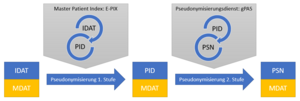
The simplest case is one-step pseudonymisation. The use of a Master Patient Index (MPI) is suitable for such projects. The most frequently used solutions here are the E-PIX tool and the Mainzelliste tool. In the MPI, patients are recorded with their personal identifying data (IDAT) and systematically assigned a (non-speaking) first-level pseudonym (personal identifier, PID). This procedure is generally appropriate if the pseudonyms remain within an institution.
If a multi-level procedure is required to increase the level of data protection, pseudonymisation services are often used. These pseudonymisation services generate a second-level pseudonym (PSN) on the basis of a PID. The PID of an MPI or existing pseudonyms such as case number, health insurance number, etc., which otherwise may not be used directly for research or must remain within the institution, can be used.
The gPAS or SimBa tool, for example, can be used as a pseudonymisation service. SimBa is a self-developed pseudonymisation service of the Research Data Management Service Centre, which was developed in a G-BA Innovation Fund project for data linkage of health insurance data.
The Trust Office is currently operating test systems for E-PIX and gPAS. SimBa was successfully used in the Inno_RD innovation fund project. The following graphic shows a two-stage pseudonymisation with E-PIX and gPAS - the software tools do not process any medical data here, but only communicate it: