

SeeUS – Seagrass under stress

SeeUS – Seagrass under stress
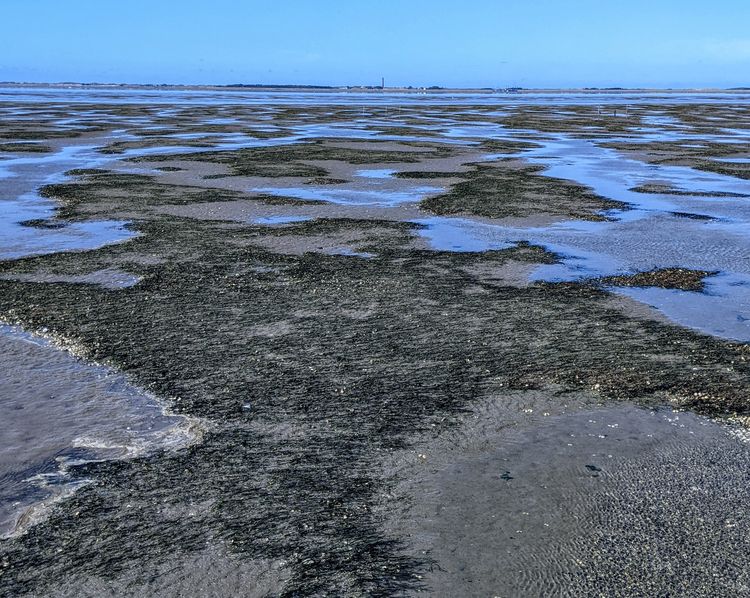
As part of a co-operation project with the Lower Saxony State Agency for Water Management, Coastal and Nature Conservation (NLWKN, Oldenburg/Brake branch), the Geoecology Working Group at the Institute of Chemistry and Biology of the Sea (ICBM) is investigating the causes of the sharp decline in seagrass populations in the Lower Saxony Wadden Sea. The project ‘Seagrass under Stress – Site and Habitat Analysis to Determine Resilience Potential’ (SeeUS) was launched in August 2021.
Seagrass beds fulfil important ecological functions in the Wadden Sea. They contribute to primary production and the nutrient cycle, provide habitats and refuges for numerous organisms, promote sedimentation and sediment stabilisation, and act as marine carbon sinks. Due to their high sensitivity to environmental changes, the seagrass species Zostera noltii and Zostera marina are also used under the European Water Framework Directive to assess the ecological status of transitional and coastal waters.
Seagrass beds along the Lower Saxony Wadden Sea coast have undergone significant changes in recent decades. Following a marked recovery since the early 2000s, the mapped seagrass area reached around 37.6 km² in 2013. Since then, a sharp decline has been observed; the 2019 survey recorded only around 8.6 km². Studies of population trends also show that the decline in densely colonised seagrass beds began as early as around 2009. The causes of this development cannot yet be attributed to a single stress factor.
The aim of the SeeUS project is therefore to systematically record site conditions and potential environmental pressures at selected seagrass beds and to correlate these with the condition and vitality of the seagrasses. Factors under investigation include sedimentation dynamics, light conditions and turbidity, weather and water temperature data, nutrient concentrations in the sediment and water column, current conditions, macrozoobenthos, heavy metals, glyphosate and potential pathogens. In addition, various physiological parameters of the seagrasses are being analysed.
The research focuses on two seagrass beds on the Lower Saxony coast: the Lütetsburger Plate in the backwater mudflats off Norderney and the Seefelder Watt in the Jadebusen. The sites differ both in terms of their hydrodynamic and geomorphological conditions and in the severity of the observed seagrass loss. At both sites, seagrass populations have continued to decline significantly up to 2025.
In order to compare the situation in Lower Saxony with that of viable and more stable seagrass populations, there is also a collaboration with the Sylt Wadden Sea Station of the Alfred Wegener Institute. The seagrass beds in the Hörnum and Keitum mudflats serve as reference sites, enabling the investigation of differences between severely declining and well-developed seagrass populations.
Start of project: August 2021
Publications from the "SeeUS" project
2025 D.S. Storey, D. Thewes, M. Prinz, U. Uebel, H. Freund (2025): Seagrass under Stress – A measurement and testing design for the assessment of environmental factors in the intertidal zone of the Lower Saxony Wadden Sea. Geography, https://doi.org/10.3112/erdkunde.2025.03.09
2021 Osterholz H, Kilgour D, Storey DS, Lavik G, Ferdelman TG, Niggemann J, Dittmar T (2021): Accumulation of DOC in the South Pacific Subtropical Gyre from a molecular perspective. Marine Chemistry, https://doi.org/10.1016/j.marchem.2021.103955