

Macroplastics
Macroplastics
Macroplastics in the southern North Sea
Sources, sinks and avoidance strategies
A research project by the University of Oldenburg on behalf of the Lower Saxony Ministry of Science and Culture.
The project was officially completed at the end of 2020.
However, wood drifters found can still be reported at:
portal.macroplastics.de/index.php?page=drifter-meldeseite
The results of the project are published on the main page of the joint project:
portal.macroplastics.de/index.php?page=ergebnisse
Plastic waste in the sea
Plastic is the generic term for a range of synthetic materials that play an important role in today's society. Plastic now appears to be indispensable in many economic sectors. In the packaging and transport industries in particular, the versatility of plastic is highly valued, for example as a robust and hard-wearing material in the form of car tyres or as a lightweight insulating and packaging material such as polystyrene. New areas of application are constantly being added.
Every year, more plastic is produced worldwide. However, this growing trend also poses a major threat to the environment. Due to inadequate waste disposal in many countries, only a fraction of the plastic produced is disposed of or recycled correctly. According to PlasticsEurope, 8.4 million tonnes of plastic waste was collected for recycling in the EU together with Norway and Switzerland in 2016, but measured against the 60 million tonnes of plastic produced in Europe, Norway and Switzerland in the same year, this only accounts for just under 14%. The problem is that the remaining plastic waste often ends up in the sea via detours, whether through river inputs, tourism, fishing, shipping, offshore industries or waste from local industries that is disposed of in the waters. This plastic waste is then found on the beach, on the sea surface or about two-thirds of it in the water column and on the seabed. As a result, enormous quantities of plastic pollute coasts and oceans worldwide.
Plastic waste in nature
Plastic waste in the environment generally poses a threat to wildlife. Curious marine mammals such as seals and whales become entangled in so-called ghost nets, suffer injuries or suffocate as they can no longer reach the surface to breathe. Larger fish, turtles and seabirds mistake floating objects for food and ingest the plastic, but are unable to digest it. As a result, they eat their fill of indigestible waste but die of malnutrition.
From macroplastics to microplastics
UV radiation, temperature fluctuations, salt water and wave action break down the larger pieces of plastic into many small particles over time. This is how macroplastics become microplastics. These tiny plastic particles can be absorbed by many living organisms. Some of them are excreted directly; however, they often accumulate in the respective organism. In this way, toxins contained in the particles also enter the surrounding tissue. As a result, it is possible that plastic produced by us humans and carelessly thrown away ends up in our homes again unintentionally...as part of our food.
Plastic waste info box
Global plastic production in 2018
359,000,000 tonnes
(in 2017: 348,0000 tonnes, in 2016: 335,000,000 tonnes)
- An estimated 10% of the plastic waste produced each year ends up as litter in the sea
- Entry through rivers, lack of waste management, tourism, fishing, shipping and offshore industries
- 15% of plastic waste is found on the surface of the sea
- 15 % on the beach
- 70% is found in the water column and on the seabed
Plastic is divided into
- Microplastics (smaller than 5mm)
- Mesoplastics (5mm-25mm)
- Macroplastics (larger than 25mm)
Microplastics are further divided into primary and secondary plastics :
- Primary microplastics are produced industrially in the form of plastic pellets, which are the raw material for all plastic items; as ‘exfoliating’ particles in cosmetics such as toothpaste and scrubs; and as particles produced during sandblasting (further information on marine litter)
- Secondary microplastics are formed through the breakdown of macroplastics. UV radiation, abrasion, mechanical fragmentation caused by wave action and temperature fluctuations cause plastics to become brittle and break down into ever smaller fragments (further information on ICBM microplastics research)
Project
In order to investigate how plastic waste reaches the German Bight via rivers and coasts, how it is distributed there and how it lands again, a team of researchers from the University of Oldenburg is using computer models to simulate currents within the North Sea. The models are checked by deploying GPS buoys and thousands of wooden drifters. The locations of the wooden drifters are reported by the public. State-of-the-art sensor technology, beach and river monitoring support the data collection. It is also very useful to make contact with interest groups such as tourists, fisheries and industry. Ultimately, the aim is to find joint solutions to reduce or stop plastic entering the marine environment.
Drifter Infobox
Material:
- The small wooden blocks are made from sustainably produced spruce wood (FSC-certified). If they are not found, they will rot over time like a branch or tree trunk in nature.
Format:
- The drifters all measure 10 x 12 cm, with half of each batch sent on the journey being 2 cm thick and the other 4 cm thick. The purpose of these two thicknesses is to determine what role the different surface area exposed to the wind, which is above the water, has for the drift speed or the distance travelled, for example. However, as the (floating) rubbish in rivers and the sea is made up of many different shapes, sizes and materials, the two types of drifter are of course only an approximation of reality.
Manufacture:
- The drifters were produced by the dedicated team at the GPS (Gemeinnützige Gesellschaft für Paritätische Sozialarbeit mbH Wilhelmshaven) workshop for the disabled in Jever. You can find more information about the workshop here.
Text:
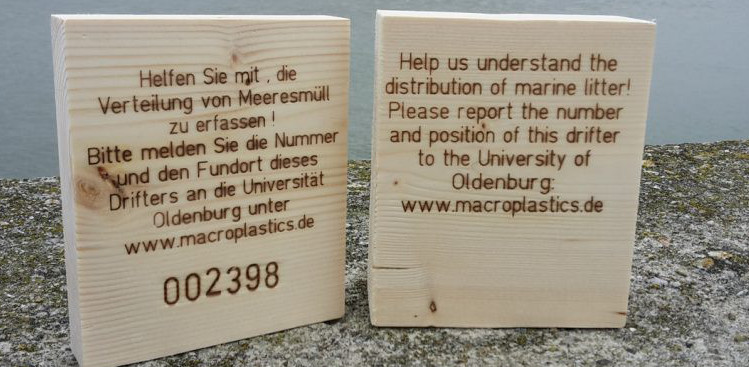
- The text with the request for re-registering students was burnt onto each drifter in both German and English at over 350 °C, i.e. no paints, varnishes, oils or glazes were used.
Quantity:
- Between October 2016 and January 2019, a total of 63,400 drifters were released into the water at 15 fixed mainland and island locations as well as several changing points in the North Sea. The current status of the drifter feedback can be found at: www.macroplastics.de #DrifterMeldung
Team
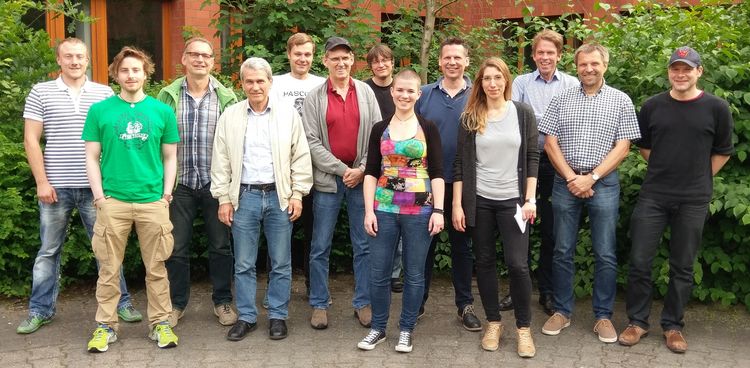
Behind the project are 14 scientists from Oldenburg, in Lower Saxony. They come from the following departments geoecology, Physical Oceanography, Coastal Research and Marine Sensor Systems. These research groups are part of the Institute of Chemistry and Biology of the Sea (ICBM) and, in the case of the Applied Geography and Environmental Planning , to the Institute of Biology and Environmental Sciences (IBU). Both institutes are part of the University of Oldenburg.
ICBM working groups
Coastal Research Working Group
| Marine Sensor Systems Research Group
|
Physical Oceanography Research Group
|
|
IBU working group
AG Applied Geography and Environmental Planning
|
Co-operations
The project is supported by various local co-operation partners. In addition, important drifter sites are supplied by the local population. Thank you very much for your help!





Rubbish bin
At the beginning of 2018, our interdisciplinary research project "Macroplastics in the southern North Sea" was nominated for the regional prize "Friesland's Heroes of the Homeland" (awarded by the Gertrud and Hellmut Barthel Foundation in Varel). With the submitted concept, we received 2nd prize in the "Environmental Protection" category in June 2018 and thus EUR 5,000 for the realisation of the "Rubbish Box" project.
This campaign box is dedicated to educating children and young people about the plastic problem in the sea in order to promote a sustainable approach to this issue. It is provided free of charge. However, the borrowing and return must be organised independently and is at the sole expense of the borrower.
How do I report a drifter?
On the project homepage www.macroplastics.de, click on the centre of the three circles labelled "Report Drifter". On the next page, zoom into the map until you have found your location. Click on the location on the map; the coordinates (latitude, longitude) of the respective location requested in the form will be filled in automatically. Complete the rest of the form with the date and time of discovery and the drifter ID (i.e. the individual identification number printed on the front of the drifter) and click on "Save". If you want to enter additional information, you can do so in the "Comment" window of the form, below the drifter ID query. After saving the message, a small pop-up window should appear and tell you whether your Drifter registration was successful.
I don't know the exact coordinates of the place where it was found. What now?
You can find out exactly where you found Drifter, i.e. the geographical coordinates, using the location function on your smartphone, for example. If you do not know the coordinates, you can still report it. To do this, zoom into the map on the reporting page of the project homepage - until you have found your location. Click on the location on the map and the coordinates (latitude, longitude) of the respective location required in the form will be filled in automatically. Complete the rest of the form with the date and time of discovery and the drifter ID (i.e. the individual identification number printed on the front of the drifter) and click on "Save".
Can I keep the drifter I found?
We leave it up to each finder to decide whether to keep or release the block(s). Of course, after an initial report and a re-release, it is very interesting for us to see where a drifter swims to next or where it is reported again. Such an observation is not easily possible with most marine litter. However, many finders keep "their" blocks as a scientific "souvenir", as something to show to family and friends, and as a conversation starter. Our drifters serve exactly these purposes, and we are happy when people talk about our project and the problem of environmental pollution.
If you decide to put them out again, please do so in the same place where you discovered the blocks. This is the only way we can track the drift path from the original release point.
I have found several drifters. What now?
Whether one or several drifters are found, the main thing is to report them! Because every data point gives us an indication of how floating plastic waste is distributed across the rivers and the open sea.
If there are a few more drifters and you don't want to register them all individually, there are two options:
- 1) You write down all the numbers on a sheet of paper or in an Excel spreadsheet with the details of where and when they were found, and email this information to We will then do the work for you.
- 2) You take some photos of the drifters where the numbers are clearly recognisable and email these pictures with the details of the location and date/time of discovery to:
In the case of larger drifter finds, we would be very pleased if as many of the blocks as possible could continue their journey to be found and reported again.
Where can I look up the location where my found drifter was abandoned?
To look up this information, click on portal.macroplastics.de/index.php?page=drifter-meldung. Below the overview map you will find a table with all the details of all drifter ejections to date.
I can barely recognise the number of my drifter. What now?
If enquiries among family, friends and/or acquaintances do not provide any information, it is best to send a close-up photo of the drifter in good resolution and details of the place and date/time it was found to . We will then take over the detective work.
Are wood drifters harmful to the environment?
No, the wooden drifters are not harmful to the environment. They are made from pure spruce wood that has been cut to size and planed before the German and English text and identification number are baked at over 350 °C. No colourants, oils, varnishes, glazes or adhesives are used. This means that no colourants, oils, varnishes, glazes or adhesives are used.
If a block is not found, it soaks up water and eventually sinks - just like a branch, twig or log would.
In addition, we scientists are not allowed to simply release any substances (into the sea or rivers) without first notifying and obtaining authorisation from the relevant authorities. All the licensing authorities considered our experiment to be ecologically harmless and granted us licences.
Could the drifters be dangerous for animals, for example, possibly by ingestion?
Most animals (not only in the sea) have, in the truest sense of the word, a prey pattern. So when sea creatures swallow rubbish or plastic, it usually resembles the organism's main food. For this reason, turtles, for example, are mostly found with light-coloured plastic bags, as these behave like jellyfish in the water; in seabirds, which prefer to eat crustaceans, pink or red-coloured plastic fragments are usually found, as these look most similar to red crustaceans. Our angular drifters, which float passively on the surface of the water, do not fit into the prey pattern of marine creatures. However, if a drifter is nibbled on by a marine creature, it will certainly quickly realise that it is wood and not food.