
Neuigkeiten
Neuigkeiten
Nomination for the top three in the 2026 Lower Saxony Innovation Award
We are delighted that Karuna Kanes and Simon Sprengel have been nominated for the 2026 Lower Saxony Innovation Award. The project “NanoXion: 3D-printed nano-metal compounds for semiconductors, medicine and quantum research” has been nominated in the “Knowledge and Technology Transfer” category.
The award ceremony will take place on 3 November 2026 in Hanover, and we’re keeping our fingers crossed!

Now in its 10th year, the Lower Saxony.next Innovation Award, in collaboration with the Lower Saxony Ministries of Economic Affairs and Science, recognises creative ideas, bold solutions and projects that deliver genuine added value for the economy and society.
More information here:
- Lower Saxony.next press release
- Article from the University of Oldenburg
-

Simon Sprengel (Prof. Momotenko’s research group) at MINT TANK -

In Prof. Momotenko’s laboratories, as part of the MINT TANK programme -

Dr Melanie Walther, head of the early-career research group, at MINT TANK -

Dr Melanie Walther, head of the early-career research group, at MINT TANK -

In Prof. Wark’s laboratories, as part of the MINT TANK programme -

In Prof. Wark’s laboratories, as part of the MINT TANK programme -

Dr Lars Mohrhusen, head of the early-career research group, and Niko Kruse at MINT TANK
The Hans Riegel Foundation’s MINT_TANK programme at the Institute of Chemistry
On 8 February 26, a chemistry workshop for scholarship holders of the Hans Riegel Foundation took place at the Institute of Chemistry. A total of 26 pupils who had been awarded scholarships and those interested in STEM subjects took part.
Following a brief welcome by the Dean and Professor of Technical Chemistry, Prof. Michael Wark, the pupils were introduced to some of the laboratories and the latest research being carried out by the Technical Chemistry division at the Institute of Chemistry. The sessions were prepared and delivered by professors, junior research group leaders and PhD students from the individual research groups:
- The research group led by Prof. Michael Wark ran the session entitled ‘Fabrication of a dye-sensitised solar cell’. In this workshop, during which the pupils were actively involved in the laboratory themselves, they investigated electrochemical activity. First, they had to cut and clean pieces of conductive glass. A titanium dioxide-based paste was then applied to these, and the dried layers were impregnated with tea solutions. The coated glass substrates and graphite-coated counter-electrodes were incorporated into an electrical circuit, and the electrochemical activity was then analysed.
- In Prof. Dmitry Momotenko’s research group, the basic principles of 3D printing of materials such as conductors and semiconductors at the nanoscale were presented. The research group uses two different methods for this: meniscus-controlled galvanic deposition and pressure-driven ion release. Potential applications and previous work were presented, and questions regarding these methods, processes and their application were answered and discussed.
- Another stop took place at Dr Melanie Walther’s early-career research group. This group is working on a sustainable project to produce fully biodegradable plastic from garden waste, hay and algae. On Sunday, a sugar fermentation process was set up in the laboratory together with the scholarship holders.
- The early-career research group led by Dr Lars Mohrhusen is investigating hybrid material combinations made from elements that will remain readily available in the long term, for use in thermal and photochemical catalysts. The pupils were introduced to the subject of nanomaterials and surface-sensitive methods under ultra-high vacuum, and the entry requirements and potential reasons for studying chemistry were discussed.
The MINT TANK is a scholarship programme that accepts winners of the Dr Hans Riegel subject prizes from a total of 21 universities in Germany and Austria. The aim is to provide scholarship holders with academic and career guidance in the STEM field through a range of seminars and to foster an understanding of different academic disciplines through networking. The ‘MINT TANK Introductory Seminar’ is the first seminar on offer; it is therefore particularly broad in scope and focuses on interdisciplinary insights into current STEM research areas. Participants are either at the end of their school education or at the start of their degree studies, meaning they are generally between 17 and 20 years old. You can find out more about MINT TANK and the Hans Riegel Foundation here: https://www.hans-riegel-stiftung.com/projekte/mint-tank
Find out more about the opportunities for prospective students at the Institute of Chemistry: Opportunities for prospective students, Overview of degree programmes
A very warm welcome, Alexander!
We would like to welcome Alexander Darsow to the research group to undertake his PhD research into the further development of electrochemical additive manufacturing.

A very warm welcome, Polina!
We would like to welcome Polina Evstigneeva to the research group, where she will be conducting her PhD research into 3D-printed metal structures for CO₂ catalysis. We wish her every success!

A warm welcome to Simon!
We would like to welcome Simon Sprengel to the research group to carry out his PhD research into high-resolution multi-nozzle 3D printing.

Welcome, Muhammad!
The working group extends a warm welcome to Muhammad Zerehi Zadeh and wishes him every success with his PhD thesis!
New publication
A new publication in the field of ‘biosensors’! A glass-based nanosensor, functionalised with an aptamer, is capable of detecting various neurotransmitters. This is an exciting result achieved through collaboration between scientists from Switzerland, Italy and Germany.
The article is available here: https://pubs.acs.org/doi/10.1021/acsnano.3c05377
New publication
Our article ‘Beginner’s Guide to Micro- and Nanoscale Electrochemical Additive Manufacturing’ has been published in *Annual Reviews of Analytical Chemistry* and is available as open access!
The article is available here: https://www.annualreviews.org/doi/10.1146/annurev-anchem-091522-122334
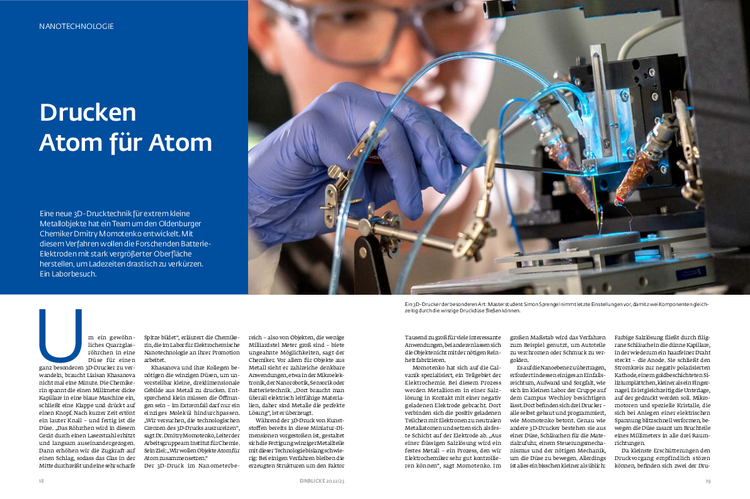
A new article in ‘Einblicke’ about our research group’s work
The University of Oldenburg’s research magazine *Einblicke* has published an article about our group’s work. See page 18 here for details.
A warm welcome, Weishan!
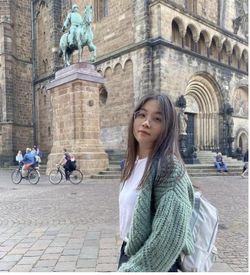
We would like to extend a warm welcome to Weishan Wu, who has joined the group as a PhD student!
Two new articles on new materials for microscale 3D printing!
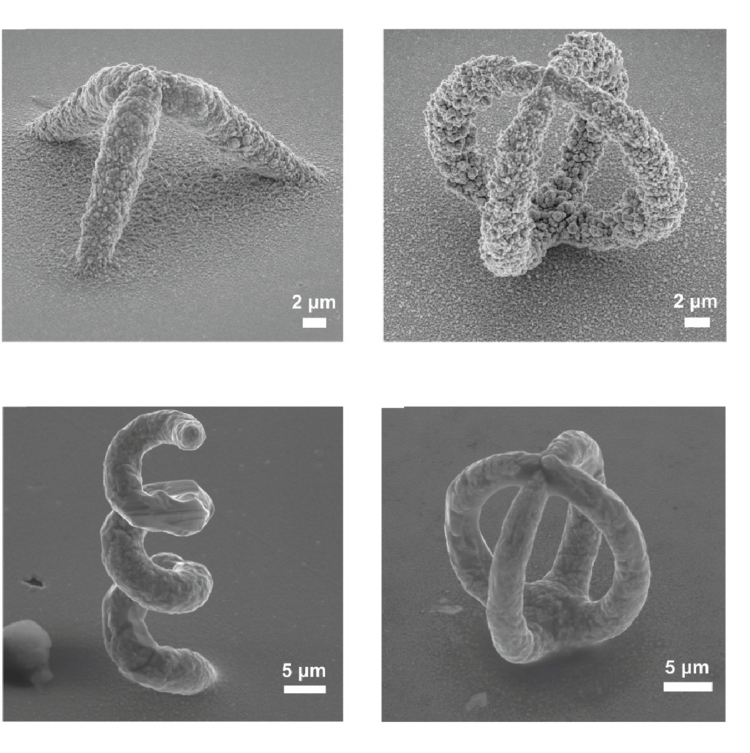
Our group has published two new articles on 3D printing of Ag and Ni microstructures, as well as Ni-Mn and Ni-Co alloys, using FluidFM, in close collaboration with ETH Zurich and Nanjing University of Aeronautics and Astronautics!
www.sciencedirect.com/science/article/pii/S2214860422001221
iopscience.iop.org/article/10.1088/1361-6528/ac5a80
Our new article in *Chemie Pharma Innovation*
Dmitry Momotenko and Julian Hengsteler have published a new article on 3D printing at the nanoscale!
The article is available from the Swiss journal ‘Chemie Pharma Innovation’: www.chemiepharma-innovation.ch/chemieindustrie/metall-3d-druck-im-nanobereich
3D printing on a nanoscale – now featured in popular blogs!
The popular designer and YouTuber Artemii Lebedev mentions our work in high-resolution 3D printing on his YouTube channel: youtu.be/C-eeqSCJX7k?t=1262
The group welcomes Karuna Kanes!
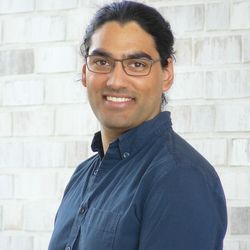
Karuna is joining the group to work on his PhD in nanoscale 3D printing. A warm welcome to him, and good luck!
The Nordwest Zeitung mentions our research into nanoscale 3D printing
A new article in the *Nordwest Zeitung* describes our latest work on bringing electrochemical 3D printing down to the nanoscale.
3D printing with nanoscale resolution – now on the radio!
Our article “Bringing Electrochemical Three-Dimensional Printing to the Nanoscale” (available for free here) is attracting a great deal of attention online – on blogs, in the news and now even on the radio! You can listen to the episode in German on the programme’s website (see Topic 3: ‘Nano 3D printers’ or scroll to 2 h: 17 min into the recording).
A very warm welcome, Liaisan!
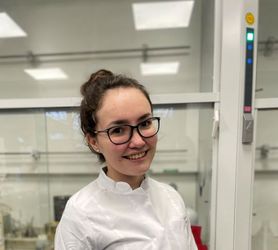
We would like to welcome Liaisan Khasanova to our team working on the nanoscale 3D printing of battery materials!
3D printing is approaching atomic dimensions
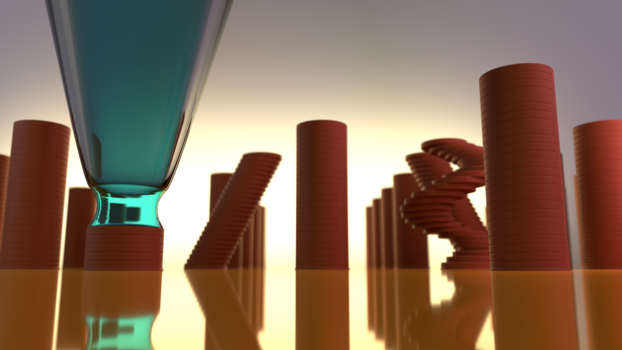
Thanks to the UOL Press Office, an article on our latest work on 3D printing of metal at the nanoscale is now available online!
A new review from us is being published
Our new paper is being published in *Electrochemical Science Advances*! The review is open access.
chemistry-europe.onlinelibrary.wiley.com/doi/full/10.1002/elsa.202100123
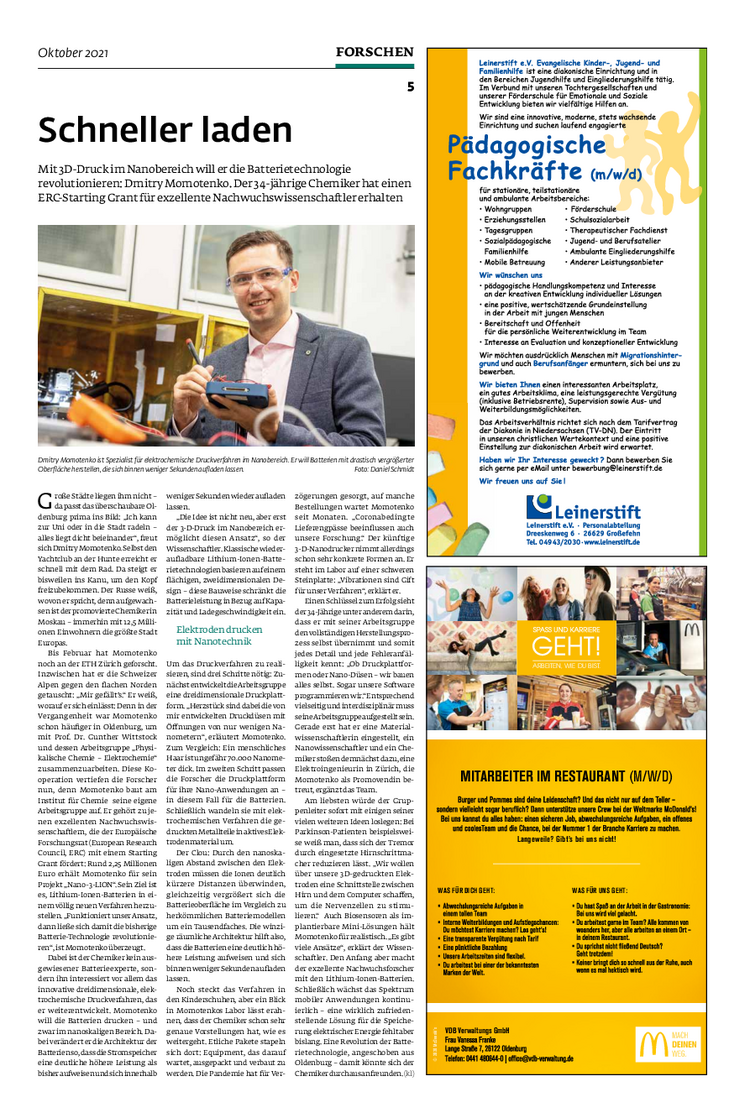
Uni-INFO interview
Our new paper on printing at the nanoscale
27 October 2021
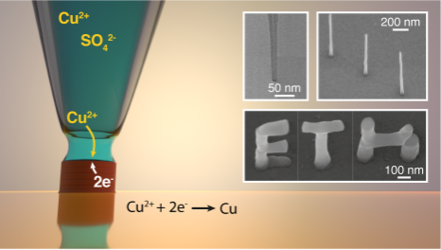
Our new paper on printing metal structures with a resolution of 25 nm is out (and is open access, so available to everyone)! This new technique enables a tenfold improvement in resolution when printing electrical conductors – a much-needed feature for the electronics of the future. The 3D-printed ETH logo at the nanoscale demonstrates the capabilities of this new approach.
Television interview with Dmitry Momotenko
18 October 2021
TV “Vektor”, based in Gubkinsky, Russia, has put together a series of interviews entitled “Our People” featuring famous residents of the town, particularly those who have made contributions to the arts and sciences. The programme is being produced to mark the 35th anniversary of the town’s history. Dmitry Momotenko, who grew up in Gubkinsky, takes part in the programme and talks about his upbringing in the town, his interest in chemistry, and how his life led him into science.
[currently available in Russian only]
Award ceremony: ISE Division 1 Early Career Analytical Electrochemistry Prize 2021 awarded to Dmitry Momotenko
1 July 2021
Dmitry Momotenko has been awarded the Early Career Analytical Electrochemistry Prize by Division 1 of the International Society of Electrochemistry (ISE)! According to Dmitry, this award is the result of hard work and collaboration between many people, all of whom have contributed to this success. He thanks the International Society of Electrochemistry for this award and looks forward to the group’s future success in electrochemical research!
The new article about our ERC project
26 March 2021

The *Nordwest Zeitung* (www.nwzonline.de) published a short article about our ERC-funded project on 3D nanoprinting of batteries. The full text is also available on the university’s website (uol.de/en/news/article/batterien-der-zukunft-4930).
The Momotenko Research Group is in Oldenburg!
10 February 2021
Dr Dmitry Momotenko is joining the University of Oldenburg. The research group will be working on nanoscale 3D batteries, a new and unique technology set to bring about a breakthrough in the field of electrochemical energy storage. The project is funded by the prestigious ERC Starting Grant programme (cordis.europa.eu/project/id/948238).