
Korte
Korte
Examples
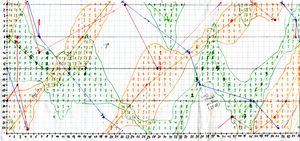
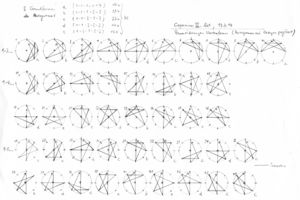
Two sketches for the spatial concept of the opera Copernicus for singers, speakers, orchestra and electronics. In this work, the ensemble is positioned in a ring around the audience.
(1) Second act: Virus-like spread of impulse swarms (plague in Florence).
(2) Third act: Pentagrams projected onto 8 points in space (prophecies of Nostradamus).
Short biography
Oliver Korte, born on 10 April 1969 in Hamburg, has been Professor of Music Theory and Aural Training at the Lübeck University of Music since 2006; he has been Vice President there since 2020. He previously taught and researched at the Hanns Eisler University of Music, the Berlin University of the Arts and the Rostock University of Music. He received his doctorate in 2002 with a thesis on Bernd Alois Zimmermann. He studied composition, music theory and musicology in Hamburg, Vienna and Berlin; he owes particular artistic impulses to private studies with Gösta Neuwirth. Korte is co-founder of the Gesellschaft für Musiktheorie (GMTH) and editor of the publications of the Musikhochschule Lübeck; his compositions are documented on several recordings and are regularly performed in Germany and abroad (including the USA, Chile, England, France and the Czech Republic). His main work to date, the full-length opera Copernicus for singers, narrator, orchestra and electronics, was premiered in Dresden in 2015 (revival in 2016).
As a composer, I examine my relationship to the environment, not least the physical environment. I conduct material studies(Glass, Gravel, The Elements), create weather logs(Essay) and measure both musical and real space(Alles fort, Epiphanie). Under laboratory conditions, as it were, I allow specific sound objects and textures to collide. These can attract or repel each other, mix or form distinct layers or even react more or less violently with each other. Of increasing importance in my work are constellations of different types of text, linguistic fields between sound and semantics, which favour the exploration of human options for action and understanding within their physical and social environment. Are the limits of our language the limits of our world?(Ludwig W.). How determined are we by our social, political and religious, but also our physical framework conditions, such as the climate?(Essay, Copernicus). How can we understand nothingness and how do we come to terms with it?(rien nul). My compositions follow a logic inherent in music and are at the same time models of certain aspects of the world.
Selection of works
- Ludwig W. (2020) for clarinet and vibraphone
- ILL ANGELS (2018) for violin, bass clarinet, percussion and piano
- Sous bois by Lili Boulanger, version for choir and orchestra (2018)
- Epigram - cryptogram - pictogram (2017) for a talking drummer
- Copernicus (2012-15), spatial opera for singers, speakers, orchestra and electronics
- Six Micrologues (2012) for clarinet and piano
- Copernicus material for 18 solo strings (2011); version for large orchestra (2012)
- Some reflections on the nature of water (2008) for twelve-part choir
- Epiphany (2007) for small orchestra
- Compass (2003/07) for cello
- The Elements (2006/07), concerto for two percussionists and orchestra
- winter blue - lion colours (2006) for choir
- Hymne au Soleil by Lili Boulanger, reconstruction of the orchestral version (2003/04)
- Essay (2003-05), cantata for soprano, choir and orchestra
- everything continues (1998/99) for three choral groups distributed around the room
- rien nul (2002), music for Samuel Beckett for sextet
- gravel (2002), elementary studies for four clarinets
- Frost (2001), elementary studies for glockenspiel and piano
- Glass (2000), elementary studies for three cellos
- Trois Morceaux by Lili Boulanger, orchestral version by O. Korte (1999)
- hesitate ... Silence (1996) for piano
- Scenes (1994-96) for orchestra
- Trio for violin, clarinet and piano (1994)
- ... from the ashes (1993) for sextet
- Music for a Wolf (1992) for marimba
- Light Piece (1991/92, rev. 2004)
- Winter Songs (1990/91) for singer and ensemble on 8 Japanese haikus
Scientific publications
- Editorships
- World - Time - Theatre. Nine studies on the work of Bernd Alois Zimmermann, Hildesheim 2018
- Ludwig van Beethoven, Symphony No. 7 in A major op. 93, facsimile after the original in the Biblioteka Jagiellońska, KrakowLaaber 2018
- Beethoven Handbook Vol. 1, orchestral music and concertos, ed. together with A. Riethmüller, Laaber 2013
- Gustav Mahler - Interpretations of his works (2 vols.), ed. together with P. Revers, Laaber 2011
- Articles (selection) and book
- Sound shapes and sound gestures with Luigi Nonoin: K. Aringer (ed. et al.), Music in context. Festschrift Peter Revers, Vienna 2019, pp. 593-611
- Subject and violence. The Dona nobis pacem from Bernd Alois Zimmermann's Requiem for a Young Poet, in: O. Korte (ed.) World - Time - Theatre, Hildesheim 2018, pp. 145-180
- On the circular paths of thought. On the libretto of my opera Copernicus, in: Die Tonkunst, 1/2017, S. 34-40
- Reconstructing Antoine Brumel. How to Bring the Chanson "Dieu te gart, bergere" Back to Life, in: Journal of the Alamire-Foundation 1/2016, p. 165-179
- George Frideric Handel's basso continuo exercises as a practical lesson in composition, in: R. Kubicek (ed.), Music Theory and Mediation, Hildesheim 2014, pp. 167-176
- "Shadow sounds". Microtonality in Dieter Mack's percussion concerto "Wooden", in: MusikTexte 150, August 2016, pp. 79-82.
- Bordun and parallel movement. On the articulation of tonal fields in Gustav Mahler, in: Elisabeth Kappel (ed.), Das klagende Lied: Mahlers "Opus 1" (= Studien zur Wertungsforschung 54), Vienna 2013, pp. 164-200
- The fauxbourdon model in Johann Sebastian Bach's choral writing, in: B. Petersen (ed.), Johann Sebastian Bach and the chorale setting of the 17th and 18th centuries, Hildesheim 2013, pp.40-50
- The seventh and eighth symphonies [Beethoven's], in: O. Korte (ed. et al.), Beethoven-Handbuch vol. 1, Orchestermusik und Konzerte, Laaber 2013, pp. 174-215
- "Il y a a un temps pour tout" : la phase sérielle de Zimmermann, in: P. Michel (ed. et al.), Regards croisés sur Bernd Alois Zimmermann, Geneva 2012, pp. 69-86
- Night and light. The Songs of the Dead [by Gustav Mahler], in: P. Revers (ed. et al.): Gustav Mahler - Interpretationen seiner Werke, Laaber 2011, vol. 1, pp. 467-497
- Macrocosm - Microcosm: About the Influence of Gustav Mahler's Eighth Symphony on the Work of Anton Webern, in: E. Kappel (ed.), A Total Work of Art: Mahler's Eight Symphony in Context (= Studien zur Wertungsforschung 52), Vienna 2011, pp. 202-213
- Empty Spaces, in: A. Avanessian (ed. et al.), Space in the Arts. Construction - Movement - Politics, Munich 2010, pp. 167-174
- Geographical place and event space. Tunjuk for large orchestrain: T. Möller (ed.), "Wenn A ist, ist A". The composer Dieter Mack, Saarbrücken 2008, pp. 120-136
- Antoine Brumel and Guilielmus Monachus. Falsobordone in practice and theoryin: J. P. Sprick (ed. et al.), Musiktheorie im Kontext. 5th Congress of the Society for Music Theory, Berlin 2008, pp. 247-259
- "An extremely complex structuring of tone colour". Compositional strategies in Bernd Alois Zimmermann's "pas de trois"in: Musik-Konzepte, special volume Bernd Alois Zimmermann, Munich 2005, pp. 51-64
- The Ecclesiastic Action of Bernd Alois Zimmermann. Investigations into a poetics of failure (= Berlin Music Studies Vol. 29), Sinzig 2003
- Decomposition. A production strategy in literature and music (with Richard Grasshoff), in: A. Haus (ed. et al.), Material im Prozess. Strategies of Aesthetic Productivity, Bonn 2000, pp. 123-136
- On Bernd Alois Zimmermann's late row techniquein: Music Theory 1/2000, pp. 19-40