
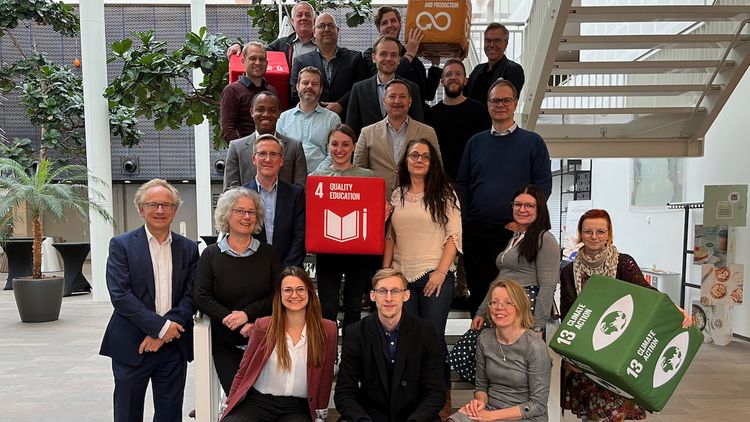


Combining economic and ecological thinking in a targeted manner when founding new companies: A project team led by Oldenburg has dedicated itself to this goal and made it onto the shortlist for the European Business Promotion Awards.
Students who specialise in sustainability in business as part of their education support start-up teams and established companies in becoming more sustainable themselves - this idea will be competing in Prague on Tuesday with other projects that have won national preliminary rounds in the race for the European Enterprise Promotion Awards (EEPA). ScaleUp4Sustainability (S4S) - in German: "Nachhaltigkeitslösungen in die Breite tragen" - is the name of the international project with nine partners led by Oldenburg economist Prof Dr Klaus Fichter.
The aim: "Anyone setting up a company in future or developing a new business idea or a new product should take sustainability and ecology into account from the outset," says Fichter, who researches and teaches innovation management and sustainability at the university. "Our concept of cooperative green venturing has brought together students and companies from Germany, Sweden and the Netherlands to create concrete ideas and implementation projects that combine economic solutions with environmental and climate protection."
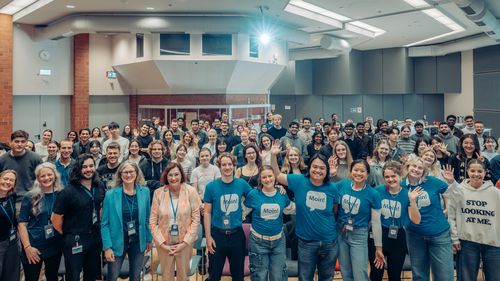
The S4S project, funded by the EU Erasmus+ programme, brought together a total of almost 300 students from Oldenburg, Linköping in Sweden and Breda and Twente in the Netherlands with companies from the respective regions, including the chemical company BÜFA, the photo service provider CEWE and the utility company EWE in Oldenburg.
For Christina Ludwig, for example, who completed her Master's degree in "Sustainability Economics and Management" at the beginning of the year, S4S offered an "exciting reality check" for the theory taught during her studies and her own ideas and visions. Together with around 20 other Oldenburg students, she was given the task of developing new sustainable product ideas for CEWE in the "Eco-Venturing" module.
"It was about developing completely new products from scratch - this included product planning, time and cost planning, marketing strategy and so on," she explains. "The transdisciplinary collaboration was very enriching and instructive at the same time - on the one hand with students from other business degree programmes at the university, and on the other with employees from various departments of the company who were available to us as contacts." Ludwig, now a sustainability consultant at the Oldenburg IT service provider BTC, remembers a "very challenging but very interesting time".
She sees the exchange between students and companies as a win-win situation for both sides: "For companies, the external perspective brings a breath of fresh air and new ideas, even for things that were perhaps only previously considered. For certain aspects, you sometimes need different food for thought to come up with new ideas." Conversely, it was extremely valuable for her as a student to be able to play through sustainable product development in a practical way and "to get to know different perspectives and to have considered the broad range that a new product has to fulfil, for example".
Together with the other regional business partners, the project participants also designed new teaching formats tailored to sustainability-related issues in the companies. For example, the "Green Business Idea Jam" was created, a workshop in which students and BÜFA employees jointly developed ideas to reduce the company's carbon footprint. And EWE Corporate Development coached students in the "Digitalisation and Sustainability" module led by Prof. Dr Jörn Hoppmann in developing new, sustainable business ideas using the "Design Thinking" method. These and other concepts are intended to enrich business teaching elsewhere in the future and help anchor sustainability as a natural component of new business models.
International exchange formats for students originally planned as part of the project could only be realised online due to travel restrictions caused by the pandemic. "This supposed disadvantage proved to be an initial success," recalls research assistant Anne Seela. The team was able to open up online formats such as the "Fujifilm Future Challenge" or the "Circular Challenge" on the topic of the circular economy to students from Oldenburg, who developed a wide range of ideas on topics such as the United Nations' sustainability goals in internationally mixed teams. The teaching staff also worked together on a transnational coaching basis.
And this experience gave rise to a follow-up project - also funded by the EU Erasmus+ programme since March. Under the heading Challenge4Impact (C4I), or "Challenge with Impact" in German, teams from the universities of Oldenburg and Linköping and the academic counselling service from Vennebroek in the Netherlands are working together until August 2024, again under the leadership of Fichter. Challenge-based learning, in which students develop independent solutions to real-life questions posed by companies, is now at the centre of virtual and international teaching-learning formats. The aim of C4I is to establish a European network for challenge-based learning with a view to sustainable entrepreneurship and to build on the results of S4S.
Another success in the EU competition on Monday in Prague would be a welcome additional boost for the work in the follow-up project.