
AdaMekoR
AdaMekoR
Motivation
Nurses who care for people with mobility impairments, often suffer from back problems because of the enormous strain on muscles and the skeleton during care activities. As a result, they are often absent from work or even unable to work.
Approach
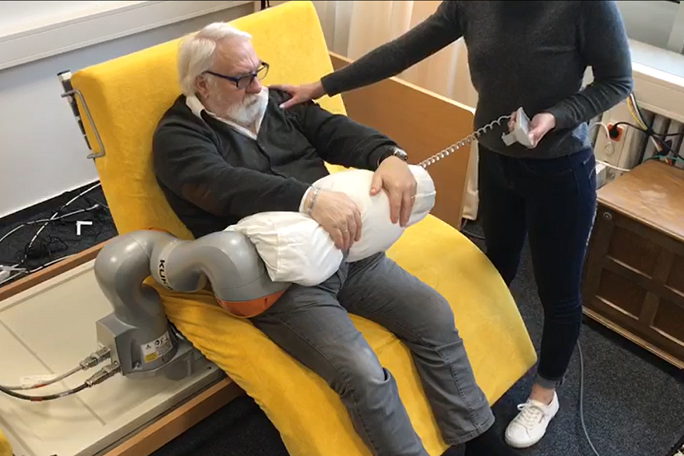
The AdaMeKoR project develops an adaptive and multifunctional motorized bed with a robotic arm system for use in care. For this purpose, sensor components are developed, e.g. to be able to adjust the bed position depending on the situation. Different holding and supporting functions of the system are tested, for example for bed-wheelchair transfer. Additionally, the system monitors the posture of the nursing staff and, in the event of harmful loads, provides information for posture optimization.
The system supports both caregivers and care recipients:
Autonomy and quality of life of care recipients can be improved by a partially automated bed-robot arm system. For caregivers, robotic support in lifting and moving a patient represents a significant reduction in physical strain. This prevents injuries or diseases of the lower back area.
Funding
The project is funded by the Federal Ministry of Education and Research (03/2020 - 03/2023).
Partners
- Johanniter-Unfall-Hilfe e. V. - Landesverband Niedersachsen/Bremen
- Universität Osnabrück
- DFKI GmbH, Bremen
Publications
Fifelski-von Böhlen, C., Brinkmann, A., Kowalski, C., Meyer, O., Hellmers, S., & Hein, A. (2020, September). Reducing caregiver's physical strain in manual patient transfer with robot support. In 2020 5th International Conference on Automation, Control and Robotics Engineering (CACRE) (pp. 189-194). IEEE.
Fifelski-von Böhlen, C., Brinkmann, A., Mävers, S., Hellmers, S., & Hein, A. (2020, December). Virtual reality integrated multi-depth-camera-system for real-time telepresence and telemanipulation in caregiving. In 2020 IEEE International Conference on Artificial Intelligence and Virtual Reality (AIVR) (pp. 294-297). IEEE.
Kowalski, C., Brinkmann, A., Hellmers, S., Fifelski-von Böhlen, C., & Hein, A. (2022, August). Comparison of a VR-based and a rule-based robot control method for assistance in a physical human-robot collaboration scenario. In 2022 31st IEEE International Conference on Robot and Human Interactive Communication (RO-MAN) (pp. 722-728). IEEE.
Kowalski, C., Hellmers, S., Hinrichs, P., & Hein, A. (2023). Estimating the Maximum Pushing Force of Robot Manipulators to Physically Assist Caregivers. In 2023 8th International Conference on Control and Robotics Engineering (ICCRE) (pp. 121-127). IEEE.
Behrens, J. L., Kowalski, C., Brinkmann, A., Marquard, S., Hellmers, S., Asmussen-Clausen, M., ... & Hein, A. (2023). Physical relief potential through robot-assisted mobilisation in nursing care: an exploratory study. Health and Technology, 13(6), 1011-1023.
Kowalski, C., Hellmers, S., & Hein, A. (2023). Investigation of interaction forces in robotic assistance during the nursing activity of positioning a patient simulator to the bed edge. Proceedings on Automation in Medical Engineering, 2(1), 740-740.