How did epidemics and infectious diseases shape the 20th century? An international conference organised by the Institute of History on 23 and 24 March will examine "Epidemics in the social and cultural history of the 20th century".
How did the Nazis stage the "Volksgemeinschaft" and how was it perceived and experienced by the "Volksgenossen"? At a conference, historians examine the concept of the Volksgemeinschaft - the Nazis' central propaganda tool.
The starting shot was fired around 15 years ago in the north of Oldenburg. The ball is now rolling all over Germany. We are talking about the integrative girls' football project "Mädchen kicken mit". Chancellor Angela Merkel has now honoured the project in person.
According to the European Commission, 17 per cent of all Europeans do not have enough money to meet their most basic needs. How to tackle the problem? A new research project at the University of Oldenburg is looking for solutions.
"Pop/Knowledge/Transfers" was the title of the conference, which examined the relationship between popular culture, science and society. Here is an interview with the organisers Prof. Dr Susanne Binas-Preisendörfer and Prof. Dr Martin Butler.
The University of Oldenburg is expanding: a new building for the Research Centres Neurosensory Science and Safety-Critical Systems is being built on the Wechloy campus. At the centre: medical technology and human-machine communication.
"How can it be that I meet up with my best friends to punch them in the nose?" Nils Baratella is a doctoral student in the "Self-formations" research training group. His topic: boxing. Ines Weber, who is researching bishops, is quite different. A portrait.
The DFG is funding the international research group "European Socialisation" with three million euros. The initial questions: What does European integration mean for society? And how does it manifest itself in people's everyday lives?
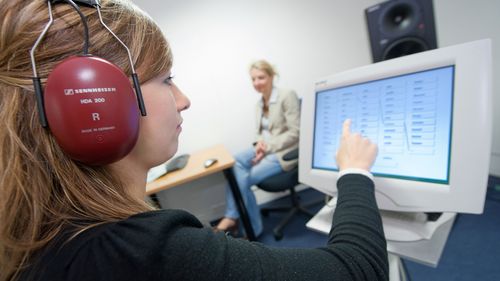
The German Research Foundation (DFG) is funding the Oldenburg research group "Individualised Hearing Acoustics" with 2.1 million euros over the next three years. The goal: "Hearing for all", even in acoustically challenging situations.
SFB extended: Another ten million for research into safety-critical systems

Great success for Oldenburg's Computing Science: The German Research Foundation (DFG) is extending the Collaborative Research Centre (Transregio) "Automatic Verification and Analysis of Complex Systems" (AVACS), which was established eight years ago.
18 years, 50 volumes: in November, the "Joint Science Conference" of the federal and state governments (GWK) approved the project for a complete edition of the philosopher Karl Jaspers. A highlight in the study of the Oldenburg-born thinker.
DFG funds Computing Science Research Training Group on "System Correctness under Adverse Circumstances": How can a transport vehicle drive autonomously without colliding with other vehicles? What secures access to computer information?