Oldenburg research as a driving force for innovation
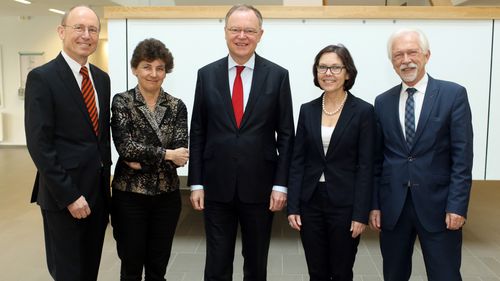
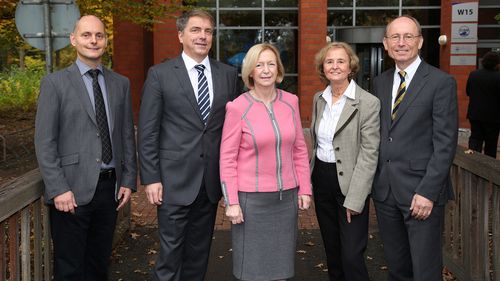
The Lower Saxony Ministry of Science will be funding nine application-orientated research projects from the European Regional Development Fund (ERDF) in the future - two of them at the University of Oldenburg.
Medicine, biology, teacher training, Computing Science, hearing research: her most recent visit to Oldenburg on Tuesday gave Federal Research Minister Johanna Wanka further insights into the diverse work of the university.
To what extent are the parties immersed in local issues in the local election campaign in Lower Saxony? How do they position themselves in socio-political terms? Three social scientists at the university have created a "map" of the political offerings - including regional differences.
The university has two new high-performance computers. A crane transported the computing cluster's cabinets, which weigh several tonnes, over the roof into the IT services server room in Uhlhornsweg. The new system is one of the most powerful computers in northern Germany.
It is not only oceans that store carbon dioxide, which plays a role in global warming, but also tropical river systems. This new building block for understanding the global carbon cycle has now been discovered by an international team of researchers, including Oldenburg marine researcher Jürgen…
The handling of veterinary pharmaceuticals affects us not only as meat consumers, but also as users of water resources. Oldenburg hydrogeologist Victoria Burke analyses residues of veterinary pharmaceuticals from liquid manure in soil and groundwater - as head of a new junior research group.
"Bringing cultural change to the minds of teachers"
The Federal Ministry of Education and Research is driving forward the reform of higher education, teaching and further education. Oldenburg experts Anke Hanft and Annika Maschwitz are providing scientific support for the multi-billion euro project. An interview.
OFFIS - the Institute for Computing Science - was founded 25 years ago. Since then, the affiliated Institute has developed rapidly. In this interview, CEO Wolfgang Nebel talks about what has been and what will be.
If computer-based processes fail, this often has serious consequences. The problem: safety-critical systems are irreplaceable in many areas. Oldenburg scientists are researching this as part of a newly funded joint project.
Penalty kicks in the knockout round: right before left
Left-footed professional footballers generally have an advantage when it comes to penalty kicks. But in the knockout rounds of major tournaments, things look different, as a team of researchers led by Oldenburg movement scientist Jörg Schorer has discovered.
It is a problem hidden underground: as the sea level rises due to climate change, the salinity of the groundwater near the coast also increases - which in turn supplies the majority of our drinking water. What can be done? This is the subject of a new research project.
Migratory birds navigate more precisely than any GPS - even after flying several thousand kilometres, they land exactly where they wanted to go. Exactly how this works is not yet fully understood. Researchers led by Oldenburg biologist Henrik Mouritsen have now taken an important step forward.
Kale is significantly better at preventing cancer than other vegetables. This is the result of a joint study by the University of Oldenburg and Jacobs University in Bremen.
Marine researchers and biologists open their doors
Anyone interested in research work should not miss out on a special offer from the university: On Wednesday, 8 June, natural scientists will open their doors for the "Day of the Sea" and "Day of Biology". Pupils and other interested parties are welcome - even without registration.
Extreme waves - mountains of water up to 30 metres high - repeatedly cause serious shipping accidents. However, it is still unclear how they arise. A team of scientists has now developed a method for the short-term prediction of extreme waves.
Science presented in an understandable and entertaining way: Bianca Brüggen, Maurits Halbach and Oliver Richters are the winners of the university's 6th Science Slam, which attracted around 150 spectators to the Exerzierhalle.
They want to preserve the legacy of one of the most important music teachers in recent history: Musicologists Melanie Unseld and Till Knipper have ensured that the estate of the university's late first honorary doctor, Gertrud Meyer-Denkmann, will be included in the renowned Paul Sacher Archive.
They are among the most stable chemical compounds of all: hydrocarbons. Over the past six years, an international team, including Oldenburg microbiologist Ralf Rabus, has been researching how nature nevertheless manages to break them down.
NEMo" research project picks up speed - improving mobility in rural areas
Mobility in rural areas - a growing challenge in times of demographic change. It is becoming increasingly difficult for rural districts and municipalities to offer appropriate services. Scientists at the University of Oldenburg are also working on this topic.