

Model Systems for the Study of Magnetoreception: Flavins and Chryptochrome 4a at Surfaces
Contact
Mailing Address
Visitors
Model Systems for the Study of Magnetoreception: Flavins and Chryptochrome 4a at Surfaces
by Moritz Bätcher

Starting Point
Within the DFG Cluster of Excellence NaviSense (Link), we study the Binding of the flavin-containing redox protein cryptochrome 4a and artificial model systems with flavins to surfaces. Cryptochrome 4a is linked to the magnetic reception of migratory birds.[1] Redox proteins are proteins that are involved in oxidation and reduction processes. Our focus is on the synthesis of modified surfaces that can bind the redox protein in an aligned fashion while preserving the protein structure with the aim of studying them spectroscopically under different orientation with respect to weak magnetic fields. Functionalized self-assembled monolayers (Link) are used for this purpose.

Methods for Characterization of Modified Surfaces
PM IRRA spectroscopy (Link) and atomic force microscopy (AFM, Link) can provide evidences of successful binding of the redox protein to surfaces. The binding to surfaces enables classic electrochemical experiments (cyclic voltammetry, differential pulse voltammetry, square wave voltammetry) to be carried out even with the simultaneous application of an external magnetic field of specific directions. Detected voltammetric response signals (i.e., voltammograms) could indicate that the redox protein is capable of direct electron transfer (DET).
Flavin-containing Model Systems for the Investigation of Electron Transfer Properties
The surface binding of specifically synthesised flavin-containing model compounds is another key target. By building and characterizing artificially made molecular sensors, we aim for understanding the structural requirements of a response to weak magnetic fields.
Flavins are the redox-active group in the protein cryptochrome 4a and, depending on their local environment, undergo very different redox reactions, which can be investigated in model systems. Such reactions are referred to as proton-coupled electron transfer reactions.
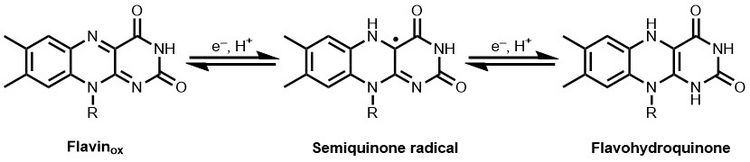
The targeted binding of these model compounds to surfaces enables the systematic investigation of electron transfer between flavins and an electrode. The results obtained in this way serve as reference data for a better understanding of the proposed mechanism of magnetoreception. The use of mixed monolayers allows the molecular environment of the flavin to be adjusted, thus providing a way to mimic the local environment of flavins within the protein structure of cryptochrome 4a. Such mixed monolayers are formed by combining different molecules in one monolayer, some of which carry functional end groups for protein binding, while others do not carry end groups and thus dilute the functionality.

Cyclic voltammetric measurements show that flavins exhibit special redox behaviour in aqueous buffer solutions. The oxidized flavin is reduced to flavohydroquinone in a single step by accepting two electrons and two protons. A radical intermediate product cannot be observed under these conditions, as the second electron is transferred at a more positive potential than the first one. In contrast, single-electron transfer reactions of flavins can also be observed in a hydrophobic environment using voltametric methods.[2]
Weiterführende Literatur
[1] P. J. Hore, H. Mouritsen; The Radical-Pair Mechanism of Magnetoreception. Annu. Rev. Biophys. 2016, 45, 299-344. https://doi.org/10.1146/annurev-biophys-032116-094545
[2] S. L. J. Tan, R. D. Webster; Electrochemically Induced Chemically Reversible Proton-Coupled Electron Transfer Reactions of Riboflavin (Vitamin B2). J. Am. Chem. Soc. 2012, 134, 5954-5964. https://doi.org/10.1021/ja300191u