
Risk Management and Financial Analysis (M.Sc.)
Risk Management and Financial Analysis (M.Sc.)


Manage risks with confidence – whilst working and with a practical focus!
Risk management and financial analysis require profound knowledge in many disciplines: mathematical and economic knowledge is required, regulatory requirements must be taken into account as well as market developments. Our Master's programme qualifies you for value and risk-oriented management tasks as well as for strategy consulting - at insurance companies, banks and other large companies. We combine proximity to university research with current practical challenges. You benefit from a flexible degree programme that is characterised by professional excellence and outstanding personal support.


Start dates & schedule
At the start of the summer or winter semester;
You can join as a guest student at any time
Current semester dates


Who is the degree programme suitable for?
The degree programme is aimed at professionals from the fields of financial services, insurance, auditing, controlling and consulting. It is suitable for anyone who quantifies, evaluates and communicates risks and who would like to further their education in value-oriented strategy consulting for investment and financing, reporting and controlling.
What prospects does the degree open up?
The Master's degree qualifies graduates for responsible positions in risk management, financial analysis, controlling, auditing, consulting or financial institutions. Graduates can manage projects in the Solvency/Basel area, assess "fit & proper" results and fulfil the actuarial function.

Details of the degree programme
How is the Master's programme structured?
The programme includes modules in the areas of risk management, financial analysis, statistics, econometrics and quantitative methods. The degree programme is structured on a part-time basis and is modular.
You will complete five compulsory modules and select a further six compulsory elective modules according to your own interests. At the end of your degree programme, you will take the final Master's module in which you will write your thesis.


6 modules with 6 CP each
- Asset Liability Management
- Company valuation and financing
- Data science and machine learning
- Financial data analytics with R: methods and applications
- Monte Carlo methods
- Quantitative risk management
- Risk and sustainability of alternative investments
- Risk communication
- Regulation and sustainability of alternative investments
- Default risk and rating
- Risk models - risks in insurance
- Extreme value and operational risks

Online colloquium, final thesis and final colloquium
The Master's thesis (20 CP) is a scientific examination of a subject-related issue. You choose the topic to suit your academic appointment. The thesis is written independently using scientific models and methods. The preparatory online colloquium (2 CP) supports you in formulating the research question and developing the research design. You will present your work in the final colloquium (2 CP).
Module allocation: individual and variable
The modules of the degree programme each deal with completed subject areas and can be taken in the order of your choice. You determine the number of modules completed per semester yourself - and thus individually regulate the duration of your degree programme. There is no minimum number of modules per semester - nor is there an obligation to complete the degree within the standard period of study of four semesters.
Management of studies: part-time and flexible
The internationally recognised academic degree "Master of Science" (M.Sc.) stands for excellent specialist training at university level. Upon successful completion of the programme, you will have earned 90 credit points. This opens up new career paths and, if applicable, the option of a doctorate.
Which teaching formats are used?
The degree programme combines online learning materials, workshops, face-to-face events and self-study phases. Thanks to the digital formats, content can be flexibly processed and coordinated with academic appointments. The programme is varied and practice-oriented. Input from lecturers, study materials as well as internet-based discussions and online tasks with direct feedback ensure varied learning.

Competence-orientated teaching and testing
Knowledge acquired in the module is applied, consolidated and expanded by working on real projects from the student's own working life. Students can apply their newly acquired expertise directly in the workplace.
What examinations are there?
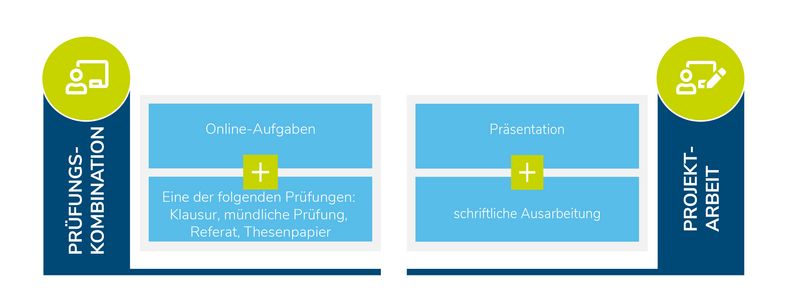
Examinations include, for example, written exams, seminar papers, case studies or the preparation of a project. The course certificate is integrated into the module during the course of study - there are no separate examination dates. The examinations always combine two parts:
- Online assignments plus another performance such as written exam, oral examination, presentation, thesis paper).
- Presentation plus written elaboration on a project
Example of your study programme
The exemplary study plan illustrates the individual adaptability of the degree programme to your own time budget. There is additional leeway with the recognition of credits and competences.
This exemplary study plan for the standard duration of study shows an ideal-typical Master's programme with a duration of four semesters plus thesis and colloquium and an even distribution of modules.


Your path to the University of Oldenburg
When can I join the degree programme?
Applications for a place onthe programme can be submitted between 1 June and 1 September (winter semester) and between 15 December and 1 March (summer semester).
1. check admission requirements
What are the admission requirements for the degree programme?
As a rule, a university entrance qualification and academic appointment in the field of finance or risk are required. You can apply for a place on the Master's degree programme with the following requirements:
- A first academic degree (Bachelor's, Diplom, State Examination or Magister) from a university or university of applied sciences.
- At least one year of professional experience.
2. compile and submit application documents
Applications for a place on a degree programme are made online via the University of Oldenburg’s application portal.
- online application for a place at university
As part of the online application process, you will create an application form and submit the documents and supporting evidence listed below in digital format.
- Higher education qualification: Proof of a recognised degree (Diplom, Bachelor’s, Master’s or Magister degree; State Examination), including a transcript (academic record) of your previous studies, specifying the credit points achieved to date
- University semesters: Proof of the university semesters completed to date (= all academic semesters completed in Germany, including any previous leave of absence semesters) (e.g. certificate of academic progress, enrolment certificate, most recent enrolment certificate or certificate of exmatriculation)
Work experience: Proof of at least one year’s professional experience (e.g. employment contract, reference, certificate from employer)
You may also submit additional documents:
- Tabular CV
- Certificates of previous further education and training
Module registration form: Please register as early as possible, or at the same time as submitting your application for modules, to ensure you secure a place on your preferred courses.
3. allocation of study places
Once we have received your application, we will confirm receipt and check whether your documents are complete. If any documents are missing, you can submit them to us by the application deadline. Your application documents will be dealt with promptly by the admissions committee; places are allocated on an ongoing basis during the application period. The admissions committee checks whether the admission requirements have been met and decides whether to admit or reject applicants.
4. accept a study place and enrol
After the admissions committee has reviewed and checked your application, you will be informed of its decision via the application portal. If it is determined that you fulfil the admission requirements, you can accept your study place via the application portal and submit a proposal for enrolment. This is generated via the application portal and contains further information on completing enrolment.
Please send the proposal for enrolment, including any attachments, to the Admissions office of the University of Oldenburg.
Module fees
For students, the fee per module is 1,200 euros; for guest students, the fee is 1,500 euros.
University contribution
In addition to the module fees, the University of Oldenburg charges
- a semester fee of currently 227.10 euros for enrolled students.
- a guest lecture fee of currently 60 euros if a module is taken as further education.
There are no further ongoing or additional costs for examinations or similar.
Shortening the study programme through credit transfer
Many of our students have extensive professional qualifications, have completed further education or have already earned credits. These competences acquired (outside) higher education can benefit their studies. Students who submit a proposal for the recognition of modules and whose competences and prior achievements are recognised can shorten their studies: fewer modules have to be studied, which reduces the time and financial burden.
Detailed information on credit transfer can be found in our guidelines; a proposal for credit transfer can be submitted at any time.

From further education to a degree course at any time
Each module of the degree programme can be taken individually as further education. The certificate is fully recognised towards the degree programme. This means you can simply start without enrolment and decide later whether to pursue the degree!
Several modules can be combined to form an internationally recognised qualification. For example, you can obtain a Certificate of Advanced Studies (CAS) or a Diploma of Advanced Studies (DAS) in the field of Alternative Investments and Sustainability.
Our modules and further training programmes

R - Software and Tools for Financial Data Analytics (Rmf)

Company valuation and financing (Rmf)

Quantitative methods (Rmf)

Risk and Sustainability of Alternative Investments (Rmf)

Alternative Investments and Sustainability (Rmf DAS)

Financial Markets and Financial Market Theory (Rmf)

Default risk and rating (Rmf)

Regulation and Sustainability of Alternative Investments (Rmf)

Data Science and Machine Learning (Rmf)

Risk communication (Rmf)


Risk management and regulation (Rmf)

Quantitative risk management (Rmf)

Financial Data Analytics with R: Methods and Applications (Rmf)

Asset Liability Management (Rmf)

Monte Carlo methods (Rmf)


Questions about the degree programme Risk Management and Financial Analysis (M.Sc.)
How much time do I need to plan for the degree programme?
You choose how many modules you take each semester and thus control your study capacity. With us, a module comprises 6 credit points and we calculate an average of 5 to 8 hours per week. However, you are usually flexible in terms of time so that you can bring forward or catch up on certain tasks in the module if you have academic appointments. All binding dates are communicated directly when you book the module, allowing you to adjust your own time management. The combination of online phases, few attendance dates at the weekend and flexible self-study sections makes it easy to combine the programme with an academic appointment.
Where and when do appointments take place on site?
We have a large proportion of very flexible online phases in each module. There are usually two compact workshops per module at the weekend (Fri 15-20 and Sat 9-16). As a rule, one workshop takes place on site at the University of Oldenburg and the other online.
Occasionally, modules also take place completely online. We will indicate this directly when you register for the module.
You can schedule all relevant dates when you register for the module.
What our participants say


Stay well informed!
Follow us on LinkedIn,
expand your network and
discuss risk management with us
.