
Business Administration (B.A.)
Business Administration (B.A.)


Get started, no matter where you are - part-time and practical!
You’ve already learnt what really matters in business through your work. Now you want to shape things yourself and take on responsibility. You want to put ideas into practice, develop teams and break new ground. On this part-time Business Administration programme, you’ll gain a solid foundation in Business Administration and the skills needed for the business world of the future. Study flexibly, apply your knowledge directly in your job and benefit from personalised support and a strong network.
The programme is structured to be compatible with a full-time job. In the modules, you can tackle specific challenges from your own company and even use these to fulfil your examination requirements. Because we recognise your professional expertise, you can save time and reduce your tuition fees. When it comes to admission, professional experience is our top priority: with us, you can study without an Abitur.



Scope
180 credit points, 8 semesters plus a Bachelor’s thesis;
– individual duration of study is common, as it is possible to shorten the programme by having existing qualifications recognised

Start dates & schedule
At the start of the summer or winter semester;
You can join as a guest student at any time
Current semester dates


Who is the Business Administration degree programme suitable for?
The part-time Business Administration programme is aimed at working professionals who wish to further their specialist knowledge, improve their career prospects or take the next step towards specialist or managerial roles. The course content combines up-to-date business knowledge with a strong practical focus.
What career prospects does the degree open up?
With a Bachelor’s degree, you’ll be qualified for roles of responsibility across all areas of business. The specialisations you choose will make you an expert – and ensure your career is future-proof.
Your qualifications count
We assess any qualifications, further education or creditable credits you have already obtained to see if they can be recognised. This often allows you to shorten the duration of your degree, save valuable time and reduce your study costs.

The Potential of Failure: Why Failed Start-ups Strengthen Start-up Ecosystems
Thursday, 29 October
What actually happens to founders whose start-ups fail – or who step down after a successful exit? The research shows that they don’t disappear; they are ‘recycled’. This talk will show how knowledge, capital and networks from defunct ventures flow back into the start-up ecosystem – and why regions such as Bremen/Oldenburg in particular can benefit from this.

Making the difference
Are you facing a new task in your academic appointment? Great - then this is a project that you can work on in the practice-oriented Bachelor's degree programme. During your project studies, you will learn what it takes to be a leader alongside your specialist skills: organising, moderating and presenting.

Details of the degree programme
Business Administration basics and know-how for future business
Ten compulsory modules will teach you the key fundamentals of business administration. With two specialisation tracks, each comprising three modules, you can tailor your studies to your interests. The credit points (CP) indicate the scope of the modules. Existing qualifications may be recognised – this often allows you to complete your degree in less time.


Six profile modules with 10 CP each
Select two profiles, each consisting of three modules:
One profile module can be replaced by the professionalisation module, consisting of five skills training courses with 2 CP each.

Study part-time and flexibly
The degree programme leads to a Bachelor of Arts (B.A.). This academic degree is internationally recognised, stands for an excellent education and entitles you to take up a Master's degree.
In the 180 credit point programme, you will take ten compulsory and six elective modules. There is also the final module with the Bachelor's thesis. The modules deal with self-contained subject areas and can usually be taken in the order of your choice.
You organise your study plan according to your time budget; the focus is set in the profile modules. There is no minimum or maximum number of modules per semester, nor is there an obligation to complete the programme within the standard period of study. You can reduce the duration of your studies if necessary by recognising prior achievements and skills.

Personal contact with teachers and fellow students
You will be supported by lecturers and mentors in all phases of the programme. The degree programme team will also support you with organisational issues. You can use our online learning environment C3LLO to exchange ideas with other students and manage your project work.
Flexible study programme with compact attendance phases
In terms of content and teaching, you can expect a varied and practice-orientated course. You will learn online and in compact on-site workshops. Self-study, input from lecturers, study materials as well as internet-based discussions and online tasks with direct feedback ensure varied learning.

Example of your study programme
The exemplary study plan illustrates the individual adaptability of the degree programme to your own time budget. There is additional leeway with the recognition of credits and competences.
This exemplary study plan for the standard duration of study shows an ideal-typical Master's programme with a duration of four semesters plus thesis and colloquium and an even distribution of modules.
-
 Regular curriculum The following study plan shows a typical Bachelor's degree programme with a duration of nine semesters and an even distribution of modules. 584 KB
-
 Shortened curriculum This study plan shows how the degree programme is shortened by crediting five modules. 565 KB


Your path to the University of Oldenburg
Applications for a place at university can be made between 1 June and 1 September (winter semester) and between 15 December and 1 March (summer semester).
1. check admission requirements
To secure a place at university, you need either a general or a subject-specific university entrance qualification. You must also meet the professional admission requirements.
a) General university entrance qualification
- Abitur or
- Master craftsman’s examination or
- Completion of a recognised vocational training programme comprising at least 400 teaching hours
b) Subject-specific university entrance qualification
- Relevant university of applied sciences entrance qualification or
- a three-year commercial apprenticeship and at least three years’ work experience in the relevant profession, or
- successful completion of the Z examination
Vocational admission requirements
- Completed vocational training in an occupation recognised in the Federal Republic of Germany, or at least one year’s professional experience and
- current employment or equivalent activity. Running a household independently whilst providing responsible care for at least one person in need of education or care is recognised as employment.
2. compile and submit application documents
Applications for a place on a degree programme are made entirely online via the University of Oldenburg’s portal: When completing an online application for a place, you will need to complete an application form and submit the following supporting documents digitally:
- University entrance qualification: Proof of a general or subject-specific university entrance qualification
- Training or work experience: Proof of completed vocational training or at least one year’s work experience
- Current employment: Proof of current employment or comparable work at the time of application
Applications for a place on a degree programme can be submitted within the following deadlines:
- for the winter semester: from 1 June to 1 September
- for the summer semester: from 15 December to 1 March
Enrolment for modules: Please register for modules as early as possible, or at the same time as submitting your application, to ensure you secure a place on your preferred courses.
For applicants with a foreign degree from a non-EU country, the application deadlines are 1 August for the winter semester and 1 February for the summer semester.
3. allocation of study places
Once we have received your application, we will confirm receipt and check whether the documents are complete. If any documents are missing, they can be submitted later up to the application deadline. The application documents are reviewed by the admissions committee and the study places are allocated.
Studying without A-levels
Do you want to further your academic studies but don’t have an Abitur? No problem! Our part-time Business Administration studies programme is also open to you if you’ve completed vocational training and have relevant work experience. What matters to us is your practical knowledge.
Module fees
For students, the standard fee per module is 1,080 euros; for guest students, the standard fee is 1,320 euros.
If you would like to take a semester off, there are no fees. You will retain your study place. The fees are reduced if competences can be credited.
University contribution
In addition to the module fees, the University of Oldenburg charges
- a semester fee of currently 227.10 euros for enrolled students.
- a guest lecture fee of currently 60 euros if a module is taken as further education.
There are no further ongoing or additional costs for examinations or similar.
Flexible payment options
Module fees are payable:
- by invoice: Each module is invoiced individually at the beginning and the fees are spread over the duration of the programme.
- by direct debit and in monthly instalments at the start of the module over a period of six months.
Promotion of the part-time Bachelor's programme
At both state and federal level, there are various options for financial support for part-time further education or a Bachelor's degree programme. In addition to state and private funding programmes, student loans and scholarships can also be used. In addition, expenses for further education can usually be claimed for tax purposes (income-related expenses). You can find more information in our guide to student financing and funding. We are also happy to advise you personally.
Shortening the study programme through credit transfer
Many of our students have extensive professional qualifications, have completed further education or have already earned credits. These competences acquired (outside) higher education can benefit their studies. Students who submit a proposal for the recognition of modules and whose competences and prior achievements are recognised can shorten their studies: fewer modules have to be studied, which reduces the time and financial burden.
Detailed information on credit transfer can be found in our guidelines; a proposal for credit transfer can be submitted at any time.

Start a degree course at any time via a further education programme
Modules can be taken individually as part of further education and subsequently credited in full towards the degree programme. Students can join the programme at any time. Each module concludes with a Certificate of Advanced Studies (CAS).
Our modules and further training programmes

Fundamentals of Economics (BWL)

Accounting and controlling (business administration)

Innovation Management (Business Administration)

Personnel development and talent management (business administration)

Sports Management (Business Administration)

Scientific work (business studies)

Private commercial law (business administration)

Entrepreneurship (Business Administration)

Fundamentals of Business Administration (BWL)

Digitalisation in the company

Organisation and personnel (business administration)

Marketing (Business Administration)

Service Marketing (Business Administration)

Digital business models (business administration)

National and international sports and association law (BWL)

Sports marketing and sponsorship (business studies)

Strategic Marketing (Business Administration)

Recruiting and Employer Branding (Business Administration)

Sustainability Management (Business Administration)

Leadership and communication (business administration)

Statistics and empirical research methods (business studies)

Project management in practice (business administration)

Online Marketing (Business Administration)

Financial Management (Business Administration)
Do you want to take more than one module as further education? Our programmes in Business Administration (B.A.), which culminate in a Diploma of Advanced Studies (DAS), comprise three modules with different focuses.
Our DAS certificates

Sport and Business (Business Administration DAS)

Human Resources and Leadership (Business Administration DAS)

Innovation and Sustainability (Business Administration DAS)

Marketing (Business Administration DAS)

Digital Business Management (Business Administration DAS)

Why participants recommend us

Practical relevance
Students can work on projects from their own profession in the individual modules and can be included in examinations.

Flexible
Study when it suits your family, job and free time - the study format makes it possible. You study mainly online.


What our students say


Coordinating, presenting, communicating - my soft skills have improved"
Rebekka Hilbrands is Crewing Superintendent
My entire educational journey


My business studies are an investment in the future"
Wiebke Saathoff works in the legal department of a retail company
My entire educational journey

The supplier management we built up during our studies is now alive in our company"
Theis Abel is a strategic buyer at a medium-sized company

Questions about studying
Why should I study Business Administration part-time at the C3L Centre for Lifelong Learning?
A part-time business administration degree programme allows you to continue your academic development without giving up your job. You build up business knowledge and apply it directly to your everyday work. This is useful if you want to take on more responsibility or reorient yourself professionally.
What makes the C3L special is that it combines academic content with a high degree of practical relevance. You work on real tasks from your job and receive personalised feedback. And best of all: instead of written exams, the focus is on practice-oriented examinations such as projects, presentations and reports.
What does it mean to study part-time and how does it work?
The part-time business studies programme combines online learning materials, virtual live sessions, on-site workshops and self-study phases. The digital formats allow you to work on content flexibly. You can apply your knowledge directly on the job and study flexibly alongside your academic appointment. In addition to a few fixed dates, which you will be informed of well in advance, you can organise your study time as you wish. You mainly study when and where you want - but never alone, because you always have a strong network behind you at on-site workshops and in your project groups.
How much time does a part-time business studies programme take?
The workload for the modules on the part-time Business Administration degree programme averages around 5–8 hours per week. Whilst the actual workload may vary depending on the module and your personal circumstances, the flexible management of studies makes it easy to plan.
The programme is normally structured over 8 semesters and can be easily combined with a full-time job. The actual duration of the programme may vary from person to person.
If you already have prior knowledge, further education or other qualifications, these may be recognised under certain conditions. This reduces the number of modules you need to complete, which often shortens the duration of the programme and may also result in lower overall costs.
Are there any funding opportunities?
Yes, tax deductibility, educational leave, employer contributions and regional or national funding programmes for in-service further education are available. Individual counselling is recommended. You can find more information and a guide to study funding here .
What do you learn on a Business Administration degree programme?
In the Business Administration degree programme, you will learn the basics of business administration, e.g. marketing, controlling, financial management, organisation and human resources.
You can also specialise in areas such as innovation and sustainability, human resources and leadership or digital business.
Can I study Business Administration at C3L even without an Abitur?
Yes, at C3L you can study Business Administration even without Abitur. The entry requirements are either completed vocational training and work experience, a master craftsman’s certificate, or a relevant university of applied sciences entrance qualification.
In addition, professional skills may be recognised for credit.
How do I apply and can I get advice in advance?
Applications must be submitted online. The application deadlines are:
- Winter semester: 1 June – 1 September
- Summer semester: 15 December – 1 March
If you’re unsure, we recommend a personal consultation. During this, you can find out:
- whether the degree programme is right for you
- how you can balance it with your job
- which specialisms make sense
Why not book an appointment straight away?
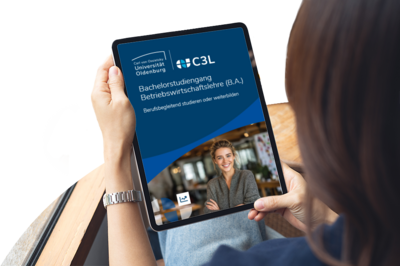
Alternatively, you can download a brochure and find out more at your leisure.
Who can I contact for advice?
For organisational, content-related and individual questions, you can contact the C3L course team at any time. An appointment can be made by telephone, online or on site. This allows you to clarify whether the programme suits your goals and your current situation. It is best to use our online booking for your appointment.


Stay well informed!
Follow us on LinkedIn,
expand your network
and discuss all things Business Administration with us
.


