Symposium on the promotion of teacher-schoolchild interactions
Symposium on the promotion of teacher-schoolchild interactions
Can we continue to ignore students' social interactions, emotions and well-being?
The promotion of teacher-schoolchild interactions in emotionally challenging teaching situations
The symposium on the promotion of teacher-schoolchild interactions in emotionally challenging teaching situations took place from 14 September to 15 September 2023 at the Hanse-Wissenschaftskolleg in Delmenhorst, which was one of the sponsors of the conference together with the Lower Saxony Ministry of Science and Culture. The organiser, Dr Juliane Schlesier (Associate Post-doc Fellow at the HWK, research assistant in Empirical Teaching and Learning Research at the CvO University of Oldenburg and, at the time, deputy professor for General Primary School Pedagogy at the University of Vechta), created an opportunity for academics in teacher training and stakeholders from school practice to exchange ideas at the symposium. The conceptual focus was on the knowledge transfer between science (teacher training) and school practice at the centre. For this reason, representatives from science and teacher training were invited to the symposium, as well as scientists in qualification phases focussing on the topics of emotions, social interaction and well-being. Representatives of school practice were also among the participants. These included, for example, representatives from award-winning schools of the German School Award or a winner of the Klaus-von-Klitzing Award (teachers), an education officer from the RAA M-V, an education officer in the qualification and further development of international youth work (IJAB), a student teacher and many more. A total of 25 invited persons took part in the symposium in person and a further 47 interested persons from various departments and disciplines from numerous universities in Germany and Austria (University of Cologne, University of Bremen, University of Frankfurt, University of Hildesheim, CvO University Oldenburg, Ruhr University Bochum, University of Heidelberg, University of Leipzig, FAU Nuremberg-Erlangen, University of Wuppertal, University of Siegen, University of Gießen, etc.) were registered for digital participation due to high demand and were thus able to join the introductory lecture and keynote speeches online.
Aims and structure of the symposium
Scientists and school practitioners presented findings from research and (school) practice on teacher-schoolchild interactions in emotionally challenging teaching situations and discussed these from multiple perspectives. Among other things, the effects of COVID-19 restrictions and digital formats on teacher-schoolchild interactions were analysed and possible/conceivable or already implemented interventions to promote teacher-schoolchild interactions in emotionally challenging teaching situations (in online and face-to-face lessons) were discussed. Another aim of the symposium was to establish a sustainable network involving young researchers in teacher training to promote teacher-schoolchild interactions, which includes both teacher trainers and representatives of school practice.
There were several formats at the symposium: introductory lecture, keynotes, keynote speeches and joint work in three focus groups to promote collaboration and networking. The content of the presentations was recorded by Laura Ohmes (CvO University of Oldenburg) using the sketchnoting method.
Introductory lecture
Introductory lecture - Dr Juliane Schlesier
At the beginning of the symposium, Dr Juliane Schlesier gave an introductory lecture in which she began by pointing out that the focus of research and the public is usually primarily on students' performance and less on their socio-emotional experience and development. However, a positive emotional experience and a high level of well-being lead to better performance (Lichtenfeld et al., 2022; Lazarides & Buchholz; Mega et al., 2014; Pekrun et al., 2017), meaning that the emotional experience at school should also be taken into account with regard to children's performance. The COVID-19 pandemic has shown that the pandemic restrictions - which were primarily aimed at restricting social interactions - have had a negative impact on the emotional experience of pupils and (prospective) teachers (Hußner et al., 2022; Naumann et al., 2021; Westphal et al., 2022): For example, teachers suffered from emotional exhaustion and some children had significantly more negative emotions in class than before the pandemic. This shows that social interactions are central to the emotional experience of students - especially when they are particularly emotionally challenged in some situations (e.g. when they fail a task, get a bad grade, etc.; Schlesier, 2020; Schlesier et al., 2023). The aim should therefore be to gain a deeper understanding of social interactions in emotionally challenging classroom situations on the one hand and to determine how the interactions between teachers and students can be supported on the other.

Keynotes
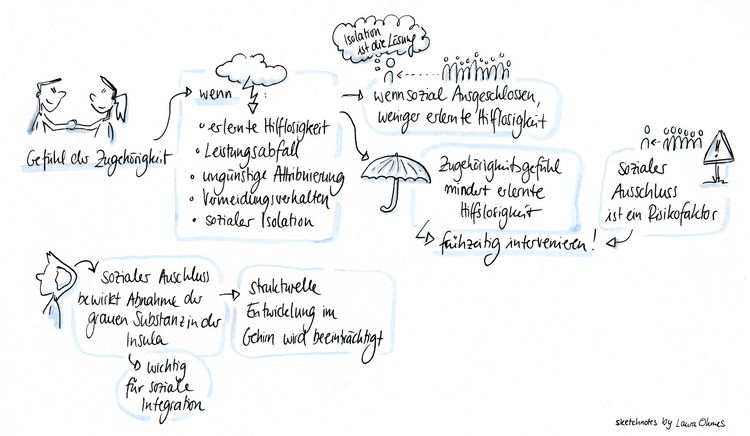
1st keynote - Prof Dr Dr Diana Raufelder
The first keynote speech on the topic of "Why social relationships are so important in the school context" was given by Prof Dr Dr Diana Raufelder from the University of Greifswald's School Pedagogy department and looked at the various social relationships in the school context and their effects on students' performance, motivation and emotional experience.
Diana Raufelder emphasised that teachers can not only benefit from the teacher-student relationship, but that they should also particularly value it, as it can be a prerequisite and consequence of successful academic appointments and private actions (Horstkemper, 2000, p. 144). Empirical findings show that a good teacher-student relationship has a positive effect on school performance, motivation and the development of students' social and emotional skills (Davis, 2003; Roorda, Koomen, Spilt & Oort, 2011; Wentzel, 2009, 2010; Zimmer-Gembeck, Chipuer, Hanisch, Creed & McGregor, 2006). Student-student relationships also have a major influence. Positive peer relationships lead to a greater sense of well-being, a better attitude towards school, greater motivation and better performance (Juvonen, & Wentzel, 1996; Wentzel 2005; 2010; 2017).
Diana Raufelder also presented the results of a study on whether the perceived teacher-student relationship, belonging to the school and social exclusion moderate the development of learnt helplessness during adolescence. She comes to the conclusion that the school's sense of belonging can protect students (especially at grammar schools) from developing learnt helplessness if they are supported early on. In addition, relationships should be strengthened, as a positive teacher-student relationship reduces the likelihood of learnt helplessness. It is important to note that social exclusion is a risk factor that either contributes to alienation from school (secondary schools) or to the reinforcement of learnt helplessness (grammar schools). For this reason, social exclusion should be counteracted at an early stage and the sense of belonging should be strengthened in everyday school life.

2nd Keynote - Junior Professor Dr Daniela Raccanello
Junior Professor Dr Daniela Raccanello of Developmental and Educational Psychology at the University of Verona, Italy, presented Keynote 2 with the topic "How to Foster emotional competence in primary and secondary students: Development of evidence/Based Interventions". The Development of Evidence-Based Interventions]". She talked about what learning and achievement emotions are and what constitutes them. She also explained how emotions can be categorised and what their function is. The second part of her keynote speech focussed on emotion regulation, i.e. the processes by which an individual influences which, when and how emotions are felt and expressed (Gross, 1989). Junior Professor Daniela Raccanello pointed out that the "HEMOT-Helmet for EMOTions" app can offer preventive emotional precautions in the event of a disaster: Children, young people and adults can use it to research and train how to deal with their emotions.

3rd keynote - Prof Dr Stephanie Lichtenfeld
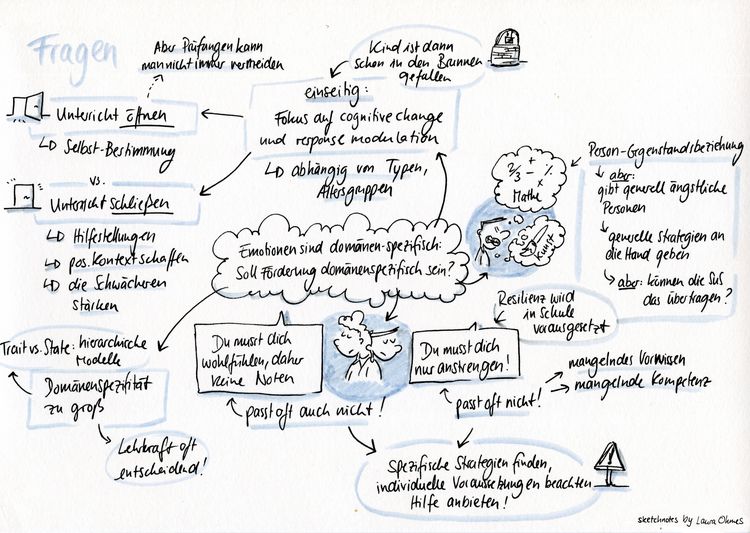
Prof Dr Stephanie Lichtenfeld from Educational Psychology and School Development at the University of Hamburg gave the 3rd keynote speech on the topic of "Changing emotions, but how? Learning and performance emotions and their regulation in the school context". She categorised learning and performance emotions and differentiated between positive emotions, such as the joy of learning, and negative emotions, such as boredom. With regard to emotion regulation, she drew attention to various strategies (Zimmermann & Iwanski, 2014). In an open discussion with the participants, research desiderata regarding emotion regulation in the context of school emerged, such as domain specificity or individual differences in the use of various strategies.

Keynote speeches
Keynote speech - Prof Dr Marie-Christine Vierbuchen
Prof Dr Marie-Christine Vierbuchen from the Department of Special Needs Education (specialising in learning) at the European University of Flensburg gave a lecture on social-cognitive information processing as a piece of the puzzle in supporting social-emotional development. She categorised the ability to process social information as a fundamental element for pupils' emotional intelligence and social skills.
Prof Vierbuchen presented the training modules basic training, emotion regulation training and transfer training as well as problem-solving strategies for better handling of emerging emotions and for better information processing.
Teachers play a crucial role here, as they help to support the social and emotional development of pupils in emotionally challenging classroom situations. Teachers should therefore receive appropriate training to improve teacher-pupil interactions. However, it is also necessary for teachers to be trained in recognising and managing their own emotions and social information in order to successfully deal with students in stressful classroom situations.

Keynote speech - Dr Wiebke Endres
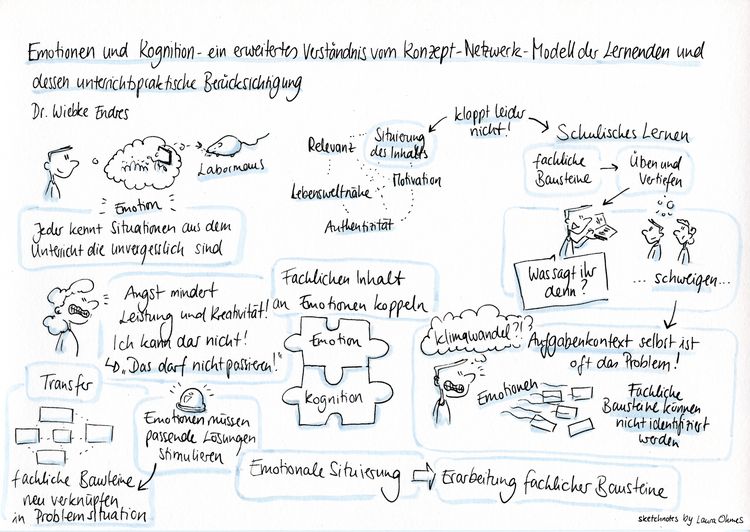
Dr Wiebke Endres, Neues Gymnasium Wilhelmshaven and winner of the Klaus von Klitzing Prize, gave a keynote speech on emotion and cognition.
Traditionally, the two are viewed separately and emotions are seen as a hindrance to thinking. Wiebke Endres used an example from her own school days to illustrate how much better learning content is remembered when it is linked to emotions. It turns out that feelings are of central importance for thinking (Ciompi, 2003) and the separation of emotion and cognition is rather questionable from her perspective. A model of mood congruence effects already points to a link between memory performance and learning mood and thus to a connection between emotion and cognition (Bower, 1981). Learning content should therefore be specifically linked to students' emotions. Wiebke Endres is using these findings to research the development of teaching materials. She wants to develop a new primer in which there are different characters who experience an adventure. All pupils should be able to identify with a character and thus empathise with the character. The characters now have to solve puzzles and complete tasks in order to continue their story or adventure. Compassion and other emotions should encourage the pupils to want to help the characters solve the puzzles or similar; for example, they have to complete maths problems. In this way, subjects that are often seen as one-sided (e.g. maths) can be made more interactive and exciting for students.
Keynote speech - Prof Dr Karin Zimmer
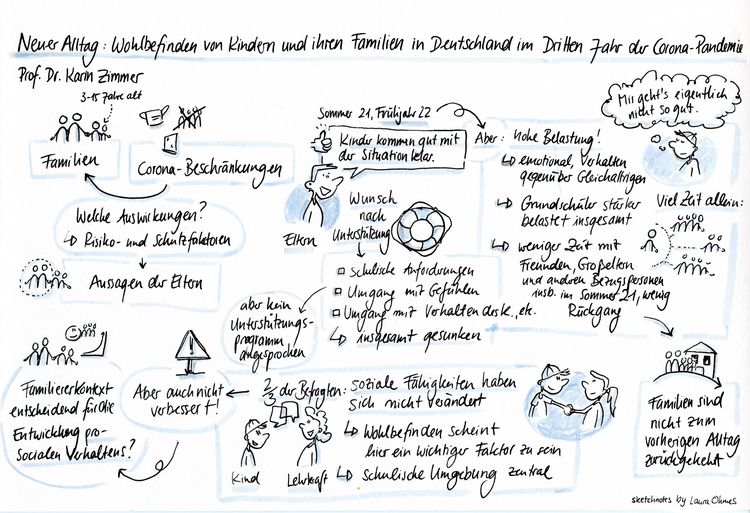
Prof Dr Karin Zimmer from Empirical Educational Research at the University of Vechta gave a keynote speech on the well-being of children and their families in Germany in the third year of the coronavirus pandemic. Contact restrictions were imposed to contain the pandemic, which not only characterised everyday family life, but also posed major challenges. Prof Karin Zimmer presented a data collection for which households with children were surveyed online about the situation at home during the pandemic. The results revealed that although parents had fewer requests for support in spring 2022 than in the previous summer, they wanted support in dealing with their children's feelings, moods and behaviour, as well as help at school. Parents still rated their children as highly stressed in the second data collection and said that the children's carers were still mainly members of the household and that they were more alone.
Focus groups
To ensure an optimal exchange and a productive time in a smaller group, there were three working groups, each of which worked on the topics of 1) well-being, 2) emotions & stress and 3) social interactions. The working groups each had a team leader who structured and moderated the work phase.
Well-being" working group
In the "Well-being" working group led by Dr Ramona Obermeier of Educational Research at the University of Linz, Austria, the well-being of students was identified as central to their performance, their behaviour and their further educational career. Teamwork was used to discuss how well-being is created and what students need to feel good at school. Among other things, the promotion of positive social relationships, a positive classroom climate and the strengthening of the parent-child relationship were worked out to create well-being.
Emotions and stress" working group
In the "Emotions and Stress" working groupled by Dr Frances Hoferichter from the University of Greifswald's School Pedagogy department, two teams worked on methods for reducing stress, testing them and considering how they could be implemented sustainably for teachers at school and put into practice for pupils in everyday school life. Afterwards, all groups presented the methods they had practised and their experiences and explained how they had answered the questions within their group.
Social interactions" working group
In the third working group, Dr Stefan Markus from Teaching, Learning and Instructional Research at the University of Wuppertal worked with his team on the topic of "social interactions". All working group participants were provided with different coloured cards and considered ways to promote social connectedness, autonomy and students' sense of competence. A salad of ideas was created from the cards and discussed together with all group participants

Group photo of the participants on site: Junior Prof Dr Daniela Raccanello, Laura Ohmes, Prof Dr Stephanie Lichtenfeld, Franziska Mühlbacher, Prof Dr Gerda Hagenauer, Dr Stefan Markus, Dr Ramona Obermeier, Prof Dr Bettina Hannover, Deputy Prof Dr Juliane Schlesier, Prof Dr Barbara Moschner, Dr Wiebke Endres, Prof Dr Dr Diana Raufelder, Dr Frances Hoferichter, Tobias Fenske, Prof Dr Barbara Moschner, Dr Wiebke Endres, Prof Dr Diana Raufelder, Dr Frances Hoferichter, Prof Dr Juliane Schlesier, Tobias Fenske, Prof Dr Barbara Moschner, Dr Wiebke EndresProf. Dr Juliane Schlesier, Prof. Dr Barbara Moschner, Dr Wiebke Endres, Prof. Dr Dr Diana Raufelder, Dr Frances Hoferichter, Tobias Fenske, Prof. Dr Karin Zimmer, Lilith Rothmund, Prof. Dr Kathrin Lohrmann, Prof. Dr Marie Vierbuchen, Dorotha Trynks, Anne Sorge-Farner, Dr Mareike Trauernicht, Madita Frühauf.
Picture: Hanse-Wissenschaftskolleg
Many thanks to all those who supported the realisation of this symposium. Many thanks to the HWK and the MWK, who supported the symposium financially, Dorothe Poggel and Thurid Werner for the implementation and coordination of the processes, to Lilith Rothmund for her support in the organisation - and last but not least to all participants for their exciting impulses!
Organiser: Dr. Juliane Schlesier
Text by Lilith Rothmund & Dr Juliane Schlesier