

Analytical infrastructure

Analytical infrastructure
Sample preparation and analytical infrastructure
In addition to the tropical aquarium facility for ecological experiments and coral propagation experiments, chemical analysis is another focus of the Environmental Biochemistry working group. Analysing various organic molecules from marine organisms and their associated microbiome requires special procedures for sample preparation and purification and, above all, high-quality equipment for identifying and quantifying bioactive target compounds. Here, for example, we can chemically separate bioactive secondary metabolites from a variety of marine organisms using preparative high-performance liquid chromatography (prep-HPLC, Agilent 1260 Infinity) and identify these molecules with high-resolution mass spectrometers (HRMS, WATERs Q-ToF Synapt G2-Si) and quantify them accurately down to trace amounts (WATERs TQ-S XEVO Micro). Below we describe our state-of-the-art analytical infrastructure in more detail.
Preparative HPLC for the purification of compounds
The Agilent HPLC (1260 Infinity) with DAD (Diode Array Detector) and ELSD (Evaporative Light Scattering Detector) is a powerful analytical system for the separation, detection and quantification of complex mixtures of organic compounds.
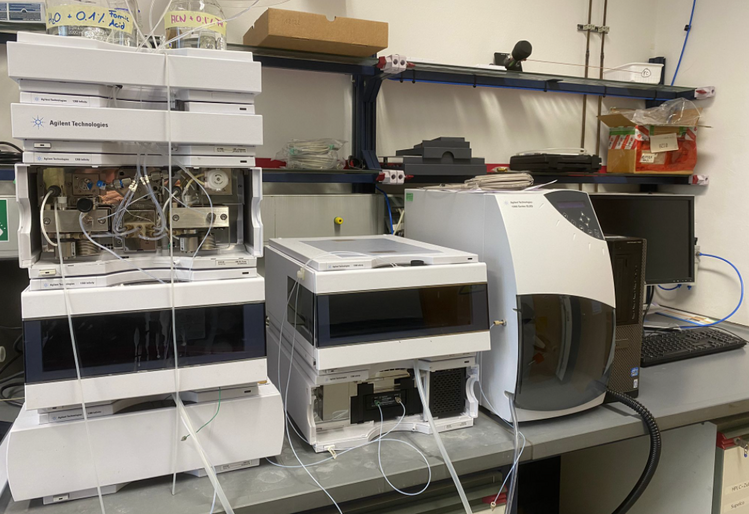
The Agilent GC (1260 Infinity) is equipped with a DAD (Diode Array Detector) and an ELSD (Evaporative Light Scattering Detector).
The DAD is a UV-Vis detector that uses a diode array to detect and quantify multiple compounds in a single run. It can detect a wide range of compounds, including non-chromophoric and semi-volatile compounds, and has a linear dynamic range of up to 4 orders of magnitude. The advantages of using a DAD are: (1) higher sensitivity and specificity compared to conventional UV detectors (2) ability to perform spectral analysis to identify and confirm compounds (3) ability to perform quantitative analysis using multiple wavelengths
The ELSD is a universal detector that can detect a wide range of compounds, including non-volatile and non-chromophoric compounds that are not recognised by UV detectors. It works by vaporising the mobile phase and detecting the light scattered from the sample. The advantages of using an ELSD include: (1) higher sensitivity and specificity compared to refractive index detectors, (2) universal detection, regardless of the chemical nature of the analyte, (3) low detection limit and high dynamic range.
Gas chromatography coupled with mass spectrometry
Gas chromatography coupled with mass spectrometry combines two separate analytical techniques to provide highly accurate and detailed information about the compounds in a sample. GC enables the separation of organic molecules, from small gaseous molecules to compounds with a much higher number of carbon atoms, such as polychlorinated biphenyls (PCBs), hexachlorobenzene (HCBs), hexachlorocyclohexane (HCH) and dichlorodiphenyltrichloroethane (DDT). The Agilent 6890 Series GC is a versatile and reliable GC suitable for a wide range of samples, from trace analysis to high throughput applications. The benefits of using a GC include: (1) high separation performance and resolution, (2) excellent reproducibility and accuracy, (3) ability to process a wide range of sample types and matrices.
In conjunction with an MS, it enables the identification of molecular structures and simultaneously provides information on the concentration of a target analyte. The Agilent GC-MS single quadrupole benchtop instrument with a 6890 GC and a 5973 MSD is the "workhorse" of our group for the characterisation of GC-suitable organic contaminants and pesticides. It operates exclusively in EI mode and has a full scan capacity from m/z 2 to 800 Daltons. The Agilent 5973 MSD is a robust and reliable detector that is often used to analyse complex mixtures. The advantages of using an MSD include: (1) high sensitivity and selectivity, (2) the ability to identify compounds based on their mass spectra, (3) the ability to quantitatively analyse using Selected Ion Monitoring (SIM).
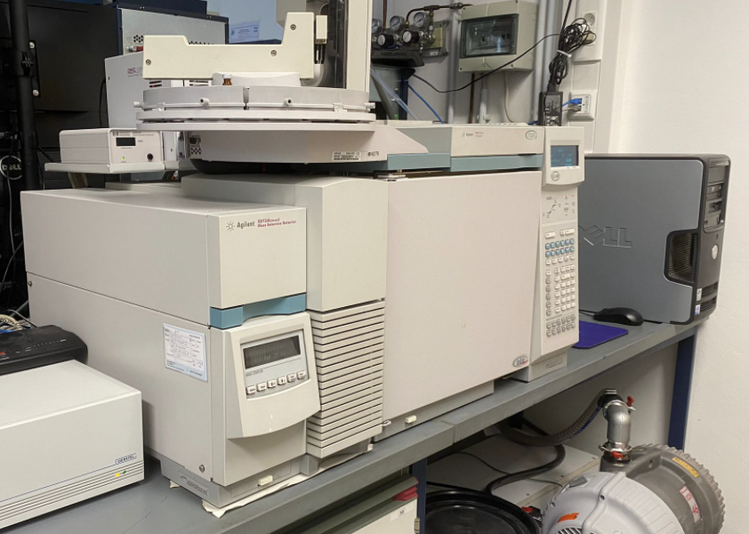
The Agilent GC (6890 series) MSD (5973) is a powerful analytical system that combines the high separation performance and reproducibility of the GC with the high sensitivity and selectivity of the MSD.
Liquid chromatography coupled with mass spectrometry (LC-MS)
Liquid chromatography coupled with mass spectrometry (LC-MS) is used to identify polar, high-molecular organic compounds and enables the semi-quantitative determination of concentrations. In the Environmental Biochemistry group, LC-MS techniques are mainly used to characterise the metabolome of marine organisms and their associated microbiome.
By combining LC and MS, the LC-MS system offers several advantages, including: (1) improved sensitivity and specificity compared to LC or MS alone, (2) the ability to identify unknown compounds by their mass spectra, (3) the possibility of quantitative analysis using SIM or Multiple Reaction Monitoring (MRM), and (4) compatibility with a wide range of sample types and matrices, including biological fluids, environmental samples and complex mixtures.
Overall, LC-MS is a powerful and versatile technique that offers high sensitivity and specificity for the separation, identification and quantification of a wide range of organic compounds in complex mixtures.
SYNAPT G2-Si mass spectrometry
The SYNAPT G2-Si mass spectrometer (Waters) is a hybrid quadrupole mass spectrometer with ion mobility and orthogonal acceleration (Q-ToF) that combines high-resolution mass spectrometry (HRMS) with highly efficient ion mobility-based (IMS) measurements and separations. It can be equipped with either a dual-orthogonal API source (LockSpray™ ESI/APCI) or a matrix-assisted laser desorption/ionisation ion source (MALDI). In routine mode, the SYNAPT is connected to a Waters ACQUITY UPLC H-Class system to screen metabolites in solution, or optionally to an imaging system (MALDI imaging mass spectrometry for short) to analyse chemical components and their spatial distribution within a sample.
Here are some features and benefits of this instrument: (1) High-resolution mass measurement that enables the detection and identification of even minor components in complex mixtures. The accurate mass measurement also enables the determination of elemental composition, which is useful for the identification of unknown compounds. (2) This instrument is equipped with ion mobility separation, which separates ions based on their size, shape and charge. This provides an additional dimension of separation, which can improve the specificity and accuracy of compound identification. (3) The instrument offers a range of fragmentation techniques, including collision-induced dissociation (CID), electron transfer dissociation (ETD) and radiation-induced dissociation (HCD). These techniques provide different types of fragmentation information that can be used for structural characterisation and identification of unknown compounds. (4) The SYNAPT G2-Si mass spectrometer offers high sensitivity, enabling the detection of even the smallest amounts of compounds in complex mixtures. (5) The instrument features a data-independent acquisition (DIA) mode that provides comprehensive and reproducible data for label-free quantitative analysis. The DIA mode also enables the detection of low-abundance analytes and the identification of co-eluting isobaric compounds.
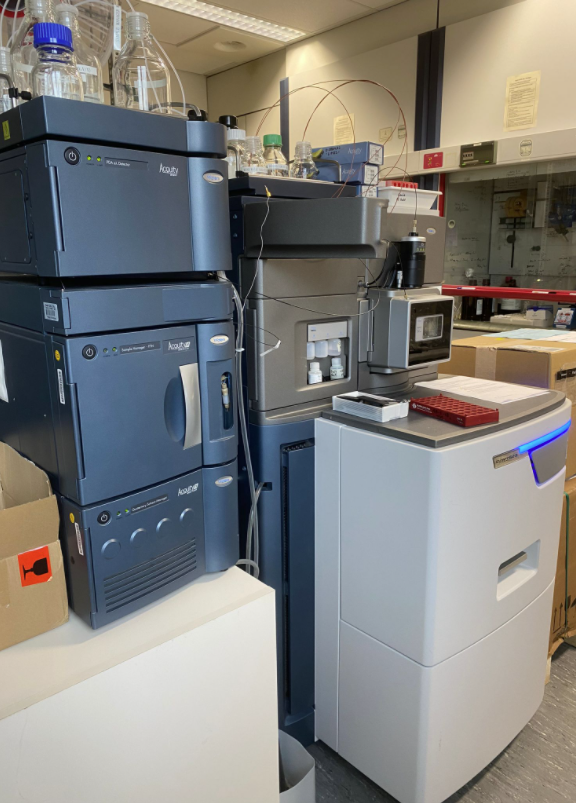
SYNAPT G2-Si mass spectrometry is suitable for a wide range of applications including metabolomics, lipidomics and small molecule analysis.
Xevo TQ-S micro triple quadrupole mass spectrometry
The Xevo TQ-S Micro Triple Quadrupole Mass Spectrometry (Waters) is a highly sensitive and selective instrument for the quantitative analysis of small molecules and biomolecules. This compact, powerful workhorse is fast, reliable and consistently delivers low quantitation values with a wide dynamic range. Here are some features and benefits of this instrument: (1) Triple quadrupole technology, consisting of two mass filters and a collision cell, enables highly selective and sensitive detection of target compounds in complex matrices. (2) The Multiple Reaction Monitoring (MRM) mode enables highly specific and sensitive detection of target compounds in complex matrices. This mode also enables the detection of analytes with low abundance and the identification of co-eluting isobaric compounds. (3) The high sensitivity and wide dynamic range enable the detection and quantification of trace amounts of compounds in complex matrices. This makes it an ideal tool for our ecotoxicological project on the effects of UV filters on corals. (4) The fast scan rate enables high-throughput analysis of samples without sacrificing sensitivity or selectivity.
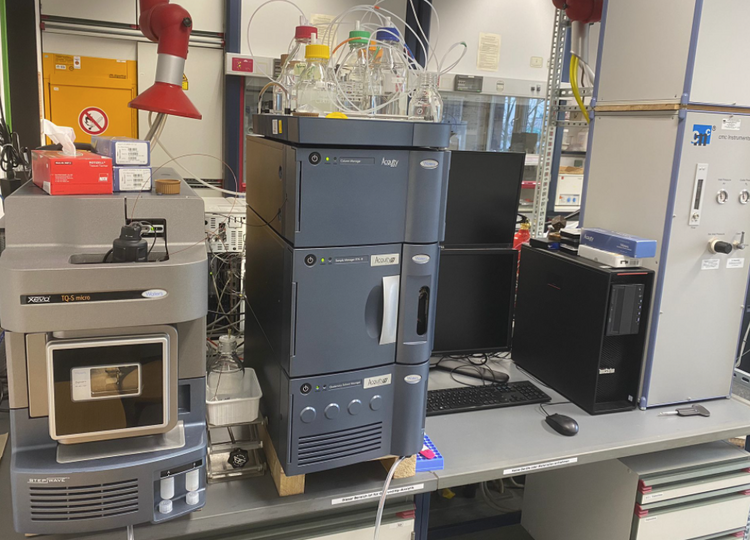
The Xevo TQ-S micro-triple quadrupole mass spectrometer is a highly sensitive and selective instrument suitable for a wide range of applications including ecotoxicological screening, drug discovery and environmental analysis.
Synergy H1 Hybrid Multimode Reader
The Synergy H1 Hybrid Multimode Reader is a microplate reader designed for various applications including absorbance, fluorescence and luminescence assays. The BioTek Synergy H1 is a modular multimode microplate reader with monochromator-based optics and filter-based optics. The patented hybrid technology offers flexibility and sensitivity for a wide range of applications. The modular platform allows upgrades to expand functionality as your lab operations change. The Synergy H1 offers continuously adjustable monochromators for the selection of fluorescence excitation and emission wavelengths. The fluorescence bandwidth can be adjusted in 1 nm increments between 9 and 50 nm, allowing users to fully optimise reader settings to achieve the best assay performance compared to fixed bandwidth systems. Overall, the BioTek Synergy H1 is a versatile and reliable microplate reader that is widely used in various research fields including drug discovery, molecular biology and biochemistry.
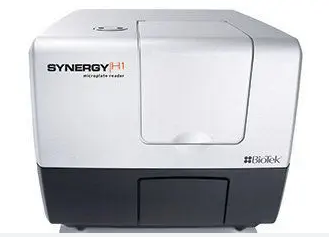
The BioTek Synergy H1 is a microplate reader designed for various applications such as absorbance, fluorescence and luminescence assays.
Direct mercury analyser
The mercury analyser DMA-80 (Direct Mercury Analyser) is used for the quick and easy determination of Hg in solid or liquid samples. In our group we analyse the Hg storage in bird eggshells, bird embryos, bird feathers, fish and their organs as well as in sediment samples. For this purpose, the weight of the samples is determined using the integrated analytical balance of the DMA-80. The samples are processed sequentially by an automatic autosampler. The analysis per sample takes between 6 and 7 minutes.
Mode of operation: The sample is decomposed with oxygen at high temperatures, the released Hg is bound to an amalgam collector, then atomised and measured with the built-in atomic absorption spectrometer.
Hg detection range: In our group, Hg values in the range from 0.05 ng to 50 ng are determined. Theoretically, the DMA80 can measure Hg values from 0.001 ng to 1000 ng.
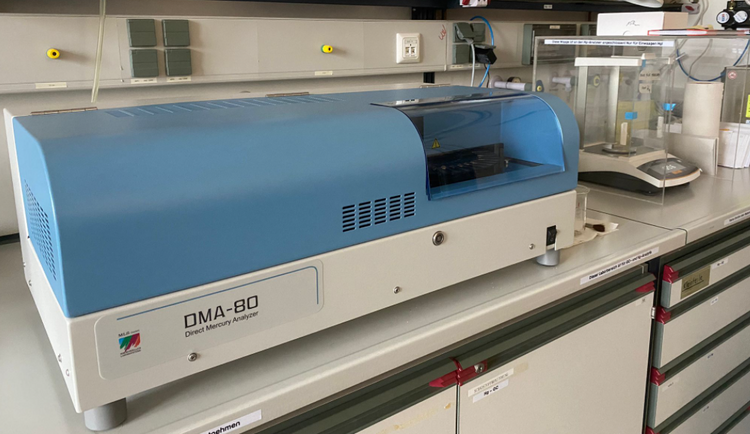 The Direct Mercury Analyser (DMA) is used for the quick and easy determination of Hg in the range from 0.05 ng to 50 ng.