

Simulator training
Simulator training
Simulator training²
Data-supported competence and learning progress diagnosis of simulator-supported education and training measures A research project in co-operation with
- Jade University of Applied Sciences, Department of Maritime Studies, Elsfleth
- Reederei Schepers, Elsfleth
- Reederei Martime, Elsfleth
- Reederei Briese, Leer
- Interschalt Maritime Education & Training, Schenefeld near Hamburg The concept of the Simulatortraining² project uses the latest generation of ship handling simulators. Training, Schenefeld near Hamburg The concept of the Simulatortraining² project The latest generation of ship handling simulators are used to capture and record the handling data of ships when novices and experts perform five different tasks under controlled conditions.
The tasks are selected in such a way that they have the best possible operationalisable evaluation criteria for good or poor handling.
A simple example of this is the task of manoeuvring a ship from a berth in the current of a river into a harbour basin. <link> </link> The time required to manoeuvre from one berth to another or the distance travelled can be used as evaluation criteria, for example. On the handling side, for example, the number and size of rudder control commands, the number and size of engine commands, the speeds, the propeller pitches used, etc. can be analysed. All this data is stored in a database management system. The data collected in this way is analysed using standard statistical methods and the application of exploratory data analysis and data mining techniques.
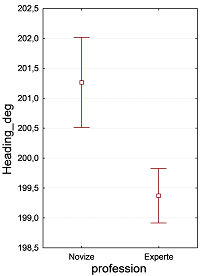
The procedure and objective of these analyses can be described in simple terms as follows: After separating the task fulfilments into "good" and "bad", in the simplest case into these two groups, a search is made for the handling characteristics in which these two groups differ most clearly. The following graphs are intended to illustrate this: <nobr>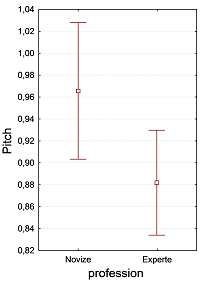
 </nobr>
The two groups distinguished here, "novices" and "experts", are most clearly separated by the speed ranges shown on the far right in the comparison of three handling characteristics shown: The experts drive recognisably slower. Using the aforementioned analysis methods, area-specific classifiers are calculated for each task under consideration.
These classifiers are then applied and used to
- a decision on a possible training requirement: If the individual values determined online are in the optimum range, there is no need for training.
- to assess the progress of the training measure: is there a tendency to approach the areas of optimal handling, or are the values stagnating or deteriorating?
- make a decision about suitable and less suitable education and training scenarios: Under which conditions, in which scenarios does the strongest and most sustainable learning progress succeed.
| School I Institute of Educational Sciences AG Pädagogische Psychologie
|