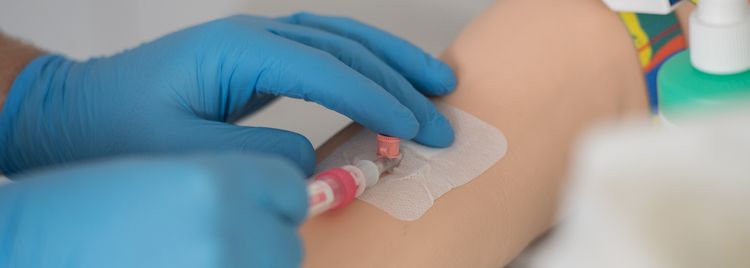
The model degree programme in Medicine teaches clinical and practical skills right from the start. Students are taught the procedures and techniques involved in physical examination, and practical skills are imparted. In addition to examination techniques, it is also of central importance to be able to identify the structures being examined and their physiological characteristics.
Aligned with the content of internships and lectures, these ‘clinical and practical skills’ – integrated into the modules – are taught across years 1 to 4.
At the start of each course, a brief overview of the topic is provided, along with a demonstration of the examination techniques where appropriate. The learning content is then practised under the guidance of lecturers and, where applicable, student tutors, who are on hand to answer any questions.
In groups, students simulate contacts with their fellow students, thereby experiencing a change of perspective. Experiencing examinations from the patient’s point of view enables them to provide constructive feedback and to critically reflect on their own actions.
Students then practise and consolidate the examination techniques they have learnt at their own discretion during the designated practice sessions. Tutors are also available during these sessions.
The competence learning objectives for the individual courses are aligned with the Heidelberg Standard Examination and describe in detail the clinical and practical skills to be acquired. These are assessed in the oral examinations (OSCE).
Learning outcomes and course content can be found in the module handbook, which is provided by the teaching co-ordination team at the start of each academic year.