Curricular events
All the latest information for lecturers on running their courses at the Clinical Training Centre is available in a course of the same name on Stud.IP:
- Community Forum: 6.01.70010 Information on courses at the KTZ
If you have any further questions not covered by the information provided, please do not hesitate to contact us directly!

Curricular events

Clinical and Practical Skills (KPF)
Medicine – from the first year of study
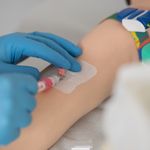
The model degree programme in Medicine teaches clinical and practical skills right from the start. Students are taught the procedures and techniques involved in physical examination and acquire practical skills. In addition to examination techniques, it is also of central importance to be able to identify the structures being examined and their physiological characteristics.
Physiology
Medicine – from the first year of study
The physiology internships on the topics of muscles and nerves, reflexes, ECG and respiration take place at the KTZ. Here, fundamental physiological knowledge is combined with practical skills. Students carry out clinically relevant examinations themselves, covering topics such as nerve conduction velocity, reflex status, ECG (including stress ECG) and spirometry, amongst others.
Seminar with practical components
Medicine – from the third year of study onwards
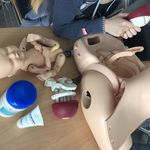
The model degree programme in Human Medicine teaches clinical and practical skills right from the start. Students are taught the procedures and techniques involved in physical examination and acquire practical skills. In addition to examination techniques, it is also of central importance to be able to identify the structures being examined and their physiological characteristics.
Subject-specific consultation (FK)
Medicine – from the third year of study onwards
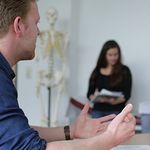
Here, students carry out a full consultation (including a physical examination) with a simulation patient. One student takes on the role of the doctor, whilst the other students and the tutor act as observers and provide feedback on the consultation.
Election events
Medicine – from the third year of study onwards
The KTZ offers a wide range of optional courses on various topics with a clinical and practical focus. Examples include:
Pre-clinical elective
- Psychosocial crisis intervention and stress management
- In vivo anatomy
Elective module
- Suturing and knotting course
- Travel and Tropical Medicine
- Ultrasound
- Pre-hospital and In-hospital Emergency Medicine
- Digital Technologies in Modern Medicine: AI, Mixed Reality, 3D Printing
PE workshops
- Escape Room: Neurology
- Introduction to chiropractic therapy
- Communication with dying patients
- Interprofessional Emergency Simulation
- Crew Resource Management in an Interprofessional Team
The detailed programme and further information on the individual events can be found on the respective Stud.IP event page.
Molecular Biomedicine
The Master’s degree programme in Molecular Biomedicine conducts its internships in the field of Molecular Physiology at the KTZ. Further details can be found on the degree programme’s website.
Advanced Nursing Practice
In the ‘Clinical Practice’ module, regular weekly sessions take place at the KTZ. The course covers both practical clinical skills (e.g. examination techniques, auscultation, ultrasound) and communication skills. To create a realistic setting, simulation models playing a wide variety of roles (e.g. patients, relatives, colleagues) are regularly used in the communication sessions. Further details can be found on the degree programme’s website.
Healthcare research
As part of the module ‘Challenges and Organisation of Care for an Ageing Population’, practical teaching sessions are held regularly at the KTZ. Using the ageing suit provides an excellent and vivid hands-on experience of geriatric issues. Further details can be found on the degree programme’s website.
Medical Computing Science
The KTZ offers a course entitled ‘Medical Basics for Computing Scientists’. Students can gain hands-on experience of basic medical techniques – ranging from auscultation and ultrasound to resuscitation procedures – to gain an insight into clinically relevant examination and treatment options. Further details can be found on the degree programme’s website.