

Hardly any child today grows up without mobile devices. Yet even some teachers only have a rudimentary understanding of how computers or the internet work. Computer science education specialist Ira Diethelm and her team want to change that and are developing freely available teaching materials.
Whether at school, doing homework, chatting with friends or playing games: digital media are part of everyday life for most children and young people. Yet they often know very little about how smartphones and tablets work or the structure of the internet. This could change through more Computing Science lessons in schools. Whilst the subject was long neglected, more and more Federal States are now introducing Computing Science as a compulsory subject.
Prof. Dr Ira Diethelm welcomes this development. However, she also points out that only a few universities offer a teacher training degree in Computing Science. As a result, many teachers are teaching a subject outside their specialist field and have to learn the subject content and teaching methods on their own.
Teaching resources available for free download
It was these teachers, who were not specialists in the subject, that Diethelm had in mind when she launched the ‘IT2School – Discovering IT Together’ project in 2014. The project was funded and initiated by Wissensfabrik – Unternehmen für Deutschland e.V., an association of around 130 companies today that are committed to more comprehensive teaching in the STEM subjects – that is, science, Computing Science, technology and mathematics. With the aim of making these lessons more engaging and practical, the Wissensfabrik had previously launched other teaching resources.
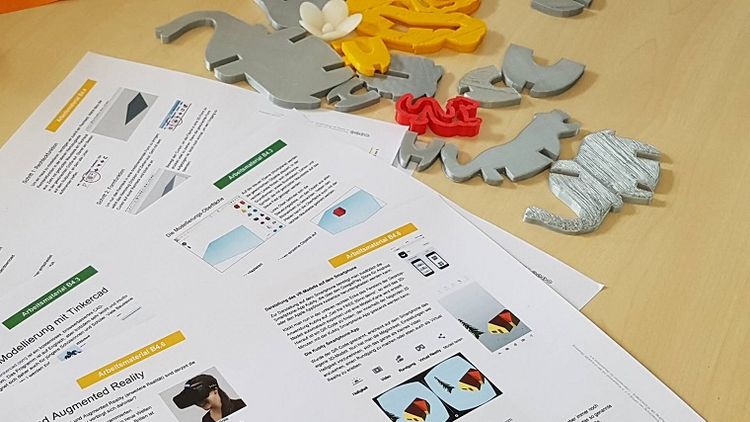
IT2School became not only the Wissensfabrik’s first project on computer science teaching, but also the first whose results are freely available online to everyone as Open Educational Resources (OER). Teachers can download them as Word or PDF documents and, if necessary, adapt and redistribute them themselves. “In this way, we want to reach as many teachers as possible and make it easy for them to work with the materials,” explains Diethelm.
From the Internet model to artificial intelligence
Twenty-four teaching modules have been developed so far, with new ones being added all the time. They cover topics as diverse as programming, 3D printing and robotics, with the latest modules also covering artificial intelligence. Each module contains materials for several lessons: teaching concepts and suggestions for lesson planning for teachers, and worksheets for pupils.
For some modules, school classes need additional materials, such as the ‘Calliope’ minicomputer, which makes it easy to learn programming. However, when designing the project, Diethelm also took care to make getting started as easy as possible by keeping the cost of materials low. Among other things, the project includes a cardboard game explaining how the internet works, and a teaching module in which children and young people communicate with one another by blinking or moving their arms. “Secret languages can be a good starting point for pupils to understand how encryption works in Computing Science,” says Diethelm. “What’s more, the teaching units can be prepared by teachers with minimal effort.”
To develop the modules, Diethelm and her team drew on findings from teaching and learning research as well as their own research results: for example, they had investigated how computer science teachers plan their lessons and what ideas pupils have about the internet.
The materials are currently being used in more than 500 schools across Germany. Whether Computing Science is a compulsory subject or not, and what content the curricula cover, varies from Federal State to Federal State – Lower Saxony, for example, has just introduced Computing Science as a compulsory subject for the tenth class across the state in the current school year. For this reason, Diethelm and her team did not base their work on any specific curriculum. Instead, they focused on three fundamental principles of Computing Science that feature in most curricula: digitalisation, automation and networking. These refer to the processes by which information is represented, stored, processed and transmitted across different systems.
Lessons for the dinner table
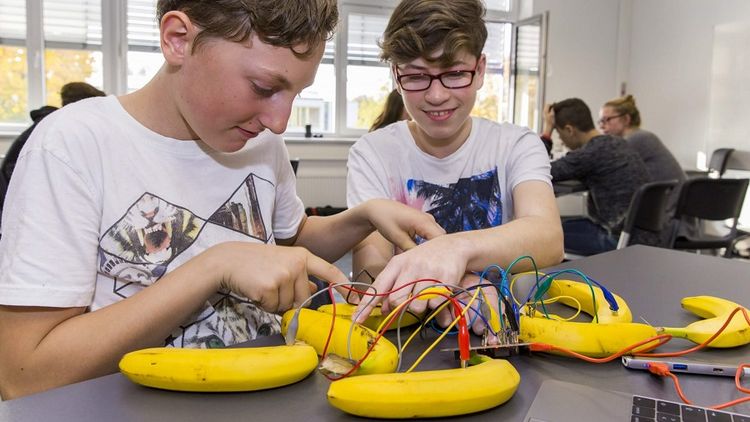
To ensure the materials were engaging and widely adopted, Diethelm engaged in extensive discussions with teachers and the team at the Wissensfabrik. “We asked ourselves: what could inspire the pupils so much that they’d talk about it with their families in the evening?” says Diethelm. IT2School therefore focuses on tangible results that children and young people can present to others, for example at a school fete. The project team devised a learning unit in which pupils use a 3D printer to make flowers or pen holders, or play the piano on pieces of fruit. “Our aim is for young people to play a creative role in shaping IT systems themselves and to produce something they can be proud of,” explains Diethelm.
She describes pupils’ understanding of how computers and the internet work, and their acquisition of basic programming skills, as a cultural skill, comparable to reading, writing or arithmetic. And just as German lessons do not end with learning to read, she believes that IT lessons must be about more than simply using computer programmes or following rules of conduct online.
A basic understanding of Computing Science is needed not only to understand how search engines or privacy policies work, but also to form an opinion on political issues such as the introduction of upload filters, restrictions on net neutrality, data retention or the influence of AI systems – for example, in automated marking. Diethelm is convinced that you can only judge what you understand. That is why computer science lessons are so important against the backdrop of current challenges. “Imagine if we had to have the climate debate without people having learnt geography or chemistry at school.”
Diethelm observes that the coronavirus pandemic has led to a shift in thinking in this regard – not only in terms of the technical equipment in schools, but also regarding the importance of computer science lessons. She recalls a training session for teachers that she ran at the start of the pandemic. The timing – Maundy Thursday at 7 pm – was far from ideal. Nevertheless, more than a thousand people took part in the online event. “Digitalisation and Computing Science as a school subject were already important topics before the pandemic. But the fact that everyone had to grapple with them intensively at the same time has given the field a major boost,” she sums up.
This article first appeared in 2022 on the “Forschungsnotizen” blog of the “Innovative Hochschule Jade-Oldenburg! (IHJO)” transfer project. This is an updated version.