

The floors
The floors
Info box
Chromic | Stands for a soil coloured by iron oxides in the WRB. |
Cambisol | Reference soil group of the WRB with soils characterised by microstructure formation, browning or loaminess. |
Edaphon | The edaphon refers to all organisms living in the soil. |
Luvisol | Reference soil group of the WRB with soils characterised by clay displacement. |
Polyhedron structure | A polyhedron structure is an aggregate with components with very similar lengths of the three main axes. These have predominantly sharp edges and smooth lateral surfaces |
Rubefaction | Red colouring of soil due to haematite. |
Browning | Browning is the formation and precipitation of iron oxides from iron ions released by the weathering of ferrous rock and the resulting brown to reddish-brown colouring of the soil. |
WRB (World Reference Base for Soil) | World Reference Base for Soil Resources is an international soil classification system. |
(Amelung et al., Scheffer/Schachtschnabel, 2018)
As in the entire Mediterranean region, the three reference soil groups of the World Reference Base for Soil Resources (WRB) Luvisole, Cambisole and Lepotsole can also be found on Giglio. Luvisols and Cambisols can be assigned to the two soil types Terra rossa and Terra fusca. Both form the Terra calcis class in the German soil classification system (Skowronek, 2016). Leptsols play a separate role.
Terra rossa
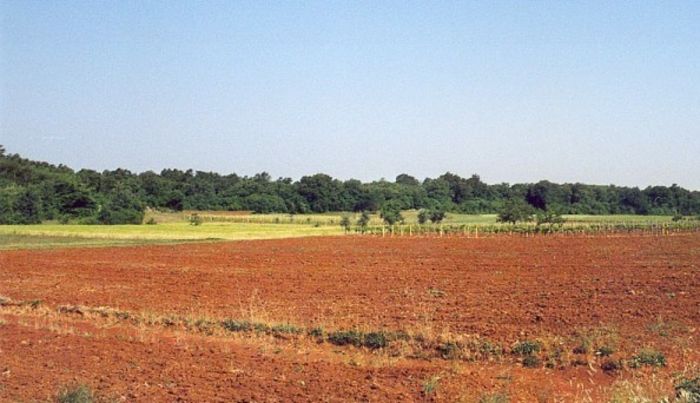
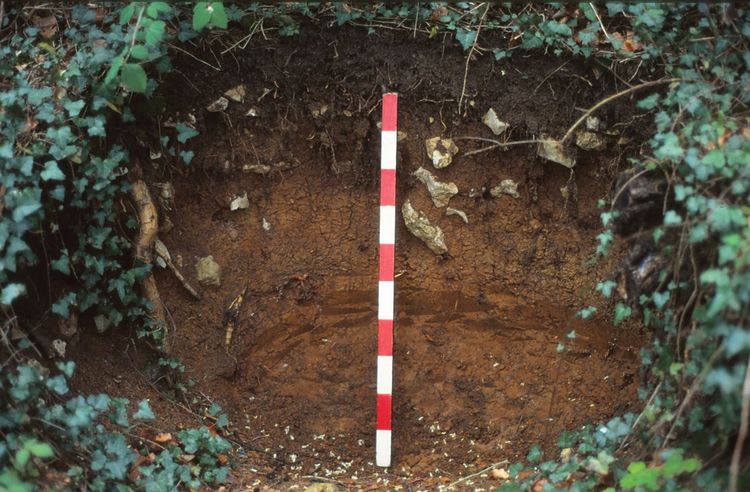
According to the WRB, Terra rossa soils belong to the Chromic Luvisols (Aydinalp and Fitz Patrick, 2009). With its striking red colouring, this soil type characterises the landscape in many Mediterranean regions. The iron oxide haematite Fe₂O3 is responsible for this red colour, which is formed through intensive chemical weathering in the warm and humid Mediterranean climate with wet winters and dry summers. It is precisely these alternating humid climatic conditions that enable the formation of soil from hard, iron-rich, clay-poor limestone and dolomite rocks. The soil could develop from their insoluble residues, such as clay minerals, iron oxides or hydroxides, e.g. goethite (FeOOH) (Lucke et al., 2014).
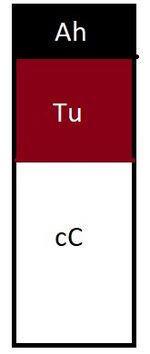
The profile sequence of the terra rossa is Ah/Tu/cC (Eckelmann; et al., 2005).
The Ah horizon forms the mineral topsoil horizon. At a maximum of 10 %, this has only a low humus content. This is due to the fact that the soil usually remains frost-free in winter and therefore humus can be decomposed by the edaphon throughout the year.
The Tu horizon has a brown-red colour due to the enrichment with haematite (up to 5 %) and forms the subsoil horizon. This consists of solution residues of the parent rock, limestone or dolomite, and the impurities contained therein, which have dissolved in rain or soil water. Clay minerals predominate and form the main component of this horizon with a proportion of around 65 %. The fine earth is free of primary carbonate, which was dissolved by the rainwater or soil water. The "u" in Tu stands for rubefied (www.ahabc.de, accessed on 30/10/2020).
The "c" in the cC horizon stands for carbonate. This is because the cC horizon is the parent rock, which consists of slightly weathered limestone or dolomite with a carbonate content of at least 75 %. (Amelung et al., Scheffer/Schachtschnabel, 2018)
Terra fusca
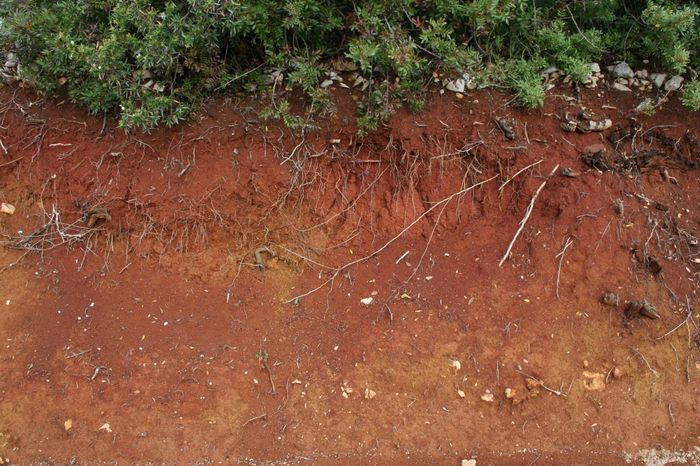
According to the WRB,Terrra fusca soils are categorised as Chromic Cambisol due to the frequently occurring loess layer, but as Luvisol if the subsoil is clay-rich (Amelung et al., Scheffer/Schachtschnabel, 2018).
They have a bright yellow-brown colour and develop from rendzines on carbonate-rich, low-iron parent rock and are also referred to as limestone brown loam. With a clay content of more than 65 % in the T horizon, they are very clay-rich. Terra fusca soils are also usually moderately to strongly acidic, very plastic when moist and therefore very susceptible to erosion and have a lower humus content than other rendzines. They are formed by the leaching and weathering of carbonate or gypsum rock. What usually remains are residues from impurities in the rock, mostly silicates such as clay minerals. The lime is completely washed out. The bright colouring may be due to the colouring of the solution residue, but it is usually due to browning, i.e. the release of iron that is bound in the carbonate or silicate rock and subsequently oxidises (Amelung et al., Scheffer/Schachtschnabel, 2018).
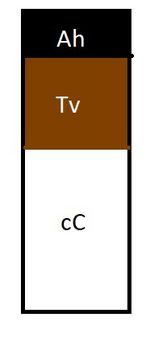
The profile sequence of the terra fusca is Ah/Tv/cC (Eckelmann et al., 2005).
The Ah horizon forms the mineral topsoil horizon. This has a higher humus content than that of the Terra rossa soils, but never more than 30 % of the total mass.
The Tv horizon refers to the subsoil, which can be up to several decimetres thick. This consists of the solution residues of the carbonate-containing parent rock. These solution residues consist of more than 65 % clay, such as the clay minerals illite and kaolinite. The lime is completely washed out. The bright yellowish to reddish-brown colour of the horizon is the result of browning processes (see above). Furthermore, the Tv horizon has a pronounced polyhedral structure and a low pH value. The "v" in the Tv horizon stands for the browning process.
As with the Terra rossa soil, the underlying cC hor izon consists of slightly weathered limestone or dolomite with a carbonate content of at least 75 %. The "c" in the cC horizon of Terra fusca also stands for carbonate. (Amelung et al., Scheffer/Schachtschnabel, 2018).
Leptosols
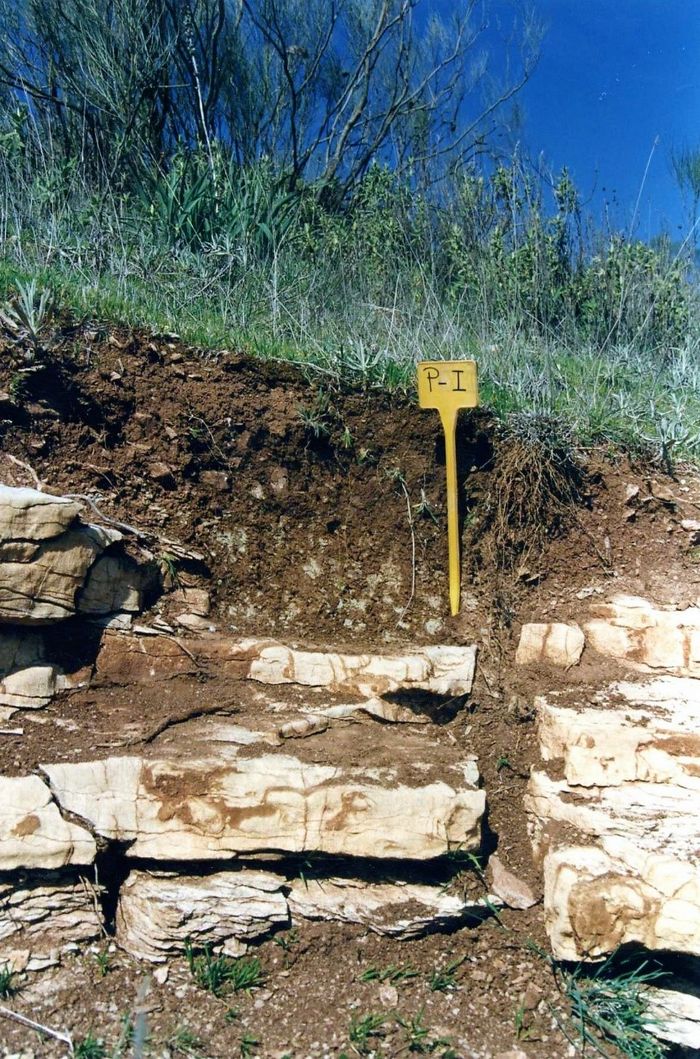
Leptosols are described as very shallow or skeleton-rich soils with less than 20 % fine soil content. These include the two soil types Rendzinen and Ranker. They are often found on shallow hilltops. Rendzines usually only have a thin Ah horizon followed by a lime-rich C horizon. Rankers also have a thin humus-rich Ah horizon, but on siliceous parent rock (Amelung et al., Scheffer/Schachtschnabel, 2018).
Utilisation of soils
The density of the terra fusca soils, caused by the high clay content, makes it difficult to work the soil agriculturally. Added to this is the susceptibility to erosion, especially when wet.
In addition, the soil is often located on shallow terrain, such as hilltops. The stone-rich Rendzina topsoil makes cultivation even more difficult. For this reason, sites on terra fusca are often used for forestry or as pastureland Terra rossa, on the other hand, is well suited for agriculture due to its earthy loam structure. Although the surface often dries out during the summer, the deep clay horizon means that sufficient water is retained even during temporary periods of drought (Skowronek, 2016).
The limiting location factor in the Mediterranean region is the water retention capacity of the soil: if it is high, good harvests can be achieved. In contrast, only deep-rooted permanent crops such as olives, almonds, figs or vines can be grown on more permeable soils with a lower water retention capacity.
Due to deforestation in the Mediterranean region, which was carried out on a large scale early on, shallow, dry leptosols remain. These can only be used as extensive pastures for livestock.
Degradation of Mediterranean soils
Soils in the Mediterranean region are endangered by various causes. In addition to ongoing climate change, overgrazing and deforestation, these include the intensification of arable farming. Intensive arable farming, for example through the use of heavy machinery, leads to additional soil compaction, especially in the clay-rich soils terra rossa and terra fusca. This can increase susceptibility to erosion, for example during heavy rainfall events, which will continue to increase as a result of climate change. But the soil structure can also be changed, which in turn can affect the water retention capacity. Excessive grazing or deforestation thins out the protective vegetation cover and exposes the soil to erosion by wind or water. In addition, the organic content of the topsoil decreases due to the lack of litter (EEA, 1998). As the humus content is generally already low in terra fusca and very low in terra rossa in particular, this can seriously jeopardise the fertility of the soil. The stresses on the soil also lead to internal soil degradation, such as the destruction of the edaphon or changes in the pH value. Furthermore, nutrient depletion can occur due to the lack of litter input (Amelung et al., Scheffer/Schachtschnabel, 2018).
Due to all these forms of degradation and additional land sealing through urbanisation, around 8.3 million hectares of arable land have already been lost in the Mediterranean region between 1961 and 2020 (Zdruli, 2014), according to the EU Commission, which refers to a study by Zdruli in 2014 (European Commission, 2014). Unfortunately, large areas are expected to be added in the future. The pressure on land not yet used for agriculture or development is therefore likely to increase. This could jeopardise the relatively high biodiversity of wild plants still present on Giglio and throughout the Mediterranean.
Bibliography
Ahabc.de - The magazine for soil and garden: Terra rossa. At: www.ahabc.de/bodentypen/klasse-typen-oder-bodensystematische-einheiten/bodentyp-terra-rossa/ (Last accessed on 04.11.2020)
Ahabc.de - The magazine for soil and garden: Terra fusca. At: www.ahabc.de/bodentypen/klasse-typen-oder-bodensystematische-einheiten/bodentyp-terra-fusca/ (last accessed on 04.11.2020)
Amelung, W. et al. (2018), Scheffer/Schachtschabel Textbook of Soil Science, Berlin, Heidelberg: Springer Berlin Heidelberg
Aydinalp, C. and Fitz Patrick, E. A. (2009), Pedogenesis and characteristics of the Terra rossas developed on different physiographic position and their classification, Agrociencia, 43(2), pp. 97-105.
Eckelmann, W. et al. (2005), Soil science mapping guide. KA5. Ad hoc working group on soil. Hanover: Federal Institute for Geosciences and Natural Resources
EEA (1997), The environment in Europe : the second status report, Report, (Chapter 11)
European Commission (2014), Mediterranean land degradation threatens food security, Science for Environment Policy, Issue 391
Geografie Diplom, Bodenkunde-Bodengeographie, Die Böden der winterfeuchten Subtropen, insbesondere die Böden des Mediterranranraums: Terra Rossa und Terra fusca Unter: www.geographie-diplom.de/Texte/Physisch/boden5.htm, (Last accessed on 04.11.2020)
Lucke, B. et al. (2014), Red mediterranean soils in jordan: New insights into their origin, genesis, and role as environmental archives, Catena. Elsevier B.V., 112, pp. 4-24
Skowronek, A. (2016), Terrae calcis, Handbook of Soil Science, pp. 1-38.
Zdruli, P. (2014), Land resources of the mediterranean: status, pressures, trends and impacts on future regional development, Land degradation & development, V.25, No. 4 , pp. 373-384