
Microplastics in marine ecosystems
Contact person
Dr Barbara Scholz-Böttcher
Research Group: Organic Geochemistry
Phone: +49-441 798-5362
Fax: +49-441 798-3404
Microplastics in marine ecosystems
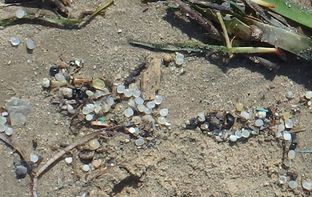
Over the last 60 years, the production and use of plastics of all kinds has increased significantly. This has led to a steep and continuous increase in plastic waste, which accumulates in the environment and ultimately also in the oceans. Physical, chemical and biological degradation and comminution processes lead to a constant decrease in particle size with a simultaneous increase in the number of particles. Particles smaller than 5 mm are referred to as microplastics. Technically utilised plastic particles that are produced in very small sizes from the outset are referred to as primary microplastics and those that are produced through fragmentation are referred to as secondary microplastics.
Microplastics are now ubiquitous, persistent and are increasingly accumulating in all environmental compartments. In addition to the microplastic particles already mentioned, tyre abrasion and particles from paints whose binders are plastics also play a significant role. The possible release of additives, which are always added to plastics, albeit in varying quantities, into the environment (leaching) and the interaction of microplastics with environmental pollutants are further relevant factors. The increasing bioavailability of microplastics and associated pollutants with decreasing particle size harbours potential risks that are increasingly coming to the attention of the public. In contrast, the effects of these plastic particles on marine and terrestrial ecosystems and their exact distribution are still largely unknown and the subject of current research
In our working group, we have established a new, sensitive pyrolysis-gas chromatography-mass spectrometry method (Py-GC/MS). It can be used to identify and reliably quantify the vast majority of typical plastic types, which currently account for well over 80 % of annual plastic production. The mass concentrations of the individual polymer types are determined. The method is complementary to the spectroscopic methods widely used in microplastic analysis (e.g. infrared and Raman spectroscopy), which focus on determining the number, size and type of particles. While mass concentrations provide important information about the distribution of MP within the environment, which enables a comparison of data between different sample types on a spatial and temporal scale, particle-related investigations are highly relevant from an ecotoxicological point of view. Accordingly, numerous co-operation projects aim to create and interpret complementary data sets. A wide variety of environmental compartments have already been successfully analysed for MP using Py-GC/MS. These include biota (fish, mussels), sediments, water, air, road dust and sea salts. The behaviour of various additives that enter the water from the plastic and subsequently interact with surfaces and organisms is also being investigated.