Education


Education
Research diver training at the ICBM

Training companies in Germany
There are seven DGUV-approved training centres in Germany. In addition to the ICBM as the only training centre in Lower Saxony, the universities of Rostock, Kiel and Munich, the AWI on Helgoland and the ZMT in Bremen as well as an archaeological research company in Constance (Archaeotask) offer this intensive training.
Training at the ICBM in Oldenburg
The training to become a research diver is organised annually and also earns credit points in the form of three modules
An information event (online) takes place at the beginning of October. Following this, all interested parties must register and take part in a trial training session (approx. 45 minutes of swimming and snorkelling in the university swimming pool).
A maximum of 16 participants will then be selected to take part in the "Research Diver Training I" event. Preference will be given to students and employees of the University of Oldenburg, mainly from the field-researching natural science degree programmes or Institutes.
The training programme lasts two semesters. The programme concludes with an examination before the DGUV's examination committee for research divers.
History
The ICBM has been an official training centre since 1999 - 272 students and scientists have been successfully trained in 26 courses to date. Many of the research divers trained and certified in Oldenburg have been able to use their qualification for various theses or temporary jobs or projects and in some cases for permanent positions.
Training programme
Workshop ‘Research Diver Training I’, max. 16 participants (Module: mar466, KP6)
Running throughout the semester: weekly swimming and snorkelling training at the University of Oldenburg swimming pool, culminating in a practical interim examination which must be passed to continue on the training programme.
First aid course (9 teaching units) integrated into the training (usually in December)
Block (approx. mid-March): eight-day theory seminar
Type of examination: 2-hour written exam
Winter semester ‘Training as a Research Diver I’, max. 16 participants (module: mar466, 6 CP)
Throughout the semester: weekly swimming and snorkelling training at the Oldenburg University swimming pool, culminating in a practical interim examination
First aid course (9 teaching units) integrated into the programme (usually in December)
Block (approx. mid-March): Eight-day theory seminar
Type of examination: 2-hour written exam
End of winter and summer semesters: ‘Research Diver II’ training, max. 12 participants (mar467, 6 CP)
Training on the autonomous light diving apparatus (aLTG)
Block (approx. mid- to late March): 2½-week intensive phase at the university swimming pool using the aLTG
Throughout the summer semester:
regular weekly training sessions at the Oldenburg University swimming pool
Block (late May/early June): five-day intensive phase with the aLTG in open water
Afterwards, alongside the weekly swimming pool training: 4–5 individual sessions (from early/mid-June) until the end of the summer term: one day per week: Diving with aLTG in open water (Wednesday)
Summer term holidays
6 weeks of final training with a concluding external examination over 1½ days (before the DGUV examination committee)
1 week of final training: ‘Marine biology field trip to Gammel Albo, Denmark’ (mar468, 6 CP)
Prerequisites
Study or employment at the University of Oldenburg (practical natural science specialisation). Free places can be allocated to external applicants - however, this has not been possible in recent years due to high demand.
Health certificate confirming suitability for swimming and snorkelling in a swimming pool (not older than 2 years).
German lifeguard badge silver or higher (not older than 10 years. If necessary, this badge can also be completed parallel to the training from October until the end of the year).
Willingness and ability to expose yourself to physically demanding situations in and under water, as well as a certain basic athleticism and the necessary time availability.
Previous diving experience is not necessary, but can't hurt either.
Equipment
Not necessary at the beginning - standard equipment for snorkelling can be rented. Own equipment can be purchased at favourable conditions.
For the "Research Diver Training II" event, each participant needs
-dry suit, if necessary with suitable undergarment
-gloves
-open water fins
All other equipment will be provided.
Costs (as of December 2025)
Costs (as of December 2025)
100,00 € Training for research diver I (to be paid: beginning of November)
Practical training with supervision, rental equipment, first aid course
160,00 € Research diver training II: Intensive phase aLTG in the pool (to be paid: beginning of February)
Practical training with supervision, rental equipment
420.00 € Research diver training II: Open water phase (to be paid: mid-April)
Practical training with supervision, rental equipment, costs for material transport
960.00 € Final training / marine biology field exercise: open water, often in external waters (to be paid: beginning of July)
Practical training with supervision, rental equipment, costs for material transport, accommodation and entrance fees, examination fee (€ 160) for DGUV
Information on the current share price (as at 15 Dec. 2025)
Training 2026 - all 14 places currently occupied!
In mid-October 2025, 14 participants were selected, all of whom are working towards the intermediate examination in January 2026. A maximum of 12 participants will then be able to continue their training.
02-10 March 2026 (+ further individual dates by arrangement)
Theory seminar 08:30 to approx. 18:30
11.-25.03.2026
Intensive phase on autonomous light diving equipment (aLTG) in the university swimming pool on Uhlhornsweg, 08:00-approx. 18:00
VL time summer semester 2026 (09.04.-10.07.2026)
Weekly swimming pool training at the aLTG, ends with a practical examination
Each Thursday or Friday, water time: 14:00-16:00 with approx. 2 hours preparation and follow-up time each
01-05.06.2026, 08:00-ca. 18:00 Intensive phase in open water (Kleiner Bornhorster Lake, Oldenburg)
12.08.-05.10.2026 Final training 2026
12-21.08.26 (Wed-Fri, Mon-Fri): Banter Lake, Wilhelmshaven & Zetel (Overnight stay at a diving club in WHV)
24-28.08.26 (Mon-Fri): Small Bornhorst Lake (on site by the day)
29.08.-06.09.26 free
07-11.09.26 (Mon-Fri) Small Bornhorst Lake
13-19.09.26 (Sun-Sat) Marine biology excursion to Gammel AlboDenmark
21-25.09.26 (Mon-Fri) Small Bornhorst Lake/Kreidesee Hemmoor (deep Tg)
28 - 01.10.26 (Mon, Tue): dress rehearsal university pool & open water, (Wed/Thu): Examinations before the DGUV examination committee
05.10.26 (Mon): Tidying up at the Kleiner Bornhorst Lake
Information on the next course (as of 15.12.2025)
Information about the next course
Training 2026–2027
Introductory meeting via online video conference on 8 October 2026, 6.00 pm – approx. 7.30 pm
Registration by approx. 14 October 2026
Trial session (approx. 45 mins) Thu or Fri 15/16 October 2026, 14:00–16:00
A maximum of 16 places will be allocated by 19 October 2029; thereafter:
Regular swimming and snorkelling sessions 22 October 2026–19 January 2027, Thursdays or Fridays 14:00–16:00 (in the water)
Plus one evening by arrangement as an online meeting (Wed 18:30–approx. 20:30): preliminary discussion of the training content (until approx. the end of November 2026)
In January 2027: Interim assessment (swimming and snorkelling skills in the swimming pool)
End of February 2027: Allocation of up to 12 places in the aLTGtraining course
Expected dates: 1–9 March 27: Theory seminar, full-day
10–24 March 2027 (2.5 weeks): Intensive phase at aLTG at the university swimming pool
From 8 April to 9 July 2027: Summer semester 2027
Regularly. Swimming training on aLTG (Thu or Fri, 14:00–16:00 in the water, with approx. 2 hours of preparation and follow-up each time)
31 May–4 June 2027: 1-week intensive phase aLTG in open water
June until the end of the VL period: one day a week with aLTG in open water (Wednesdays)
Final training: mid-August – early October 2027 (including a one-week break)
Training 2023
All 12 participants successfully completed the 2023 final training programme and passed the examination before the DGUV examination committee with good to very good results. Congratulations to them!
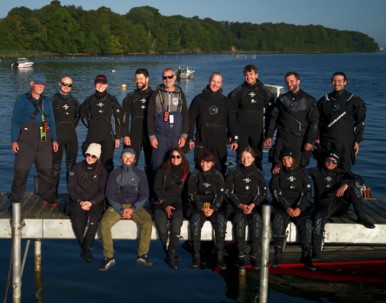
Final training 2023: Participants and supervisors in Denmark (Photo: Svenja Steidl)
Training 2024
All 11 participants successfully completed the 2024 final training programme and passed the examination before the DGUV examination committee with good to very good results. Congratulations to them!

Final training 2024: Participants, supervisors and examiners at Kleiner Bornhorster See (Photo: Katja Fiegener)

