

The Benthal
The Benthal
The structure of the benthic zone is much more complex than that of the pelagic zone. A basic distinction is made between hard bottoms and sedimentary bottoms. 88 % of the Mediterranean seabed is covered by sedimentary bottoms. This corresponds to an area of approximately 2.4 million square kilometres. In addition, rocky soils and mixed soils also occur as transitional areas between the aforementioned forms.
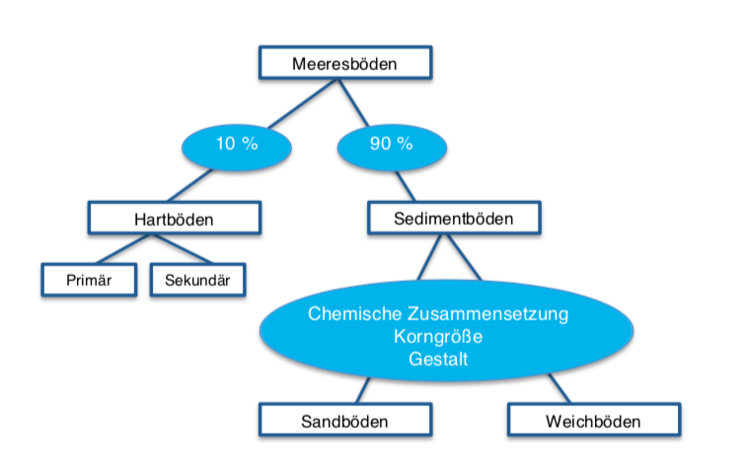
The different characteristics of the benthic habitats, in combination with different biotic and abiotic factors such as light, water movement and vegetation, result in a very high diversity of species.
The diversity of benthic habitats ranges from primary and secondary hard bottoms to sediment bottoms of different grain sizes with the associated gaps and seagrass meadows.
Substrates with a high degree of stability, which are therefore less affected by sedimentation, offer a stable and long-lived habitat for sessile or hemisessile flora and fauna organisms, which is why biodiversity is very high on hard substrates, for example. Sand or gravel bottoms are much more exposed to hydrodynamic conditions (currents, waves, tides) and are less stable. Here, biodiversity is expressed by a diverse endofauna, particularly small, specialised species or other adaptations such as camouflage.