

Hard floor
Abiotic factors and zonation of the hard soil benthos
The most important abiotic factors that lead to zonation are
- Immersion time
- Salinity
- Exposure to light
- Temperature fluctuations
- Wave action/currents
The most important groups of phytobenthos on hard substrates are
- Cyanobacteria
- Red algae (Rhodophyta)
- Green algae (Chlorophyta)
- Diatoms (Bacillariophyceae)
- Brown algae (Phaephyceae)
Hard floor
The hard-bottom benthic community develops on bedrock and boulder fields.
In the Mediterranean, for example, granite, chalk, sandstone and limestone coasts can be found.
Primary substrates include hard substrates such as rocks or boulder fields that are not covered by sediment. Typical rocky habitats are rocky coasts or steep slopes in deeper water.
Secondary or biogenic substrates describe hard substrates made of lime, which are formed by red algae (coralline/red algae). These three-dimensional structures are extremely complex and offer a variety of surfaces and gaps.
Benthic life forms
Benthic organisms can be categorised trophically and functionally as phytobenthos, zoobenthos and bacteriobenthos or, based on their size, as macro- (> 1 mm), meio- (0.1-1 mm) or
microbenthos (< 0.1 mm).
In addition, vagile, sessile, fixo and hemisessile life forms can be distinguished from each other.
The life cycle or the degree of attachment to the substrate can also be described e.g. as a heli-, mero- or holobenthic life cycle .
The spatial relationship to the substrate can be epi-, meio-, meso-, endo- or hypobenthic .
Vagile: Free-moving, mobile
Sessile: Sedentary, immobile
Fixosessile: Fixed organisms that can never change their location
Hemisessile: Sedentary organisms that can change their location
Heli-: Partial
Mero-: Temporary, only in one life phase
Holo-: Completely
Epi-: living on the substrate/on other animals and plants
Meio-/Meso-: living between the particles of the substrate
Endo-: living in the substrate
Hypo-: living in cavities on the underside of stones/shells
Zonation of the littoral
Contrary to its general definition as an intertidal zone, the Mediterranean littoral is more of a surf zone. Here the abiotic conditions change much more vertically than horizontally. The diverse subdivision of the hard-bottom benthos, together with the stability of the substrate, results in a great diversity of species. In general, the proportion of hard substrate decreases with water depth due to a lack of wave energy and sedimentation processes.
With increasing depth, the wave effect, water temperature, light intensity and the risk of drying out decrease, whereas the water pressure increases. The spectral composition of the light, the vertical and horizontal components of the water movement influenced by wave action and grain size also change, with the latter generally decreasing with increasing depth.
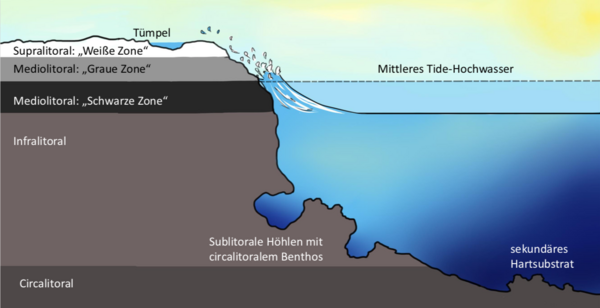
Supralittoral
The uppermost zone of the littoral is usually only reached by spray water and lies above the average highest water level. It is often referred to as the white zone due to the pronounced occurrence of halophytes. The organisms in this zone are mostly air-exposed, with halophilous, terretric animals and plants dominating in the already less species-rich communities of this zone. Species richness is rather low compared to other zones of the littoral. The pools of the supralittoral are strongly influenced by rainwater, which sweetens the water, whereas evaporation increases the salt content here immensely.
Mediolittoral
As a zone of blue and green algae, the grey zone adjoins the white zone seaward. It regularly receives spray water and, together with the black zone, forms the mediolittoral. The organisms in this zone are immersion-tolerant (lat. immergere = "to immerse"), but cannot tolerate either prolonged drought or prolonged flooding. As a zone between high and low tide, the upper mediolittoral is only moistened by waves and rarely flooded, while the lower mediolittoral is exposed to frequent but not prolonged flooding.
Infralittoral
The strong light zone or infralittoral (upper sublittoral) is always covered by water. The existence of (macro)algae, especially Phaeophyceae and Chlorophyceae, and sea grasses is possible there. The algal phytoplankton is comparable to terrestrial shrub vegetation on land and can be divided into four layers: The base is formed by the crust and cushion layer, sometimes several centimetres thick, which forms a secondary (biogenic) hard substrate (mainly from the calcareous red algae) on the primary rock substrate. The subsequent turf layer consists of small-growing species. A typical representative is the red alga Jania rubens, which also occurs as an epiphyte on the brown algae of the high shrub layer. The lower shrub layer is characterised by shorter fleshy algae with a large proportion of different red algae. Brown algae form the high shrub layer of the algal phytolayer of the infralittoral.
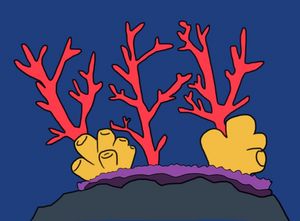
Circalittoral
In the following low-light zone (Circalitoral), species such as corals and sponges tend to dominate, as algae are less competitive here. The so-called coralligéne can be found on bedrock of darker depths, but also on shaded steep walls, overhangs and crevices in the shallow areas of the Circalitoral. It describes a secondary, biognenic hard bottom, which is formed from hard-growing (incrusting) red calcareous algae. This creates extensive bioconstructions. There are both coralligène on hard bottoms and platform coralligène on sediment substrates. Typically, a high layer of gorgonians (red), a middle layer of bryozoan colonies and sponges (yellow), a "living" crust with living red coralline algae (purple) and a "dead" crust of dead red coralline algae (black) are formed.
In the circalittoral, algae occur that can survive with little light and an altered light quality. As the lower occurrence limit of marine macrophytes is limited by the light supply, the transition from the infralittoral to the circalittoral is marked by the occurrence of particularly adapted macrophyte species. These include mainly red algae and some highly specialised green algae, which have an extremely high chlorophyll content (black absorbers). In addition to the Coralligène, caves of various types and offshore rock communities can be found on the hard bottoms of the Circalitoral.
Special abiotic relationships in hard-bottom benthos
In addition to abiotic factors, biotic interactions are also decisive for species composition in the colonisation of the littoral.
Competition
Space is a limiting resource in hard-bottom benthos. Sessile, colonial life forms, which can quickly colonise free substrate through asexual reproduction or overgrow other individuals (interference competition), prove to be particularly competitive. Territoriality can be seen here as an extreme form of interference competition, e.g. in some limpets that defend their territory.
In addition to the substrate, access to food is also a limiting resource. Filter feeders are dependent on a certain volume of water per unit of time, while grazers require a minimal food area.
Symbiosis
The forms of association of epi- and endobiosis are widespread in hard-bottom benthos. Endosymbiotic algae (zoochlorellae and xanthellae, which colonise protozoa, hydrozoa, sponges, corals or giant clams) are examples of this.
Predator-prey relationship
The most important herbivores of hard-bottom benthos include beetle snails, slugs, small crustaceans and sea urchins. Widespread protective mechanisms against predation are e.g. calcareous incrustation or secondary plant substances.
The most important carnivores include sea anemones, predatory planarians and snails, octopods, crabs, starfish and fish. Their prey has protective mechanisms of camouflage, armour, hiding and poison. The latter is also a strategy for acquiring food.