Subject-specific consultation (FK)

contact

Clinical Training Centre

V02 – 1st and 2nd floors

by appointment


Simulation Patient Programme

V02 – 1st and 2nd floors

by arrangement

Your points of contact

Medical Director, KTZ:

Dr Katrin Wüstenbecker, MD


Head of the Simulation Patient Programme:

Ulf Goerges

We’re also on social media

ktz_uol

Subject-specific consultation (FK)

Content, structure and objectives

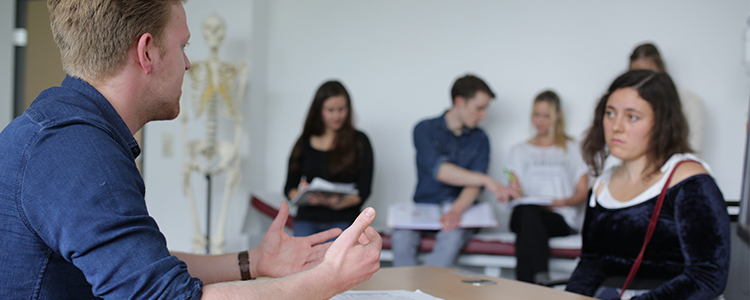
Here, the students conduct a full consultation (including a physical examination) with a simulation patient.

One student takes on the role of the doctor, whilst the other students and the tutor act as observers and provide feedback on the consultation.

The clinical case is then discussed in more detail as a group.

This session is specifically designed to practise ‘clinical reasoning’ using the case study in question as an example.

The practical content listed is based on previous experience. Lecturers reserve the right to make changes to the content at any time.

Learning outcomes and course content can be found in the module handbook, which is provided to you by the teaching co-ordination team at the start of each academic year.

Overview of Teaching Format: Subject-Specific Consultation

General information

Years of study3–5
Group size15 students
Teaching formatSeminar / Subject-specific study group
ObjectivesIn-depth analysis of clinical patient cases in the context of the patient consultation, taking into account all phases of a patient consultation.
Format and procedure
  • In-depth and practical analysis of clinical patient cases through the conduct of patient consultations with a simulation actor playing the patient’s role:
  • one student at a time conducts a consultation
  • the other students are divided into two groups: one group focuses on the medical content of the consultation, whilst the other group concentrates on the communicative aspects of the consultation
  • It is decided in advance which skills the consultation should focus on (feedback is provided specifically on these points)
  • The cases are discussed one after the other: following each case, there is a reflection and feedback session on the clinical consultation that took place. After feedback has been given by and to the role-play actor, the students provide each other with feedback from the perspective of observers; where necessary, any questions regarding the content should be clarified.
  • Subsequently, the theoretical underpinnings of the specific case are discussed and critically reflected upon.
  • The aim of the ‘Subject-Specific Consultation’ is to bring students as close as possible to their future professional practice.
This means, therefore, that they are expected to conduct their medical history interviews ALONE and WITHOUT outside assistance. During the medical history interview, they are expected to arrive independently at a diagnosis, and where appropriate, at differential diagnoses and a sensible treatment proposal.
The following structure should be followed:
  • The student conducts the medical history interview with the simulation patient ALONE, without external assistance, until the interview concludes with the patient’s departure.
  • The group observes the interviews with varying points of focus:
  • Clinical aspects
  • Conversational skills
  • Feedback session:
  • Feedback from the person who conducted the consultation.
  • Feedback from the simulation participant
  • Feedback from the group
  • Feedback from the lecturer
This standardised didactic and methodological approach across all subject-specific consultation sessions is intended to contribute to the greatest possible learning success for students.

The students’ tasks

PreparationTheoretical preparation based on the Heidelberg Standard Examination
During the sessionActive practice

The lecturers’ tasks

Preparation
  • Familiarisation with the cases for the session
  • Brief coordination with the simulation participant
  • Coordinating the material with the KTZ team
During the session
  • Observation of the patient consultation and feedback to the student(s)
  • Facilitating peer feedback (supplementing the feedback provided where necessary)
  • Discussion of the content of the cases
(Changed: 10 Aug 2026)  Kurz-URL:Shortlink: https://uol.de/p120657en
Zum Seitananfang scrollen Scroll to the top of the page

This page contains automatically translated content.