For students

Feedback

If you have had a look around these pages, we would be delighted to receive your feedback! Click here for our short survey.
For students
If you have questions about OER and would like to ask them in person, why not drop by the OER regulars' table?
You'll find initial answers about OER on this page.
Have fun browsing!
Basic knowledge
What are OER?
Open Educational Resources(OER) are educational materials that are freely available, in particular free of charge. They can have a wide variety of different formats, such as videos, texts, presentations or entire courses. The materials are published under open licences so that they can be used, adapted and passed on by anyone.
This is a good introduction to the topic of OER, with lots of detailed information on OER creation, use, licensing, etc:
How do I cite OER? The TULLU(-B) rule
If OER are used or adapted for your own materials, the sources must be cited correctly. But how?
The TULLU rule, or the TULLU-B rule, as described by twillo at https://www.twillo.de/oer/web/oer-nutzen-und-erstellen/ in step 2: "Integrating openly licenced materials from other authors", can help here.
TULLU (-B) is an acronym and stands for:
| T-title: | enter the title, exactly as the originators did |
| U-originators: | indicate who created the material |
| L-Licence: | indicate the licence under which this material is available |
| L-Licence text: | indicate the exact licence text for this licence by link (in the version of the "Legal Code", see here") |
| U-Origin: | give the link where exactly you found the original material |
| B-editing: | If applicable, indicate whether and which edits have been made to a material |
You can decide for yourself where to place the information - directly at the point where you use third-party material (e.g. if you have inserted an image) or collectively, e.g. at the beginning or end of your new material (similar to a source reference).
Explanatory video on the TULLU rule (duration: > 1 min.)
Source: "How do I recognise other people's OER in my material?" by Ly Lutter for twillo, CC BY-ND 4.0.
The source above shows how the TULLU (-B) rule was applied to the video:
Title - How do I acknowledge others' OER in my material?
Originator - Ly Lutter for twillo
Licence - CC BY-ND 4.0
Licence text - https://creativecommons.org/licenses/by-nd/4.0/legalcode.de
Origin - https://av.tib.eu/media/62511
(Since the licence contains the "ND" (= No Derivatives = no editing) component, no changes may be made).
How you compile this information is up to you - as a table, in list form, as text, etc. - as long as the information is clear and easy to find in your material.
If users do not have the opportunity to click on the short links provided, the links are also written out: "How do I make others' OER recognisable in my material?"(https://av.tib.eu/media/62511) by Ly Lutter for twillo, CC BY-ND 4.0(https://creativecommons.org/licenses/by-nd/4.0/legalcode.de).
If you have any questions about the TULLU rule, please come along to a Stammtisch meeting or ask your question via Mattermost.
What are CC licences?
The CC licences by Matthias Tams and Christoph Benedikt Heine from the orca.nrw project, licensed under CC BY-SA 4.0
OER for students
In the following we would like to introduce you to some OER that were created at the University of Oldenburg & could be useful for you.
Support for teaching in inclusive settings: "Action strategies for heterogeneous classes - OER for teacher training"
For a taster - directly to a selected material:
 | About having and needing. A podcast from the "Learner needs" package |
 | Feedback - supporting learning constructively. A presentation video from the "Inclusive education" package |
 | What is Classroom Management? (Part 1 of 2). A screencast from the "Good teaching" package. |
What is it about?
Inclusion and heterogeneity of learning groups is a topic that is relevant in all teaching degree programmes. The project "Action strategies for heterogeneous classes - OER for teacher training" has taken this as an opportunity to create videos, podcasts and texts in the format "Open Educational Resources" (OER) so that (future) teachers can better qualify themselves and face the topics of "heterogeneous learning groups" and "inclusive education" more calmly. The materials focus on the quality of teaching, the possibilities of inclusive lesson design and school development as well as the special needs of learners. Impairments in the areas of learning and social-emotional development are also taken into account.
The materials were awarded "OER of the Month" (Feb. 2023) by twillo.de.
How can the OER be used?
The project has developed scientifically based videos, podcasts and texts ("products") on various topics ("packages"). Originally, they were intended to support university teachers in discussing how to deal successfully with the complexity of teaching in an interdisciplinary way with prospective teachers.
Further possible applications have emerged in the course of the project progression, including
- As self-study material for teachers both during their studies and in school practice
- For use in subject and school conferences as impulse materials in the context of inclusive school development
- As information material for school authorities to pass on to interested schools
Where to find?
All materials can be found in a collection with 3 sub-collections on twillo.de under this link.
Project name
Action strategies for heterogeneous classes - OER for teacher training. Licensed under CC BY 4.0.
Contact - Clemens Hillenbrand /
Project website - uol.de/oer-lkb
Project duration - 01.01.2021 - 31.10.2022
OER in the "Methods file: Teaching methods from A to Z"
For a taster - directly to selected material:
| |
 |
What is it about?
The method file is an extensive collection of different teaching methods that can be used in pre-school education, in a school context and in adult education. The methods can support teachers in preparing lessons . There are also options for differentiating and varying the methods.
The site also contains student-created OER that have been developed as part of courses focusing on education, training and socialisation .
How can the OER be used?
The OER can be used in a variety of ways in the classroom and beyond. The content is particularly, but not exclusively, relevant for teachers and student teachers . For example, the radio plays invite you to take a closer look at multilingualism, language situations and basic concepts of (political) education. The existing content can also serve as inspiration and help you to create and develop your own works .
Where to find them?
All OER materials are available on the Methodology Catalogue website.
Project name:
Methodenkartei - a co-operation project at the Universities of Oldenburg and Vechta.
Contact -
Project website - www.methodenkartei.uni-oldenburg.de
Project duration - since 2016 (open-ended)
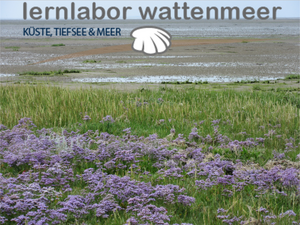
Wadden Sea Learning Lab
OER collection by Anja Wübben
Take a look - directly to selected material:
What is it about?
This collection contains learning materials on the topics of the Wadden Sea habitat , coast and ocean. They are mainly 90-minute teaching units with illustrative small experiments, digital learning components and elements of education for sustainable development (ESD).
The collection is still under construction and new topics are regularly selected in consultation with scientists from the University of Oldenburg, prepared as learning units for school lessons and tested and optimised in cooperation with various schools in the region.
Topics include
- Noise in the North Sea - suffering for harbour porpoises (The materials were developed by twillo.de as "OER of the month").
- Microplastics in the sea - formation and distribution
- Phytoplankton - Small but mighty
- Fishing in the North Sea - and its dangers
- North Sea coastal salt marshes
- Oil pollution in the Wadden Sea
- Ocean acidification
- The freshwater lens
- Light pollution in coastal areas
How can the OER be used?
The learning units (or individual modules) can be easily integrated into science lessons in schools or in environmental education at extracurricular learning centres , as in addition to exercise booklets , their sample solutions, the technical background as a factual analysis, complete material lists for the experiments and tabular lesson plans including possible lesson discussions are provided.
The teaching units were developed under the guidance of Anja Wübben for participate@UOL in the "Lernlabor Wattenmeer"(http://www.lernlabor-wattenmeer.de/) together with students in various biology didactics seminars, tested several times in practice with pupils and optimised.
Where to find:
All materials can be found in a collection with several sub-collections at twillo.de under this link.
Project - OER for teacher training from the "Lernlabor Wattenmeer".
Contact - Anja Wübben
Lernlabor Wattenmeer website - www.lernlabor-wattenmeer.de
Teaching-learning platform school
For a taster - directly to a selected material:
 | |
 | |
 | Teaching-learning platform school
|
What is it about?
The Teaching and Learning Platform School is a platform for Open Educational Resources (OER) related to schools. Using a filter, the available OER can be selected according to target group (teachers, pupils, teachers, student teachers), school subject and product type (guidelines, podcasts, videos, self-learning concepts, experiments, worksheets).
The platform was developed as part of the OLE+ project of the Teacher Education Quality Initiative and is maintained by the office of the Centre for Teacher Education - Didactic Centre. The submitted materials were developed as part of various projects and study modules and are subject to quality management. The platform is open for further OER.
How can the OER be used?
The OER can be used in a variety of ways in different subjects, during studies, during teacher training and by teachers at school. Pupils can use them for self-study. The thematic content and product types (guidelines, podcasts, videos, self-learning concepts, experiments, worksheets, etc.) are broadly based.
Where can I find them?
All OER materials are available on the Teaching-Learning Platform School website.
Project name
Lehr-Lern-Plattform Schule der University of Oldenburg
Contact -
Website - uol.de/lehr-lern-plattform-schule
Learning snacks around OER creation
For a taster - directly to a selected material:
 | Using images & texts in a legally compliant way (OER). A learning snack about legally compliant re-use. |
What is it about?
Learning Snacks are "knowledge snacks" that impart knowledge in small portions in a playful way via a chat format. The following self-learning modules were developed for a course in teacher training to support students in creating their own OER . The Learning Snacks provide a quick overview of the use and creation of OER.
How can the OER be used?
The Learning Snacks can be used to support the creation and quality control of OER.
Where to find them?
Anja's Learning Snacks on the pages of https://www.learningsnacks.de. These OER are licenced under CC BY-SA 4.0.
If you have any further ideas or suggestions for improvement, please do not hesitate to contact us for re-registering students:
Thermodynamics in the Bachelor's degree programme in Chemistry
The materials consist of 2 sub-collections. The first sub-collection contains lecture videos on thermodynamics and the second sub-collection consists of instructional videos on the thermodynamics practical course.
To get a taste of the lecture:
 |
To familiarise yourself with the instructions for the practical course:
 |
What is it about?
Even before the coronavirus, the thermodynamics required for studying chemistry was broken down into small, easily digestible morsels. This resulted in the sub-collection lecture. And in preparation for the thermodynamics practical course, a series of videos were created to prepare students for the experiments and explain some of the techniques used in the practical course.
Both are available to students as a supplement to the regular lecture or as preparation for the practical course.
How can the OER be used?
The videos can be used for support and as self-study material during your studies. They are available under the licence CC BY-SA 4.0.
Where can I find them?
The materials on thermodynamics can be found on twillo.de under this link.
Contact - ,
Website - https://uol.de/en/chemistry/physical-chemistry-al-shamery
Learning map with self-learning materials for Office applications by W. Müskens
- by Dr Wolfgang Müskens for participate@UOL
- licenced under CC BY 4.0
- published in December 2023
Click here to view the learning map
Description:
Are you actually familiar with the software you have to use during your studies?
This learning map provides an overview of helpful self-study materials that explain how to use Office software during your studies. The linked resources contain introductions as well as useful tips and tricks for the following programmes: Word, Excel, LaTeX, PowerPoint and Citavi. Navigate through the map and select the topics that interest you.
Note: The software names mentioned in this learning map may be subject to trademark, brand or patent protection even without special labelling.
Target group:
First-year students and all other interested parties
Language:
German
Credits - we appreciate the use of this OER with the following information:
Learning map Office applications by W. Müskens for participate@UOL, licenced under CC BY 4.0.
For subsequent users:
All files of the OER as download (in the ZIP folder)
"Game-based learning and virtual reality medicine and natural sciences" - a padlet compilation of freely available offers for use in teaching by Susanne Quintes
- by Dr Susanne Ouintes for participate@UOL
- licenced under CC BY 4.0 - all templates, graphics or other elements created by Padlet itself are excluded from the licence.
- published in March 2024
Description:
This padlet provides an overview of teaching and learning offers that prepare and convey content with game elements (also known as game-based learning or edutainment). The focus is on free offers that are as freely accessible as possible and can be easily integrated into your own teaching.
Target group:
Teachers and students as well as all other interested parties
Language:
German
Credits - we appreciate the use of this padlet under the following credits:
"Game-based Learning and Virtual Reality Medicine and Natural Sciences" by Susanne Quintes, licensed under CC BY 4.0 - all templates, graphics or other elements created by the padlet itself are excluded from the licence.