Michael Hölling
Michael Hölling
Generating turbulent wind fields in the large wind tunnel
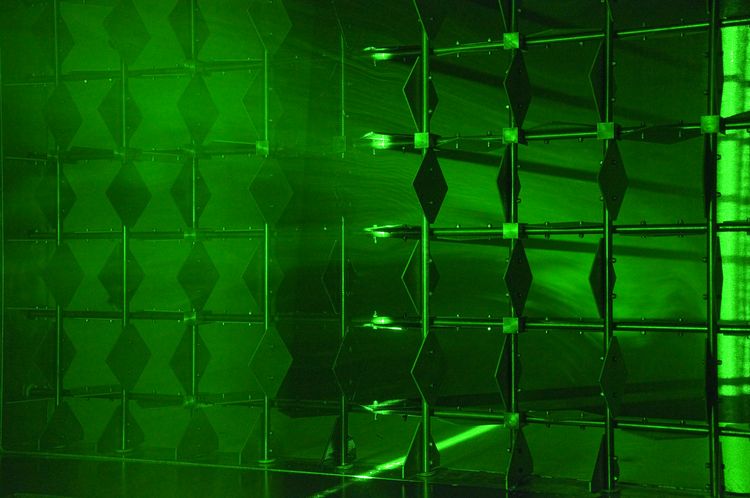
With a special active grid, a variety of different turbulent wind fields can be generated in the large Oldenburg wind tunnel. A total of almost 1,000 rhombic aluminum wings are mounted on 80 individually controllable shafts. This allows to block limited areas of the wind tunnel nozzle and to generate turbulence. Due to the aluminum frame construction, the 3 x 3-meter grid can be easily installed and removed in the wind tunnel. The combination of an active grid with a wind tunnel of this size makes the ForWind tunnel unique. With this grid, ForWind scientists can scale down features from complex atmospheric wind fields to the dimensions of the wind tunnel, thus reproducing characteristic properties of a real wind field in the wind tunnel, such as different types of turbulent inflows, shear and wind gusts. Their aim is to better understand turbulent flows and their effects on wind turbine components. In addition, they develop and test novel control concepts to better compensate for turbulence effects.
Optimisation of wind farms: wind tunnel experiments with model wind turbines
By 2030, 15GW are to be provided by offshore wind energy in the North and Baltic Seas.
Fossil fuels are to be increasingly replaced by renewable energies.
Wind energy plays a major role in this transition. Due to various economic and ecological factors, wind turbines are being installed in wind farms. These are increasingly being erected offshore. The need for reliable forecasts of wind behaviour and wind fluctuations is still very high, as the prevailing wind is the source of energy, but also a source of increased loads on wind turbines at the same time. Understanding the behaviour of the wind (e.g. direction and speed) within a wind farm is essential in order to use the available energy efficiently and at the same time avoid turbine failures. The predictions are usually made using numerical simulations which, due to the complexity of the flow, attempt to describe various situations in the wind farm using simplified models.
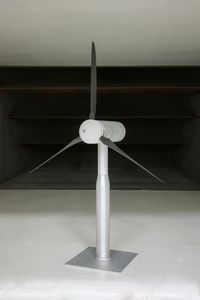
These models have to be checked, which is technically difficult and very expensive in open field tests in the wind farm, as it is not possible to set the inflow conditions and measure all parameters. For this reason, wind tunnel experiments with model wind turbines are carried out at the University of Oldenburg. In the wind tunnel, defined flow situations can be carried out under reproducible conditions, which offers very flexible and cost-effective opportunities to gain a deeper understanding and thus enable the improvement of numerical models and ultimately of real wind farms.
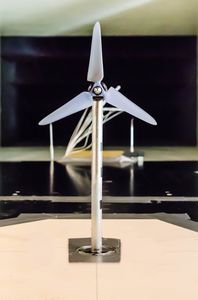
The focus here is on the influence of turbulent inflow on the behaviour of the output of wind turbines and their wake. The model wind turbines developed in Oldenburg are replicas of large wind turbines that are as realistic as possible and enable research into the effect of different inflow conditions, control parameters on turbines and performance, as well as the influence of additional dynamics of turbines installed on floating platforms.
Windkanalmessungen / Dynamic Stall
Since nowadays many fluid mechanical problems cannot be calculated or can only be approximated even with the most modern computers, many questions have to be answered by measurements on models. The university's wind tunnel, with a beam cross-section of 1.0m x 0.8m, provides the basis for a variety of measurements, such as cylinder wake, wind turbine and wind farm models or novel anemometers. A number of standard measurement methods are available, such as pressure-measuring probes, one- and multi-dimensional hot wires, and laser Doppler anemometers.
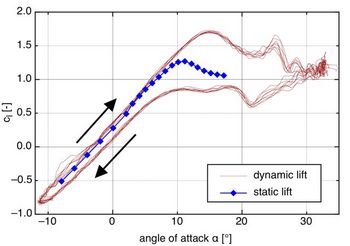
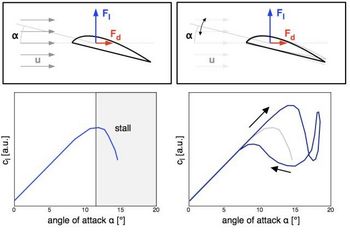
Of particular interest is also the ability to close the measurement gap for force measurements on wings. In this case, lift and drag forces are recorded without contact via the pressure distributions behind the wing and on the wind tunnel walls. This also allows measurements to be made when the wing's angle of attack changes rapidly, since strong, brief lift forces can occur here (dynamic stall). These must be well known for suitable models.