Technical education
Technical education
"Robots in the classroom" - A compendium
The Centre of Excellence Robotics in Technical Education presents:
"Robots in the classroom", a compendium on robotics, which was created as part of the "Robonatives" project in collaboration with all co-operation partners (University of Hanover, Osnabrück University of Applied Sciences and Arts, University of Oldenburg and Jade University of Applied Sciences Oldenburg). In addition to many didactic impulses for the implementation of robotics, there are extensive instructions for handling various robotic systems that were purchased by the project schools as part of the project (from general education schools to vocational schools).
For download:

TransREPAIRent: Making the circular economy tangible at extracurricular learning centres
New co-operation project in economics and technical education at the University of Oldenburg
The TransREPAIRent project, which is funded by the German Federal Environmental Foundation, will start in March 2023 and develop transdisciplinary approaches to repair culture and decision-making skills in extracurricular learning centres. Over a period of two years, the project, led by the Technical Education working group and the Institute for Economics Education at the University of Oldenburg, will teach skills that establish links between repair activities and circular economy contexts. The project links pupils and teachers at lower secondary level with university facilities such as the OX-Lab and the ATB workshop and with non-university learning locations such as the Oldenburg Resource Centre. Further information can be found here.
Robotics in the technical school lab
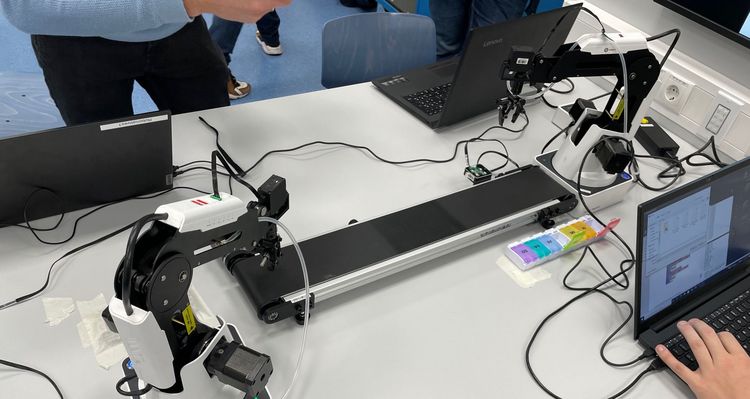
On 24 January 2023, pupils from Herbartgymnasium visited the "ATB-Werkstatt" school laboratory. Master's students of technical education organised a workshop on robotics in which various tasks could be solved in different contexts with the help of the Dobot Magician robot arm. Whether it was sorting medication in care homes, recycling smartphones or smart home solutions, there was something for everyone! Coordinate by coordinate, the students developed great solutions and mastered the tasks with flying colours!
Promotion Henrike Haverkamp
Henrike Haverkamp successfully defended the results of her dissertation on children's and young people's concepts of technology in a public thesis defence on 20 September 2022, thus completing her doctoral project.
The doctorate was completed as part of the GINT doctoral programme (link to https://uol.de/gint#c306614).
New project: "Self-directed learning in technology studies through augmented reality"
(SelTecAR)
The aim of the project is to develop a so-called augmented reality environment (AR environment), i.e. an assistance system that augments the real environment with virtual objects or instructions and supports self-directed learning processes in order to help students in technical education acquire practical skills in laboratories and workshops. After a brief instruction, students can use this AR environment as an app on their own smartphone. During self-study phases, they receive additional information and video instructions on how to operate certain tools or machines. The AR environment is also intended to make it easier for students to refresh skills they have already learnt as they progress through their studies.
The project is funded by the Freiraum 2022 initiative of the foundation Innovation in University Teaching.
Contact person:
Excursion
One important type of technology has so far been touched upon rather than treated seriously in the training of technology teachers: weapons technology. The KC makes no provision for its thematisation in lessons. However, this technology is the elephant in the room, not only because of the war in Ukraine, but also because of the fascination that this technology exerts, e.g. through computer games such as Call of Duty or World of Tanks. At the German Armoured Museum, dealing with this elephant is an educational task that has to be done every day. So how do you turn tanks into a subject without succumbing to their fascination and how do you educate people about their use and production? An excursion to the German Tank Museum in Munster took place on 25 May 2022 on this topic. A guided tour of the museum was followed by a discussion round with the museum educator.

Robonatives - ATB robotics
The educational project "Human-Robot Collaboration - Robonatives", in which ATB is involved, is being carried out as part of the Lower Saxony Digitalisation Master Plan. You can find more information here.
MariX. Your Maritime Experience
In the binational project "MariX. Your Maritime Experience" project is developing a concept for teaching maritime technologies in general education (technology) lessons. More information here.
TeGym - Technology at grammar school
Since the beginning of the year, the Technical Education working group has been supporting a school trial at OBS Uplengen, in which technology lessons are being trialled at secondary school level 1. More information here.
Experience the history of radio technology digitally

As part of the tec130 Information Processing Systems seminar, a special exhibition on the history of radio technology was prepared in winter semester 19/20. The exhibition will open on 29 January 2020 at the Michaelschule in Papenburg and will then travel on to interested schools in northern Germany. This special exhibition will allow pupils to learn about the beginnings of radio technology through to today's smartphones with the help of a research manual. Pupils not only learn about radio technology in theory, but also have the opportunity to approach the topic in a practical way with many experiments. www.sonderausstellung-atb.de
Contributions to the final RETIBNE conference
Repairing in the classroom - in the repair issue of Werkstatt Zukunft, educators, scientists, practitioners and facilitators reported on repair as an educational task in the classroom as part of the final RETIBNE conference.
Many thanks to all participants and Werkstatt Zukunft for the great contributions to the final conference of the RETIBNE project!
Mobile soldering system "MobilLAB soldering"
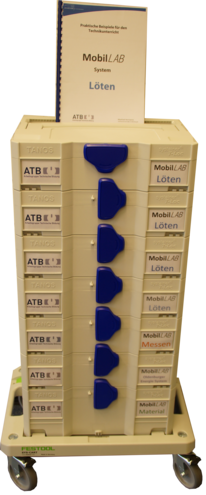
The Technical Education working group has developed a mobile soldering system. In addition to mobile use outside of technology rooms, this system is also intended to counteract the lack of technical equipment in schools and can be borrowed by students on work placement or teachers. The system contains four fully equipped soldering stations including multimeters. It also offers space for customised materials. Examples of exciting experiments and associated documentation are also part of the equipment. The working group currently has two of these systems which can be borrowed. For further information, please visit the following link:
"STEM learning in informal spaces" - co-operation project starts in October 2016
The Ministry of Science of Lower Saxony is funding a doctoral programme called "STEM learning in informal spaces". It is coordinated by the University of Oldenburg, Prof. Dr Michael Komorek and Prof. Dr Peter Röben and aims to research scientific, technical and interdisciplinary learning processes that are investigated in non-school learning spaces. Twelve Lichtenberg doctoral scholarships are being funded with around €800,000. In addition to the University of Oldenburg, applicants include the Universities of Hanover and Vechta and co-operation partners from the University of Crete (Greece) and the University of Southern Denmark (Denmark). A large number of extracurricular institutions are also involved, such as the Centre for Nature and Technology at the Aurich Energy Experience Centre and the DLR student laboratory in Bremen.
The programme started in October 2016 and will run for four years, in which the three-year doctoral scholarships are embedded. The official launch event will take place on 11 January 2017 at 18:00 in the library hall.
Technical education an integral part of the development network "School labs as teaching-learning labs"
How do you turn student teachers into good teachers? How do we strengthen their didactic and diagnostic skills? What role can teaching-learning labs play in this process? And how can promising talents for the classroom be identified right at the beginning of the degree programme? These questions are at the centre of the three development networks funded by the German Telekom Foundation. The aim is to publicise and disseminate the best STEM teacher training concepts in Germany.
The participating universities include the University of Oldenburg with its STEM teacher training departments. The "T" in STEM is represented by the Technical Education working group and is active in Development Network I "School Labs as Teaching-Learning Labs".
More information, interviews with the people involved and much more can be found at http://www.mint-lehrerbildung.de/
An interview on the topic of teaching-learning labs with the head of the working group, Prof Dr Peter Röben, and the blog about the everyday life of a doctoral candidate by Menke Saathoff are current contributions of the working group on this homepage.