
Series of lectures on language-sensitive teaching and learning in (subject) lessons, summer semester 2023
Series of lectures on language-sensitive teaching and learning in (subject) lessons, summer semester 2023
Series of lectures on language-sensitive teaching and learning in (subject) teaching
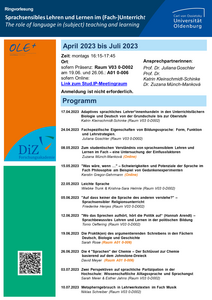
Summer Semester 2023
Students, colleagues and members of the public are warmly invited to our series of lectures Language-Sensitive Teaching and Learning in (Subject) Teaching, in which we aim to advance the interdisciplinary discourse on the language-forming and language-promoting role of (subject) teaching. The series of lectures seeks to bring together perspectives from educational science, subject-specific teaching and language teaching on the role of language in teaching and learning processes, and to reflect the complexity of school learning situations in the context of multilingualism. In addition to addressing the question of the competences to be acquired and the educational content, we aim above all to examine existing concepts, research findings and approaches for different school subjects and year groups.
Within teacher training in Oldenburg, there are already numerous efforts to draw attention to the role of language as a medium for the transmission of knowledge, for acquisition, for thinking, but also for participation and becoming part of a community. To ensure these efforts do not remain dormant, a series of lectures is to be established as a platform for networking and exchange.
‘Language-sensitive teaching and learning’ also features as a cross-cutting theme within the Research Academy (FoAk) and is intended to be integrated as fully as possible into the specialised and subject-didactic courses at the University of Oldenburg (UOL). We therefore also consider the interdisciplinary question of what a language-conscious higher education might and should look like in order to meet societal expectations to be relevant.
The lecture aims to strengthen students’ key competences in the area of subject-integrated language education and support, specifically German as a second and foreign language. Students will thus gain an interdisciplinary insight into research and school practice at the interface between language and subject-specific knowledge .
The course is listed under the area of specialisation (pb316) and is open to students from all Schools. Students can find the course under course number 3.01.1091 on Stud.IP.
The series of lectures is organised by colleagues from the Institute for German Studies. The DiZ Research Academy provides the organisational framework for its delivery.
Contact persons/Organisation:
Prof. Dr Juliana Goschler
Prof. Dr Katrin Kleinschmidt-Schinke
Dr Zuzana Münch-Manková
Programme
Time: Mondays from 16:15 to 18:15
provided in presence: Room V03 0-D002 Site plan
Deviation:
On 19.06. and 26.06. the series of lectures will take place in room A01 0-006 . Site plan
if online (only 08.05. and 15.05.): Link to the Stud.IP meeting room
Format: Lecture (60 minutes) followed by a discussion (30 minutes)
Registration is not required.
All topics and dates
1. adaptive linguistic teacher behaviour in the subjects of biology and German from primary school to upper secondary school
17.04.2023: Prof. Dr Katrin Kleinschmidt-Schinke (Room V03 0-D002)
Drawing on input- and interaction-focused concepts from first and second language acquisition research, this lecture aims to adopt an acquisition-oriented perspective on the language used by teachers. The centre of attention is on the question of how the languageteachers use when addressingtheir pupils(SgS) changes from primary school through lower and middle school to upper secondary school in biology (for primary school: general studies) and German lessons. This paper presents findings from a project in which the lessons of eight grammar school teachers and eight primary school teachers in the relevant year groups were video-recorded. A key methodological aspect is the consistent use of the same lecturer for each subject across the grammar school year groups.
2. subject-specific characteristics of educational language: form, function and teaching strategies
24.04.2023: Prof. Dr Juliana Goschler (Room V03 0-D002)
Specialised teaching poses many linguistic challenges for learners. Teachers should be sensitised to these in order to anticipate pupils' comprehension and production difficulties and to be able to reduce them through "language-sensitive" teaching. The basis for analysing specific lesson plans or materials are often lists of grammatical structures that are "typical" for educational language. However, teachers and students often find this to be insufficient on the one hand and too far-reaching for concrete application on the other. There could be various reasons for this: Firstly, teachers and students, especially of non-philological subjects, are sometimes overwhelmed by the terminology and the necessary grammatical understanding. This is possibly reinforced by a second fact: the list of grammatical features is exclusively form-orientated and not related to function: This makes it difficult to distinguish between technically necessary complexity and possibly unnecessary and easily avoidable habitus of distinction and, accordingly, to either engage in necessary linguistic competence building or to find simplifying alternative linguistic variants.
Using the example of textbook texts in various school subjects, I will show that it makes sense to analyse educational language in subject-specific detail, both formally and functionally, with regard to specific linguistic phenomena. Initial detailed analyses of these texts show major subject-specific differences in morphology and syntax, which in many cases can be explained by the respective functions.
From this, conclusions can be drawn for the admission and further training of teachers as well as for teaching: Some grammatical phenomena can only be explained and taught in the context of the respective subject. It is therefore the task of linguistics to link grammatical analysis with functional analysis and to process this in a subject-specific way so that it can be used as a basis for designing language-sensitive lessons for teachers of the respective subjects.
3. students' understanding of language-sensitive teaching and learning in the subject - an investigation of the influencing factors
08.05.2023: Dr Zuzana Münch-Manková (Online)
The presentation will explain two projects that deal with the understanding of the terms language-sensitive subject teaching (SFU) and educational language (BSP). Firstly, the survey of university lecturers (n=67) relevant to teaching at the UOL will show whether and to what extent attention is drawn to language education in teaching and what understanding of language and subject-integrated language education prevails among lecturers. For comparison, the survey of UOL students (n=396) is presented, which illustrates the extent to which both perspectives coincide and which factors have a positive influence on students' understanding of the SFU and the BSP.
4. "What if ..." - Difficulties and potentials of language in the subject of philosophy using the example of thought experiments
15.05.2023: Kerstin Gregor-Gehrmann (Online)
Philosophy is considered to be an abstract discipline that is difficult to access linguistically, but at the same time the method of the thought experiment offers a low-threshold, vivid introduction to central problem areas. The lecture will emphasise the special language didactic potential of this approach, but will also add a critical perspective. In this sense, relevant examples will be used to show how language-conscious philosophising can succeed with thought experiments - also in the sense of a general teaching principle that can be transferred to other subjects.
5. easy language
22.05.2023: Dr Wiebke Trunk & Krishna-Sara Helmle (V03 0-D002)
In this event, we will address the problem of stigmatisation towards so-called "simple" or "easy" language. Krishna-Sara Helmle, who runs a translation agency in Tübingen, will provide an introduction to the two terms.(https://leicht-verstehen.de/). We then want to clarify together which prejudices exist and why, and how we can counter them. This includes an insight into standardised or technical texts and the problem of reducing complex content so that it is easier to understand. Fundamental to this specific translation process is the question of which target group a text in simple language should be aimed at. The language-based decisions associated with this require a fundamentally empathetic approach. The aim is to overcome communication barriers in such a way that more in-depth content can be conveyed from here if necessary.
As a central educational institution, the university has an extremely important socio-political responsibility and at the same time has the prerequisites to fulfil its own intellectual demands in a reflective and self-critical manner. This includes, not least, raising awareness of language-based exclusions and implementing them in such a way that access can be created that enables educational equality.
6 "So that no one understands the language of the other?" - Language-sensitive religious education
05.06.2023: Friederike Henjes (Room V03 0-D002)
Religious education is a special (school) subject in terms of language requirements and presents subject-specific challenges: In addition to basic linguistic requirements such as multilingualism, different language levels and the use of subject and educational language, religious education focuses in particular on religious language, which is referred to as the 'other language'.
The lecture will discuss these different requirements of language-sensitive religious education and present possible challenges. Central to this is the didactic distinction between the language of understanding and the language of the understood, which raises new aspects and questions in relation to religious language.
7 "Where speaking ends, politics ends" (Hannah Arendt) - language-conscious teaching and learning in political education
12.06.2023: Prof. Dr Tonio Oeftering (Room V03 0-D002)
For Hannah Arendt, politics or the political consists above all in speaking and acting together in a world characterised by plurality. This already indicates that language and speaking, communicating with words about common issues and the corresponding joint action in school and extracurricular political education are of paramount importance.
This lecture will first provide an insight into fundamental aspects of Hannah Arendt's political theory before considering these further in terms of political education. It will also explore the extent to which the insights gained in this way could guide other subjects in the sense of language-sensitive learning, which - like political education - would like to contribute to the (political) maturity of learners in the school context.
8. the practice(s) of argumentative writing in the subjects German, Biology and History
19.06.2023: Sarah Rose (Room A01 0-006)
In many school subjects at lower and upper secondary level, written arguments are used, which is why it is understandable that a transfer potential of this discourse function from subject to subject is assumed in some cases. However, to date there has been no subject-comparative study that reconstructs the practice of arguing on the basis of actual classroom discourse in order to finally determine whether the practice of arguing is subject-specific or cross-curricular.
Due to this desideratum, an explorative study on written argumentation in the subjects German, biology and history in grades 7, 9 and 12 was conducted. The presentation will present the results of this study and reconstruct the practice of argumentation in the three subjects.
9. the 4 "languages" of chemistry - the key to chemistry based on the Johnstone triangle
26.06.2023: David Meyer (Room A01 0-006)
In the lecture, the language of chemistry will be described in more detail with the help of the well-known model of the didactics of chemistry, the Johnstone triangle. In addition to a purely linguistic description of the technical language of chemistry, the perspective on the triangle, as well as the extension to a tetrahedron, enables a more precise description of the language of the subject. Using selected examples from everyday life and chemistry lessons, the difficulties of technical language and ways of learning the language of chemistry are presented. Subsequently, prospects for language-conscious chemistry lessons can be derived.
10. two perspectives on linguistic participation in higher education: everyday academic language and language anxiety
03.07.2023: Sarah Meier & Esther Jahns, participate@uol (Room V03 0-D002)
This presentation will introduce two ongoing research projects that are being conducted as part of the university-wide participate@uol project.
Sarah Meier presents the linguistic demands that students are confronted with in everyday university life through the register of everyday academic language (Ehlich, 1999). Starting from the perspective of a language acquisition phenomenon, she shows how the relevant language skills develop during the course of study and what support and funding opportunities can result from this.
Esther Jahns investigates whether there is a form of language anxiety that relates to the oral language use of this register and the respective discipline-specific specialised language. In her presentation, she explores the question of whether this language anxiety can prevent students from participating. Based on initial interviews with students, she shows which factors favour language anxiety and which measures can reduce it.
11. use of metaphors in textbook texts in the subject of music
10.07.2023: Niklas Schreiber (Room V03 0-D002)
The lecture provides an insight into the language of instruction in the subject of music and takes as its starting point the language used in music lessons and music at school. In music as an artistic subject, the discussion about language is particularly multi-faceted. Language has not always been regarded as the central learning medium, and sometimes the idea that speaking could be detrimental to artistic endeavours is also found. Many musical concepts are also abstract (e.g. musical forms or scales), other areas such as sound seem difficult to access discursively, and making music together ultimately requires access to physical parameters (e.g. dynamics or tone articulation), which as such cannot be 'controlled' directly. Against this background, a special use of language and, in this context, the use of specific metaphors is almost obvious, which Vortrag presents on the basis of textbook texts.