

Morphological adaptations
Morphological adaptations
Sclerophyll
Sclerophyllia, for example, is a widespread adaptation to the arid conditions in the Mediterranean region. Sclerenchyma comes from the Greek where skleros = hard, brittle and enchyma = moulded. This describes very well the typical structure of the leaves. Sclerophylly serves primarily as protection against drought and dryness, but also as protection against predators. In addition, it is probably caused by stress factors, such as nitrogen or phosphorus deficiency in the soil. (Hofrichter, 2002)
Properties of sclerophyllous plants:
There are many different manifestations of sclerophyllous plants.
The greater loss of water in extreme heat is prevented by the transpiration-inhibiting structure of the leaves, and the sclerenchyma tissue of the plants ensures that mechanical strength is guaranteed even when turgor decreases.
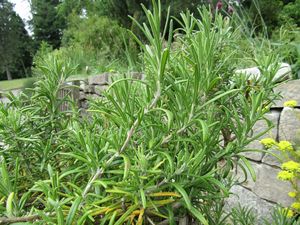
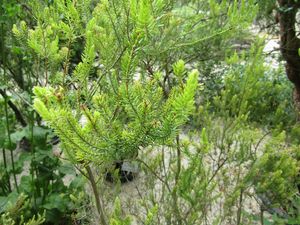
A typical leaf structure in sclerophyllosis is, for example, the reduction of the leaf surface, as in rosemary (Fig. 1) or stiff heather (Fig. 2). Both have needle-shaped leaves to minimise exposure to the sun. The reduction in leaf surface area can even lead to complete leaf loss in some plants.
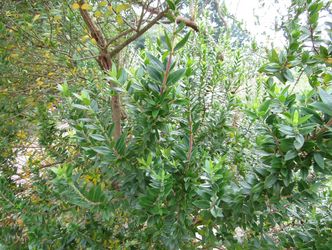
A thickened cuticle, such as in the myrtle (Fig. 3), also protects against desiccation.
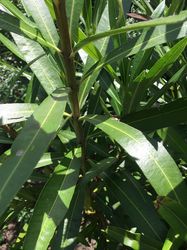
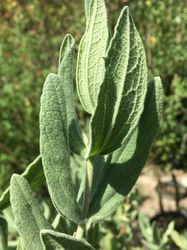
Dead epidermal leaf hairs or leathery, wax-covered leaves (Fig. 4) are also adaptations to drought.
(Pott & Hüppe, 2007 and Hofrichter, 2002)
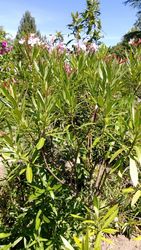
Nerium oleander(Fig. 5) is a typical plant of the Mediterranean region that also grows in our gardens as an ornamental plant. It has several characteristics that enable it to survive in the dry Mediterranean climate.
For example, the oleander has rather narrow leaves (Fig. 4) in order to provide as little surface area as possible for transpiration and to avoid direct sunlight as far as possible. However, the leaf is also equipped with other characteristics that ensure optimum survival in the Mediterranean region.
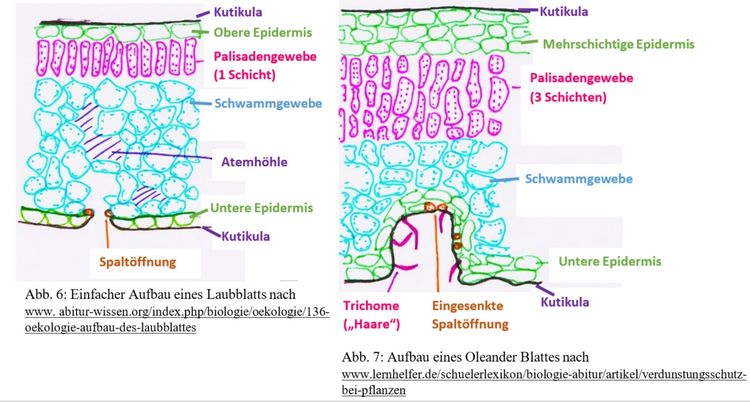
Figures 6 and 7 show the schematic structure of a leaf from a humid climate and an oleander leaf (arid climate) for comparison.
Figures 6 and 7 show the schematic structure of a leaf from a humid climate and a leaf of the oleander (arid climate) for comparison.
A comparison of the two drawings shows immediately that the oleander has a three-layered palisade tissue. In addition, unlike a leaf from Central European latitudes, it has a multi-layered epidermis. The thicker tissue ensures that it remains stable even in dry conditions and can photosynthesise. Another typical feature of the oleander, as a sclerophyll, is the sunken stomata, which can be clearly recognised in the drawing. This serves to contain transpiration, as does the hairiness with trichomes that the oleander has in its sunken stomata. All these characteristics result in a very stable and thick oleander leaf that remains intact even in dry conditions and can supply the plant with sufficient energy.
(Ortner, undated)
Malacophyll
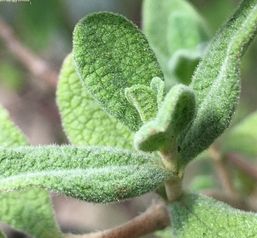
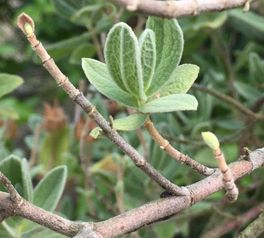
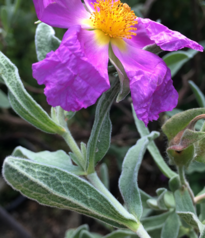
Another adaptation of plants in the Mediterranean region is malacophyllia. The name comes from the Greek malakos = soft, tender and phyllon = leaf. Malacophylls have trichomes on the surface of their leaves to reduce transpiration. These hairs are arranged in such a way that they reduce transpiration but do not allow heat to build up on the surface. (Fig. 8) In spring, before the onset of drought, the plants develop relatively large, heavily hairy leaves in contrast to the sclerophylls. The newly formed leaves become smaller and more densely hairy as the drought progresses. In the summer drought, the plant finally begins to shed a large proportion of its leaves, most of which have already dried out. This greatly reduces the transpiring surface area. Only the buds and young leaves remain, which sprout again when the rainfall rate increases (Fig. 9). An example of these adaptations is the genus Cistus , which is widespread throughout the Mediterranean region. Figure 10, for example, shows the widespread species Cistus albidus. The illustration clearly shows the whitish colour of the leaves, which is caused by the strong hairiness of the leaves. The hairiness can also be seen more clearly in Figure 8.
(Breckle, S.-W. & Daud Rafiqpoor, M., 2019)
Heliotropy
The term heliotropism comes from the ancient Greek and would translate as "turning towards the sun". This adaptation describes the movements of plants during the course of the day, which are orientated towards the position of the sun. A distinction is made between leaf tropism and flower tropism. However, both can also occur together. A classic example of flower tropism is the sunflower. However, Mediterranean plants usually fall under leaf tropism, as they have to protect themselves from the sun or, as annual plants (theroyphytes), benefit from the high energy potential.
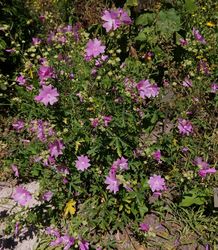
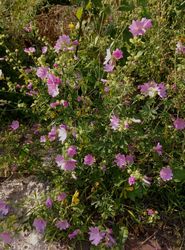
There is also diaheliotropism. In this case, the leaves are perpendicular to the sunlight during the day. This allows light absorption on the leaf surface to be optimised. Therophytes in particular use this adaptation to complete their life cycle within a few weeks before a longer period of unfavourable growing conditions occurs. In Mediterranean regions, for example, this is a dry and hot summer. In the Mediterranean region, for example, mallows are representatives of this strategy. Figures 11 and 12 show the mallow from the Botanical Garden in Oldenburg. Although it is not found in the Mediterranean region, it is intended here as a representative of the Malvaceae. Figure 11 shows a clear orientation of the plant towards the south (around 12:00), while in Figure 12 the plant turns towards the west (around 18:45) in order to absorb as much sunlight as possible, as mallows are annual plants or therophytes.
Then there is paraheliotropism. Here, the leaves orientate themselves more or less parallel to the sun. This avoids the sun and the plants can significantly reduce transpiration during the hot and dry summer. Examples of species found in the Mediterranean region include the asphalt clover (Fig. 14) and the whitish rockrose (Fig. 13).
(Lambers, H. & Oliveira, R. S., 2019)
(Ehlering, J. & Forseth, I., 1980)
Literature
Breckle, S.-W. & Daud Rafiqpoor, M. (2019). Vegetation and Climate, (Springer-Verlag) (URL: link.springer.com/content/pdf/10.1007%2F978-3-662-59899-3.pdf) (as of 30 July 2020)
Ehlering, J. & Forseth, I., (1980). Solar Tracking by Plants, (Science) (Vol. 210) pp. 1094- 1098
Hofrichter, R. (2002). The Mediterranean: Fauna, Flora, Ecology (Spektrum) pp. 203/204
Lambers, H. & Oliveira, R. S. (2019). Plant Physiological Ecology (3rd edition) (Springer-Verlag)
Ortner, Bruno (n.d.). Scleromorphic leaves of xerophytes and peinomorphosis of Ericaceae, URL: www.mgw.or.at/private/arbeitsgebiete/botanik/skleromorphe_blatt_or
Pott, R. & Hüppe, J. (2007). Spezielle Geobotanik : Pflanze - Klima - Boden (Springer-Verlag) p. 371