

Life forms
Life forms
Plant life forms on giglios
The climate of the Mediterranean is characterised by very warm, predominantly dry summers and mild winters with high precipitation and is therefore very seasonal. As severe winter frosts no longer play a role in the Mediterranean, the plants there are not adapted to sub-zero temperatures, which limits their spread to the northern and eastern regions. The floral contrast in the Mediterranean is therefore very great compared to Central Europe. The area is characterised above all by a dense scrub forest up to several metres high, down to exclusively dwarf shrubs: the maquis and garigue. These landscapes are the result of centuries of cultivation in the Mediterranean.
The extreme factor in the Mediterranean is not the winter frost, as in Central Europe, but the droughts in summer. During the droughts, the vegetation is exposed to high temperatures, a lack of water and high levels of radiation. In addition, they have to cope with the strong seasonality in the Mediterranean, as winter here is very rainy in contrast to summer. The different plant clans have adapted to these particularities through their way of life. As a result, a group from a different systematic position in similar living conditions shows similar signs of adaptation. Life forms that occur in the Mediterranean are the therophytes, geophytes and chamaephytes.
Therophytes are herbaceous and very short-lived plant species with a life cycle of one to two years. They survive the unfavourable season with generative diaspores in the soil. The development cycle is completed during the vegetation period and the plant then dies. (Example: Papavar rhoeas)
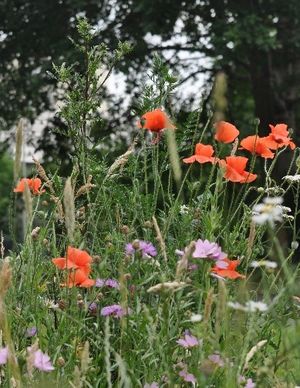
Geophytes are herbaceous plants that survive unfavourable living conditions with the help of underground organs. These serve as food stores and usually bear renewal buds. Depending on the survival organ, a distinction is made between rhizomes, tubers, bulbs and turnips.
Chamaephytes include woody or herbaceous green plants that grow to a height of 25-50 cm or larger plants whose branches periodically die back to this height. They survive with fleshy, above-ground renewal buds. Chamaephytes occur in two different forms, creeping perennials and cacti or other succulent plants. (Example: Crassula ovata portulaca monshosa)
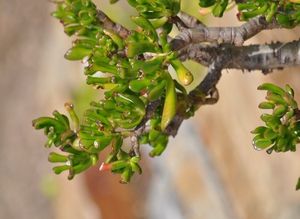
In order for the vegetation in the Mediterranean to cope with the ecological conditions, it has developed many different forms of adaptation. The Mediterranean region is characterised by an evergreen hard-leaved vegetation, the sclerophylls. Sclerophyllous plants are characterised by their thick, stiff and leathery leaves, which do not wither even when there is a severe lack of water. Some plants also have fine hairs on their leaves, which protect them from evaporation during dry periods. Plants with this adaptation are called malacophylls. Another form of adaptation is heliotropism, where the plant's growth and movement are orientated towards the sun.
The succulence
In this very well-known form of adaptation, the plants form a fleshy, juicy water storage tissue in order to survive periods of drought.
Succulents are not a plant family. Succulence is just one of many adaptations of plants to extremely dry locations through the formation of a fleshy, juicy water storage tissue. This serves to survive periods of drought, but also to protect against overheating. Succulents have developed convergently in all arid regions of the world, resulting in a great diversity. According to Eggli (2007), there are around 12,400 succulent species worldwide. Hotspots are the arid and semi-arid regions of southern Africa and the American continent. As the Mediterranean region is also warm and dry, some succulents can be found here and therefore also on Giglio.
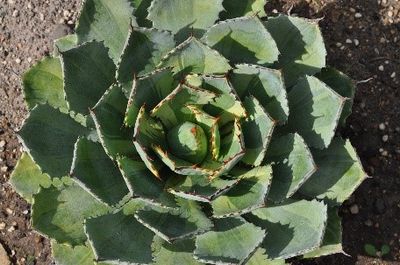
Whether a plant is succulent depends on the definition of succulence. This can refer to the succulent tissue, the surface-to-volume ratio or the eco-physiological function of the water-storing tissue. (cf. Willert & al. 1992)
The development of succulent plant organs is usually accompanied by other morphological transformations that limit water loss. This can be, for example, the reduction of the surface area by assuming a spherical shape, the complete reduction of the leaves, corking, the thickening of the epidermis or the deepening of the stomata. A measure of a plant's ability to store water is the degree of succulence, which is calculated by dividing the total water content by the surface area. Water is stored during the rainy months, which in the Mediterranean region is during the winter.
In the course of evolution, plants have found numerous ways to store water in various organs, organ parts or even specialised cells (idioblasts) as part of tissues. As a result, succulents can be categorised into four types: Leaf succulents, stem succulents, the rarely occurring root succulents and caudex plants.
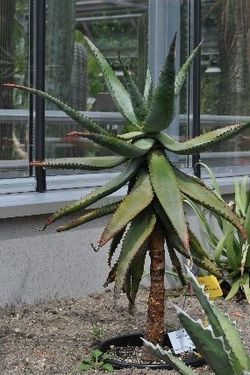
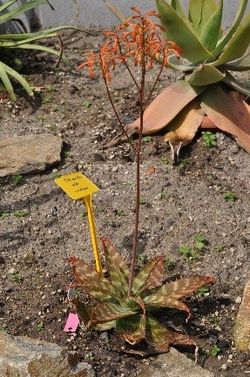
The best-known representatives of leaf succulents include species of the genus Aloe, which belongs to the Xanthorrhoeaceae family, the grass family. It originally comes from the Arabian Peninsula, but has also been naturalised in the Mediterranean region.
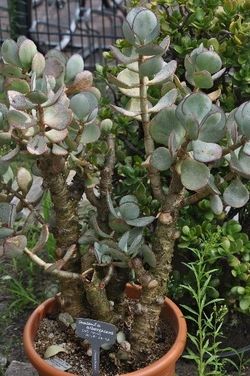
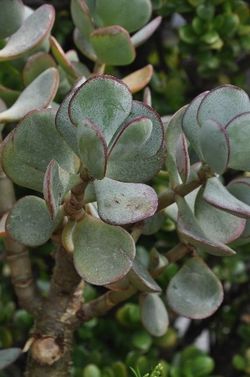
As the name suggests, these species have developed water storage tissue in the leaves. Depending on the species, the epidermis or the mesophyll is used as a reservoir. The water-storing cells have greatly enlarged vacuoles, making the leaves appear thick and fleshy. In some families, such as the Crassulaceae, all cells apart from the vascular bundles are involved in water storage. Example: Crassula arborescens.
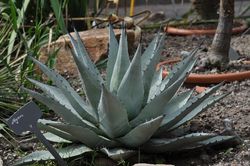
In addition, the leaf area is usually greatly reduced, in extreme cases the leaves are almost spherical, which maximises their volume with the smallest possible surface area and limits transpiration. Often the leaves are also rosette-shaped(Aeonium aboreum) in order to shade each other, as can also be observed in the aloes, for example. The Agavaceae/Agaves are another well-known family in which the leaves grow in a rosette shape and which are predominantly leaf succulents.
In stem succulents, the shoot axis is converted into a large-volume water reservoir. The storage tissue is usually located between the central cylinder and the assimilation tissue under the epidermis. This is where leaf reductions usually occur, e.g. in cacti in the form of spines. Furthermore, photosynthesis is also shifted to the shoot axis. The stems of these succulents are often divided by ribs, which increase the assimilated surface area, strengthen and shade the stem and at the same time provide space for sunken stomata. The number of stomata is usually reduced and the epidermis thickens.
Well-known families here are the Cactaceae, which can be seen here in the genus Lepismium. Furthermore, many Apocynaceae, dog poison plants, belong to the stem succulents. For example Pachypodium spec.
And the Euphorbiaceae, the spurges, are also widespread among the stem succulents.
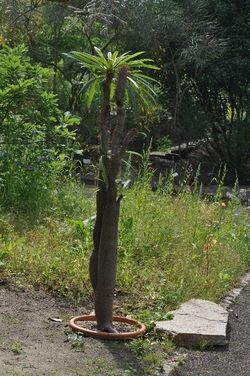
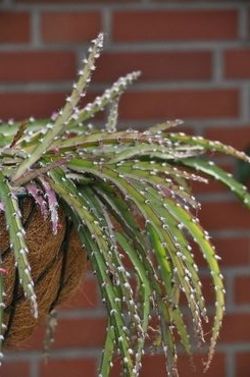
As already mentioned, there are very few true root succulents and the distinction between them and caudex plants is not clear. They have representatives in the Liliaceae, Asclepiadaceae, Vitaceae and Cactaceae families. In the Cactaceae, in addition to the primary root, the germination axis and sometimes also the shoot base are often connected to the underground storage organ. The developed organs often serve not only to store water but also nutrients. A well-known species of root succulent is Chlorophytum comosum, the green lily.
Caudex plants survive periods of drought thanks to a succulent water storage organ, the caudex, from which annual, non-succulent, climbing or twining shoots develop. The caudex consists of the base of the shoot axis and the upper parts of the root. In rare cases, however, it can also consist of parts of the stem or the root alone. There are various criteria that the plants must fulfil in order to distinguish them from the other three types. An example of a caudex plant is Ibervillea sonorae.
As another way of counteracting water evaporation, many succulents practise CAM photosynthesis. This is a mechanism in which CO2 uptake and CO2 conversion to sugar takes place at different times of the day so that the plants can keep their stomata closed during the day.
Bibliography
D. Metzinger & N. Jürgens (2010): Evolution of succulent plant families. Oldenburg: Isensee University Press. In: Schumania 6/ Biodiversity & Ecology 3
W. Frey & R. Lösch (2010): Geobotany Plants and Vegetation in Space and Time. Heidelberg: Springer-Verlag
Jörg Jost (1995): The succulent collection. At: www.zobodat.at/pdf/Wulfenia_4_0049-0061.pdf (last accessed 31.07.2020, 19:00)
Prof Michael Hohla (2018): Succulent plants - buxom & plump in life. At: www.flora-deutschlands.de/Publikationen/Hohla_2018_2_OEKO-L.pdf (last accessed 31.07.2020, 19:00)
Walter Krohn: Life on dry land. At: www.biologie.uni-hamburg.de/loki-schmidt-garten/03gruene-schule/arbeitshilfen/pdfs/leben-auf-dem-trockenen.pdf (last accessed 31.07.2020, 19:00)
Compact encyclopaedia of biology- Spectrum:: Root succulents. At: www.spektrum.de/lexikon/biologie-kompakt/wurzelsukkulenten/12943 (last accessed 31.07.2020, 19:00)
Compact Encyclopaedia of Biology- Spectrum: Stem succulents. At: www.spektrum.de/lexikon/biologie-kompakt/stammsukkulenten/11179 (last accessed 31.07.2020, 19:00)
Compact Encyclopaedia of Biology- Spectrum: Leaf Succulents. At: www.spektrum.de/lexikon/biologie-kompakt/blattsukkulenten/1670 (last accessed 31.07.2020, 19:00)
W. Frey & R. Lösch (2010): Geobotany Plants and Vegetation in Space and Time. Heidelberg: Springer-Verlag
GeoHilfe: Vegetation in the Mediterranean region - adaptation to summer drought. At: geohilfe.de/oekozonen-nach-schultz/die-winterfeuchten-subtropen/vegetation-im-mittelmeerraum/vegetation-im-mittelmeerraum-anpassung-an-sommerduerre/ (last accessed 31.07.2020, 19:00)