
Pimp My Taxi Fleet
Pimp My Taxi Fleet
Project group: Pimp My Taxi Fleet

A quick look into the future...
Companies like Uber, Google and Lyft are driving taxi companies as we know them out of the market. There are no more taxi drivers, only self-driving electric cars that take customers from A to B. This raises new questions for operators in terms of planning and some pre-existing questions:
- Where do you send your vehicles and when?
- Which roads should be avoided and when?
- Which locations are particularly attractive and when?
- What happens if a vehicle breaks down?
- When and where are the vehicles loaded?
All these questions lead to one goal:
Intelligent planning of vehicles and journeys.
The Pimp My Taxi Fleet project group aims to carry out such planning. In concrete terms, this means that a traffic simulation (which does not have to be developed in-house) will serve as the basis for planning. Building on this, the planning involves, on the one hand, intelligently placing empty vehicles (e.g. where many customers are expected). On the other hand, when a new order is received at the control centre, a vehicle must be selected to carry out this order. Any charging strategies must also be taken into account in this context, as these are electric vehicles.
Based on this initial, order-driven planning, reactive planning should be based on spontaneous or one-off events. This may involve reacting to vehicle breakdowns or external events such as major events, traffic jams or the weather and adjusting the planning if necessary.
- Contact: Tobias Brandt, Michael Brand
- Duration: 1 April 2016 to 31 March 2017 (SS 2016 + WS 2016/2017)
Technically speaking...
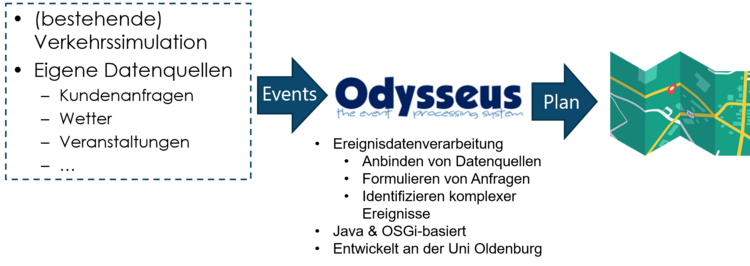
on the one hand, the data available about a vehicle (ID, position, passenger?, battery status, ...) and, on the other hand, the events to which a response is to be made should be processed using the Odysseus data stream management framework. Complex events can be identified or generated from this raw data using data stream algorithms and queries. For example, a "new order from A to B" event together with the current data of all vehicles can trigger an algorithm that selects which vehicle should carry out this order.
The plans or plan updates, which represent the result of such data stream processing, must then be prepared graphically accordingly. Odysseus provides so-called dashboards for such purposes, for which individual parts can be developed (e.g. to adequately display plan updates).