
Femtosecond pulse shaping
Femtosecond pulse shaping
Femtosecond pulse shaping
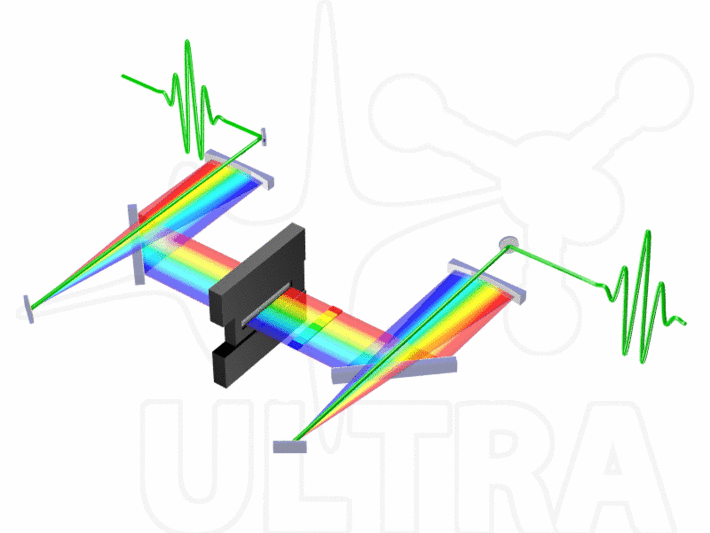
An ultrashort laser pulse can be shaped as desired in the laboratory using spectral phase modulation. The process is based on transparent liquid crystal displays (LCD), whose individual pixels can be controlled and thus manipulated specifically with regard to the refractive index.
In order to be able to shape a laser pulse using such a display, it must first be broken down into its spectral components. To do this, the laser pulse (green in the figure above left) is directed onto a grating whose reflection angles are frequency-dependent. This results in a spatial decomposition of the laser pulse into its frequency components, or a Fourier transformation. The fanned-out beam is then collimated and directed into the so-called Fourier plane in which the above-mentioned display (black-grey box) is located. By manipulating the refractive indices of the liquid crystal pixels, a phase shift of the frequency components is then achieved (hence the term spectral phase shaping). The frequency components are then reunited by a mirrored structure and a shaped pulse is created.

Pulse shaping with quadratic spectral phase functions
In the example shown above, the variation of the parameter Φ of the phase function is
φ(ω)=Φ/2⋅ω²
is visualised. Applying this phase creates a so-called chirped pulse in which the frequency components ω are linearly shifted against each other. As a result, they no longer occur simultaneously, but one after the other, whereby - depending on the sign of Φ - the chirp (chirping) can occur upwards (from low to high frequencies) or downwards (from high to low frequencies). The diagram shows the progression from blue to red and thus from high to low frequencies. This is known as a downchirp.
The linear progression of the frequency follows mathematically from the group delay T(ω). This is given by the derivative of the applied spectral phase:
T(ω)=dφ(ω)/dω = Φ⋅ω
This linear shift of the frequencies is shown in the figure above directly behind the liquid crystal display by the coloured blocks.
Pulse shaping with cubic spectral phase functions
If a cubic dependence on the frequency is chosen for the phase function introduced above instead of the quadratic one
φ(ω)=Φ/6⋅ω³
the shaped output pulse changes dramatically. The most obvious change is in the colour of the output pulse, which is now identical to that of the input pulse (green throughout). This can be easily understood on the basis of the group delay T(ω), which results from the derivation of the phase as explained above:
T(ω)=Φ/2⋅ω²
Unlike the linear group delay of the chirp, the quadratic group delay (coloured blocks behind the LCD) of the cubic phase function is even. As a result, two symmetrical frequency components around the centre frequency are delayed by the same amount and generate the centre frequency again by beating. There is therefore no temporal (spatial) sequence of different frequency components and the output pulse, like the input pulse, is continuously green.
The typical Airy function profile of the output pulse, which has a pronounced main pulse and successively smaller satellite pulses, can also be derived from the shape of the group delay. Thus, the strong main pulse is generated by the flat part at the peak of the square group delay and the satellite pulses modulated by the above-mentioned beat are shifted against the main pulse due to the symmetrically rising edges of T(ω). If the sign of the cubic phase is negative, the order of this pulse train is exactly reversed.
Pulse shaping with sinusoidal spectral phase functions
In addition to the polynomial spectral phase functions, there are many other possibilities for shaping laser pulses. In principle, any conceivable function can be used for spectral phase shaping. For example, trigonometric functions such as the sine are also conceivable. Below is the variation of the parameters A, T and Φ of the phase function
φ(ω)=A⋅sin((ω-0.5)⋅T+Φ)
shown:
The output pulse here is a multi-pulse sequence with individual pulses of constant instantaneous frequency. The amplitude of the sine wave, i.e. the parameter A, controls the characteristics of the individual pulses, while the so-called sine wave frequency T determines their time interval. A variation of the phase Φ influences the constant phase of the individual pulses. Although this has no influence on the instantaneous frequency (which is the derivative of the temporal phase), it plays an important role in phase-sensitive processes such as coherent control (one of the topics of this lecture).
Pulse shaping with discretely defined spectral phase functions
Non-continuous functions can also be used for pulse shaping. The sign function sgn(x), for example, is represented by
sgn(x)=-1, x<0 ∧ 1, x>0
is defined. From this, the so-called theta step phase function
φ(ω)=θ/2⋅sgn(ω-δω)
which has the following influence on the laser pulse when used in spectral phase shaping:
The modulated pulse here is a superposition of the unmodulated input pulse and the convolution of the unmodulated pulse with exp(i δω t)/ϖt.
In practice, this results in a double pulse sequence that decreases with 1/t at the edges. The position of the gap between the two pulses is determined modulo 2ϖ by the jump height of the theta step (i.e. the magnitude of θ) and the shape of the gap by the position of the theta step (i.e. δω). Obviously, the modulated pulse merges into the input pulse when δω assumes magnitude values at which the theta step is outside the spectrum and the spectral field essentially sees a constant phase.
The instantaneous frequency of the modulated pulse is approximately constant in the edges falling with 1/t and is given by the location of the theta step, i.e. δω. In the time range around the gap between the two partial pulses, the instantaneous frequency makes a Gaussian-like jump, the direction of which (positive or negative) depends on the sign of δω.