Teaching
Contact
Prof. Dr. Matthias Wollenhaupt
Carl von Ossietzky Universität Oldenburg
Faculty V - Institute of Physics
Carl-Von-Ossietzky-Str. 9-11
D-26129 Oldenburg
Germany
Tel.: +49-441-798-3482
room: W2 1-101
matthias.wollenhaupt@uol.de
Teaching
Atomic & Molecular Physics
The lecture on Atomic & Molecular Physics occupies the key position in the study of physics. It deals with the pioneering experiments, findings and mathematical concepts that led from classical to quantum mechanics and thus lays the foundation for all of modern physics.
Starting with the first experiments that can no longer be explained classically, the development of the atomic concept and quantum physics is traced, from which quantum mechanics is ultimately derived. The mathematical content of quantum mechanics - in particular the Schrödinger equation - is then used to quantitatively explain qualitative properties of atomic processes and discussed in detail. These include, for example, atomic spectra, molecular bonds and light-matter interaction. Modern applications of quantum mechanics, such as lasers, are also covered in this lecture.
Accompanying material on the individual topics is provided under the following links:
- Mathematical foundations
- Development of the concept of the atom
- Development of quantum physics
- Fundamentals of quantum mechanics
- The hydrogen atom
- Multi-electron systems
- Light and matter
- Fundamentals of laser physics
- Molecules
To ensure meaningful participation in the lecture, knowledge of these mathematical sub-areas is strongly recommended.
Ultra-short laser pulses
The contents and objectives of the lecture Ultrashort Laser Pulses are as follows:
- The femtosecond time scale
- Introduction to the Fourier transform
- Generation of ultrashort laser pulses
- Femtosecond pulse shaping
- Pulse characterisation (measurement)
- Fundamentals of atomic & molecular physics
- Fundamentals of molecular dynamics
- Introduction to light-matter interaction
- Observation and control of ultrafast dynamics
- Applications
Seminar on femtosecond spectroscopy
This seminar deals with theoretical and experimental elements of femtosecond spectroscopy. The students select one of the topics listed below and prepare a half-hour, presentation-based lecture on this topic based on the literature provided, which is presented to the participants of the seminar.
The following topics are offered:
- Basics of lasers
- Ultra-short pulse lasers
- Dispersion management and pulse shaping
- Elements of nonlinear optics
- Pulse characterisation
- Semiclassical light-matter interaction
- Wave packets
- Coherent control of ultrafast dynamics
- Observation of chemical reactions and experimental techniques in the gas phase
- Control of chemical reactions
- Reaction control in the liquid phase
- Ultrafast 2D spectroscopy
- Laser microscopy
- Fs laser material processing on dielectrics and nanosurgery
- Ultrafast diffraction methods
- Imaging photoelectron spectroscopy
- Photoelectron circular dichroism
- Few-cycle laser pulses and CEP stabilisation
- Attosecond laser pulses and ultrafast electron dynamics
- Free-electron lasers: ultrashort X-ray pulses and their applications
Further information on the individual topics can be found on the seminar page.
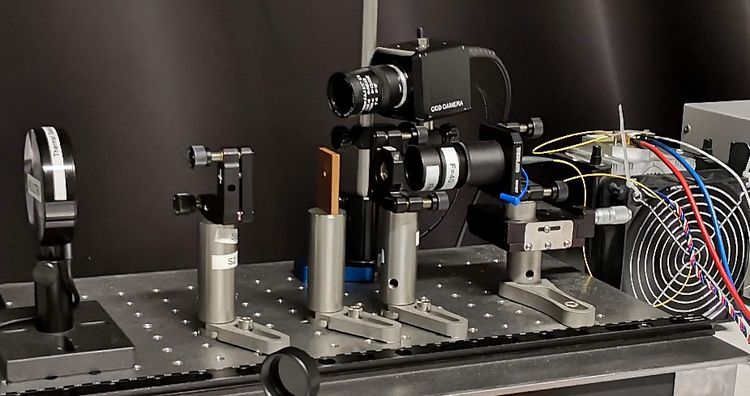
In this experiment, a diode-pumped Nd:YAG solid-state laser is set up with different resonators. Besides the fundamental wavelength of 1064nm, a KTP crystal is used for frequency doubling into the visible green spectral range. Characteristics such as mode profile, divergence, beam parameter product, output power and efficiency are investigated.
In this experiment, knowledge about laser safety and the active working and adjustment of optical setups is taught.
F practical course (MA): Fourier optics
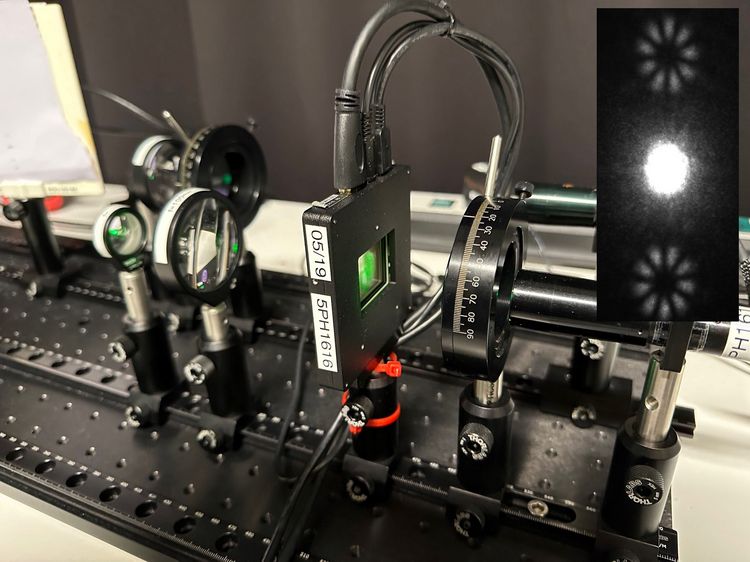
This experiment teaches the basics of Fourier optics. For this purpose, a 2D light modulator is used to apply amplitude or phase modulation. Different setups are used to investigate diffraction gratings, modulation in the Fourier plane of a 4f setup and the generation of optical vortices.
Physics for students of chemistry and environmental sciences
During the winter semester, the course covers mechanics, electrodynamics and thermodynamics. During the summer semester, the lecture covers optics, atomic and molecular physics, and solid-state physics.