

Module 2: The order of the elements
Navigation

Module 2: The order of the elements
In 1808, John Dalton was one of the first scientists to attempt to organise the elements known at the time. The atomic mass served as the starting point for his classification of the elements. The following table from a translation of his work "A New System of Chemical Philosophy" shows the elements and atomic masses.
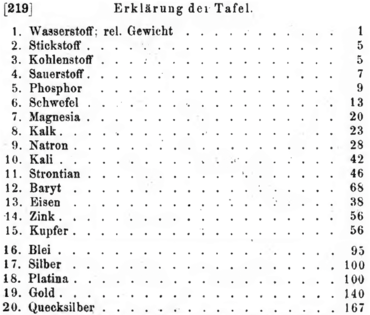
Some of the names of the elements still differ from their current names. If you compare the atomic masses with the exact values, there are also clear deviations here. However, with this list, Dalton made the start of a classification system for the elements.
At the beginning of the 19th century, around 28 elements were known. Over the course of the 19th century, many more elements were discovered, their atomic masses determined and other properties characterised, so that by the end of the century their number had grown to 84.
The ever-growing list of elements during this period led to various scientists carrying out experiments and developing different systems for organising the elements in order to create a sensible and clear classification system.
Task
Using the 34 element cards, you should identify similarities, differences and trends in the properties of the elements and use this information to develop your own categorisation system.
Task
Read the section "Historical development of a system of order" and compare the system of order you have developed with the historical variants you find in this section.
Points of comparison could be:
- Atomic masses
- Number of elements
- Number of groups
- Horizontal and vertical division
Historical development of an organisational system
The introductory text has already mentioned that a large number of chemical elements were discovered in the course of the 19th century. The following overview gives an idea of how quickly the number of elements increased.
| up to the year 1700 | 13 elements |
| at the end of the 18th century | 28 elements |
| by the year 1850 | 59 elements |
| at the end of the 19th century | 84 elements |
The development of a classification system for the elements seemed necessary due to the large number of elements in order to be able to use a systemic overview. The increasingly precise atomic masses and the known chemical similarities of some elements offered starting points for the creation of such an overview.
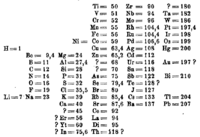
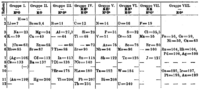
Two chemists in particular stood out in the second half of the 19th century: the German Julius Lothar Meyer and the Russian Dimitrij Iwanowitsch Mendelejew. They independently developed a classification system of the elements based on chemically similar behaviour, increasing atomic masses and their periodic regularities.
Mendeleev published his first version of the periodic table in 1869. Subsequently, in 1870, Meyer also published his own system, which he had designed in 1868. Both scientists thus influenced each other's work, as Mendeleev then revised his system and published a new version of his periodic table of the elements in 1871.
Mendeleev's greatest achievement with regard to the periodic properties of the elements is that he left gaps in his system. These gaps left room for elements yet to be discovered, whose properties (atomic mass, density, chemical behaviour, etc.) Mendeleev was able to predict with the help of his system.
Over the next 15 years, these three elements: scandium, gallium and germanium were actually discovered and Mendeleev's predictions of their properties were almost perfect.
The following illustrations show you Mendeleev's and Meyer's ordering systems.

The noble gases
When comparing your own classification system with those of Mendeleev and Meyer, you will have realised that you have included a whole group of elements in your system that the two scientists did not integrate into their system: the noble gases (helium, neon, argon, krypton, xenon and radon).
These gases were discovered and recognised as elements between 1868 and 1900.
As a completely new group, they fitted perfectly into the classification system established by Mendeleev and Meyer. From this time at the latest, the periodic table was recognised as a model for ordering the elements in the natural sciences.
