
Station 1: The charge of the nucleus and the atomic mass
Navigation
-
 Table: Nuclear charge and atomic mass This table contains the elements with atomic charge 1 to 84 and their atomic mass.
Station 1: The charge of the nucleus and the atomic mass
For his model of the structure of an atom, Ernest Rutherford assumed that the charge of the atomic nucleus is roughly proportional to the mass of the atom.
He came to this conclusion because the scattering of the positive α-particles depends on the charge of the nucleus and the greater the atomic mass of the element, the more the α-particles are scattered.
In Rutherford's time, it was not possible to precisely determine the charge of atomic nuclei. The atomic masses, on the other hand, had been determined repeatedly and ever more precisely for a long time. This "diversions" was therefore necessary for Rutherford.
Today, we know the charge of the atomic nuclei, the atomic number, very precisely and can also relate it to the atomic mass.
Task
Create a table in Excel according to the following principle:
| Element | Nuclear charge | Atomic mass (u) |
|---|---|---|
| Hydrogen | 1 | 1,0079 |
| Helium | 2 | 4,0026 |
| Lithium | 3 | 6,9675 |
| Beryllium | 4 | 9,0122 |
| boron | 5 | 10,813 |
| Carbon | 6 | 12,011 |
| ... |
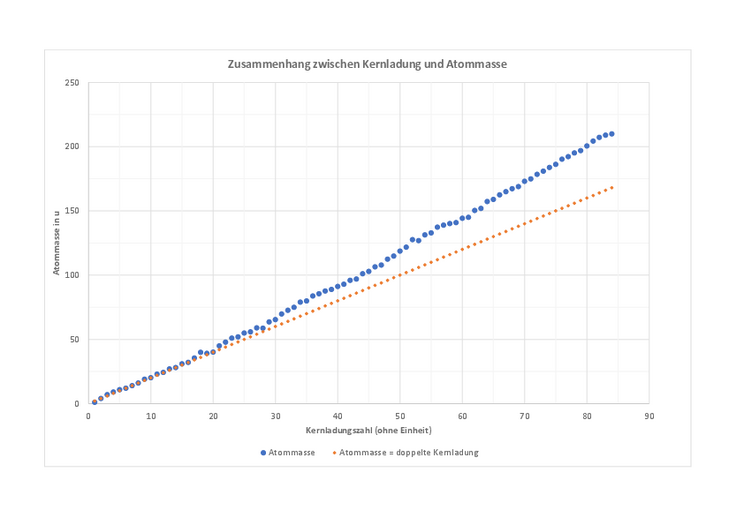
Use different elements, at least 25, from atomic charge 1 to 84. You will find the data for this in the table under Material. Then create a diagram that shows the relationship between nuclear charge and atomic mass.
Also add the linear function: atomic mass = 2∙nuclear charge to the diagram.
- Describe the relationship between nuclear charge and atomic mass that you can recognise from the data and the diagram.
- Is the relationship linear?
- In which range does it correspond to the linear function atomic mass = 2∙nuclear charge and in which range does it not?
The relationship between nuclear charge and atomic mass
Your diagram should look something like the following diagram, which was created from all the data of the elements up to atomic number 84.