
Results of the participate@UOL project at School VI
Results of the participate@UOL project at School VI
How can students and teachers shape university teaching together?
This was one of the central questions of the university-wide participate@UOL project, which was funded by the Foundation Innovation in University Teaching until December 2025. Participation of students and lecturers was strengthened through the use of innovative digital formats, increased language awareness in university teaching and the consideration of student lifeworlds.
On these pages you will find an overview of teaching and learning formats that have been implemented and integrated into teaching at our School as part of the project.
Teaching and Learning Lab sub-area
Innovative teaching concept: Virtual Reality (VR) in medical training
Virtual A&E Step.VR
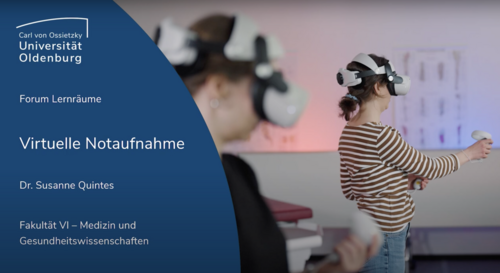
A young female patient with a fever and severe abdominal pain is lying in an examination room in the A&E department. The nursing staff report that she suffers from chronic inflammation of the bowel. The attending doctor does not yet have any further information. Sounds like a typical day on the ward? In this case, however, the young patient is virtual and the doctor is a medical student about to begin their block lab course in surgery. The young patient’s case is one of nine currently featured in the STEP.VR simulation programme, which was developed by ThreeDee and recreates a virtual A&E department. The focus is on cases in general surgery and internal medicine.
As part of the participate@UOL project, we were able to procure VR headsets, computers and the licence for STEP.VR for this new teaching format. Furthermore, the project work gave us the freedom to set up and plan the virtual A&E department. Following initial trial runs and a pilot phase, PD Dr Nader El-Sourani incorporated the virtual A&E directly into the regular curriculum. In the fourth year of study, 82 students took part in the module during the final teaching session before the start of their block lab course. The aim was to bridge the gap between theoretical university life and practical clinical work.
The Virtual A&E enables students to practise interacting with patients, simulates the time pressure experienced in a hospital setting and promotes clinical-analytical thinking. In particular, clinical decision-making can be practised and standardised procedures can be reinforced. Haptic feedback, however, is still very limited, and facial expressions and emotions can also only be represented to a limited extent by virtual avatars. Consequently, conversational scenarios and learning modules focusing on the doctor-patient relationship cannot be implemented virtually. VR should therefore not be seen as a replacement for established teaching formats, but rather as an extension of the traditional curriculum; it was thus chosen as the ‘final and concluding’ teaching module.
The seminar was evaluated and accompanied by a student research project (René Klarmann). Further information can be found in a blog post published by the Hochschulforum Digitalisierung about the event and in the associated publication.
The virtual A&E is currently being used in seminars in the subjects of surgery and internal medicine as part of regular teaching.
Publications:
1. El-Sourani N, Mühling T, Klarmann R, Quintes S, Bockhorn M. Implementation and Analysis of a Fully Immersive Virtual Reality-Based Emergency Training in a Surgical Curriculum. Adv Med Educ Pract. 16 May 2025;16:811–823. doi: 10.2147/AMEP.S507357. PMID: 40401262; PMCID: PMC12094490.
2. Blog articles from the Higher Education Forum on Digitalisation
https://hochschulforumdigitalisierung.de/notruf-aus-der-zukunft/
3. Mühling T, Späth I, Backhaus J, Milke N, Oberdörfer S, Meining A, Latoschik ME, König S. “Virtual reality in medical emergencies training: benefits, perceived stress, and learning success.” 2023. Multimedia Systems 29; 2239–2252. https://doi.org/10.1007/s00530-023-01102-0
VR-assisted peer-to-peer format at the Clinical Training Centre
In preparation. Scheduled to start in the summer semester of 2026.
Communication and interprofessional education: the virtual platform for nursing, UbiSim
Similar to the STEP.VR virtual A&E, the UbiSim platform offers standardised clinical simulation scenarios in immersive virtual reality. Existing cases can be adapted, or users can even create their own new scenarios. However, these are not acute emergency situations, but rather a wide variety of scenarios from the everyday work of nursing staff. Up to three people can be in the same virtual patient room at the same time, so that, for example, two nursing staff members and a trainer can work through a scenario together. It is also possible for up to 10 invisible observers to take part in a simulation and watch from different angles without being visible themselves.
Another distinctive feature of the platform is the ability for the lecturer to control the behaviour of the virtual patients, relatives and healthcare provider via the computer. A wide range of possible dialogues is available for this purpose. In addition to the correct performance of nursing tasks, the simulations focus on communication and are particularly well suited to interprofessional teaching formats.
We have piloted UbiSim in small groups as part of the project and are currently planning to use it in the Advanced Nursing Practice (ANP) Master’s programme.
Sub-area digital accompanying services
Abhört, the (medical didactics) podcast
with Thomas Schmidt and Susanne Quintes
The monthly podcast deals with topics from didactics and teaching with a focus on the model degree programme in human medicine. The target audience are teachers and students of the university, who are also regularly invited as guests. Initially only accessible via the Medical Didactics website, the podcast is now available on all common platforms. In addition to the low-threshold and easily accessible communication of didactic topics, we would also like to familiarise lecturers with the advantages of the audio format for teaching. Microphones, headphones and a mixing console were purchased as part of the project and are available for teachers to borrow.
Digital teaching website and courseware
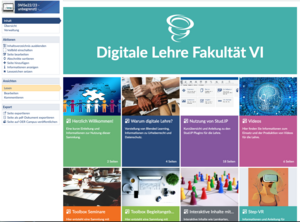
The existing medical didactics website on digitally supported teaching has been revised and expanded. In addition, lecturers can now register in a corresponding community forum via Stud.IP and find up-to-date information on the Stud.IP plugins and other applications there. These are summarised in courseware that can also be accessed without registering in the forum.
Piloting the Labster simulation platform
Labster offers the opportunity to access over 300 scientific simulations directly via the browser. Teachers and students at the University of Oldenburg were able to use all of the platform's simulations until summer 2024 and test their use for their own teaching or learning success. The aim was to enrich the teaching of complex topics through storytelling and game elements and to find out whether Labster can be a useful addition to existing teaching units.
Open Educational Resources (OER) sub-area
Padlet with freely available games for teaching
Game-based learning (also known as edutainment) uses playful elements to convey learning content and increase student motivation. Learners have to master different levels of difficulty, receive rewards or immerse themselves in a story that only progresses by solving puzzles.
To make it easier to incorporate game elements into teaching, a padlet has been created with a collection of freely available games from the fields of medicine and science.

Learning unit with videos on the topic of racism in medicine
Simon Gerhards, Niklas Ellerich-Groppe, Prof Mark Schweda in collaboration with Ulf Goerges, Susanne Schorer and Susanne Quintes.
The following extract from the introduction to the learning material provides an overview of the content and objectives. The complete description of the learning material can be found as OER on the Twillo portal or under this section as a pdf download.
The learning unit "Let's Talk about Racism" is based on the results of the research project SoDiMe on the perspectives of medical students on racism, which was carried out in the Department of Ethics in Medicine at the University of Oldenburg (https://uol.de/medizinethik/forschung/projekte/sodime). In the analysis of group discussions with medical students in Germany, five typical approaches to the topic of 'racism in medicine and healthcare' were identified: Pragmatism, scientism, subjectivism, interculturalism and criticism (Gerhards & Schweda, 2024). These typical approaches are made comprehensible in the video material "Let's Talk about Racism": Five medical students discuss a situation in the clinical training centre that one of them experienced during an internship and show these five typical arguments and attitudes. The following is an overview of a learning unit in which the material is used as part of an interactive learning interface in order to provide suggestions for the didactic embedding of the video material on racism-critical teaching in medical studies.
The learning unit "Let's Talk about Racism" pursues the following learning objectives:
1. to impart knowledge about racism in medicine and healthcare
2. to promote self-reflection on one's own approach to the topic of racism
3. support and development of action plans and strategies for dealing with racism
The learning material thus addresses learning objective VIII.6-04.4.13 of the National Competence-Based Catalogue of Learning Objectives in Medicine (NKLM) 2.0:
"They [medical students] can recognise disadvantages, stigmatisation and discrimination on racial grounds or because of ethnic origin, gender, religion or ideology, disability, age or sexual identity and take action to prevent or eliminate these disadvantages."
Literature: Gerhards SM, Schweda M (2024) How do medical students deal with the topic of racism? A qualitative analysis of group discussions in Germany. PLoS ONE 19(11): e0313614. https://doi.org/10.1371/journal.pone.0313614
The video material for the learning unit can be found here: https://doi.org/10.5446/71560
The complete description of the learning unit as a pdf document can be found here: doi.org/10.5446/71560
Formats in cooperation with all Schools

Practical workshop for teaching staff: ‘Tooltime: Media technology and teaching scenarios for hybrid teaching’
The practical workshop is run in a hybrid format by faculty staff approximately every 8 weeks. It presents various teaching scenarios, media technology, different applications for hybrid teaching and other exciting topics relating to digital-supported teaching. University lecturers can either attend in person and try out the relevant technology straight away using their own devices, or get an overview online.
The slides and information from all sessions are also made available in a freely accessible community forum on Stud.IP. In future, the plan is to produce vodcasts and short videos on the technology presented within this framework and to make these available digitally as a collection, alongside existing guides and concepts.
Cross-school courses
In the 2023/24 winter semester, the seminar ‘Journey of Discovery: Digital Education – Experimenting, Applying, Reflecting’ was jointly designed and delivered for the first time by all faculty members involved in the project.
In short presentations, the lecturers introduced digital applications, virtual worlds, gamification and open educational resources, along with their potential uses in academia and education, and subsequently discussed these with the students. The learning content was also tested and explored in greater depth during practical sessions (Maker Spaces). Finally, working individually or in groups and with the support of the lecturers, the participants developed their own digital educational product, some of which were OER. Among other things, this included interactive quizzes, teaching units on digitalisation and virtual worlds for primary schools, and an information video for refugees.
In the winter semester 2024/25, the seminar ‘Think small – Microcredentials and Future Skills’ focused on the increasing dynamism and changing requirements in the education sector. To begin with, participants were given an insight into the basics of microcredentials and future skills, and then presented individual aspects of these topics themselves in short talks. Following critical analysis and discussion, they then developed their own small-scale course formats as part of the module, utilising digital applications. Among other things, this resulted in courseware on stress management, an app for older people to help them use digital devices, and materials on autism and ADHD for use in schools and for general education. Some of these products are currently being further developed and prepared for wider use, including as OER.
In future, these courses are to be established as a cross-school programme and will form a component of a university-wide curriculum on digital skills.