
Study paths
Quick links
Aktuelles
Das Lehrangebot für den B.Sc. Uwi im WiSe26/27 wird am Fr, den 19.06.26 um 12:00 Uhr in Stud.IP zur Anmeldung freigeschaltet. Bei Lehrveranstaltungen, die von anderen Instituten angeboten werden, kann der Termin zur Freischaltung variieren (nicht vor 17.06.26). Zur Unterstützung stehen die Folien zur Infoveranstaltung für die Modulwahl unter „Studiengangsinformationen” bereit.
- Das Lehrangebot für den B.Sc. Uwi im SoSe26 wird am Di, 20.01.26 um 12:00 Uhr in Stud.IP freigeschaltet. Um das Anmeldeverfahren zu entzerren, gibt es gesonderte Termine für die Anmeldung für mar231 – Formenkenntnis: 30.01.26 um 13:00 Uhr & mar020 – UOPs: 30.01. um 13:30 Uhr. Bei Lehrveranstaltungen, die von anderen Instituten angeboten werden, kann der Termin zur Freischaltung variieren.
- Das Lehrangebot für den B.Sc. Uwi im WiSe25/26 wird am Fr, den 20.06.25 um 12:00 Uhr in Stud.IP zur Anmeldung freigeschaltet. Bei Lehrveranstaltungen, die von den Instituten für Physik und Chemie angeboten werden, kann die Freischaltung evtl. schon am 19.06.25 erfolgen.
- Die Infofolien zur Modulwahl ab dem 3. Semester sind jetzt unter „Studiengangsinformationen” verfügbar.
- Das Lehrangebot für den B.Sc. Uwi im SoSe25 wird am Fr, 14.02.25 um 12:00 Uhr in Stud.IP freigeschaltet. Bei Lehrveranstaltungen, die von anderen Instituten angeboten werden, kann der Termin zur Freischaltung variieren. Um das Anmeldeverfahren zu entzerren, gibt es gesonderte Termine für die Anmeldung für mar231 (ehemals mar010) – Formenkenntnis: 17.02. um 9:00 Uhr & mar020 – UOPs: 17.02. um 13:00 Uhr.
- Die neue fachspezifische Anlage zur Prüfungsordnung 2024 und auch die aktualisierte Modulübersicht ist online. Die aktuellen Regelungen findet ihr hier
- Hochschulinformationstag am 14.06.2024: Fachvorstellung B.Sc. Umweltwissenschaften um 12:30 Uhr. Kommt vorbei und entdeckt was im Uwi steckt.
- Die aktuellen Folien zu den diesjährigen Infoveranstaltungen zur Modulwahl und Kontaktpraktikum/Bachelorarbeit sind nun online. Einfach weiter nach unten scrollen und bei „Studiengangsinformationen” herunterladen.
- Das Lehrangebot von ICBM und IBU im WiSe24/25 wird am Do, den 13.06.24 um 12:00 Uhr in Stud.IP freigeschaltet. Bei Lehrveranstaltungen, die von anderen Instituten angeboten werden, kann der Termin zur Freischaltung variieren. Die Infoveranstaltung zur Modulwahl findet am 10.06.24 um 16:15 Uhr in W15-1-146 und unter https://meeting.uol.de/b/drm-t7g-jlk-rdv statt.
- Am 30.05.24 um 12:15Uhr gibt es Infos zur Orga von Kontaktpraktikum und Bachelorarbeit. Kommt in W15-1-146 vorbei oder schaltet euch unter https://meeting.uol.de/b/drm-t7g-jlk-rdv online zu.
- Das Lehrangebot für den B.Sc. Uwi im SoSe24 wird am Fr, 16.02.24 um 12:00 Uhr in Stud.IP freigeschaltet. Bei Lehrveranstaltungen, die von anderen Instituten angeboten werden, kann der Termin zur Freischaltung variieren. Um das Anmeldeverfahren zu entzerren, gibt es gesonderte Termine für die Anmeldung für mar020 – UOPs: 19.02.24, 11:00 Uhr & mar010 – Formenkenntnis: 19.02.24, 12:00 Uhr
- Die aktualisierte Version des Modulhandbuchs ist online. Ihr findet sie unter „Quicklinks”.
- Alle Infos aus der Fachvorstellung Uwi findet ihr unten links in der PDF unter „Studiengangsinformationen”.
- Hallo an alle neuen UWI-Studierenden! Am 10.10.2023 um 10:15Uhr findet in W32 0-005 die diesjähre Fachvorstellung statt. Dazu gibt es viele Angebote im Programm der Fachschaft!
- Neuigkeiten zum Lehrangebot WiSe23/24: mar080 und mar150 werden am Fr, 08.09.23 um 12:00Uhr freigeschaltet. Zudem gibt es als neues Angebot einen Python-Kurs in pb419!
- Die Aufzeichnungen der diesjährigen Infoveranstaltungen zu Modulwahl, Kontaktpraktikum und Bachelorarbeit sind unter https://meeting.uol.de/b/drm-t7g-jlk-rdv abrufbar. Die dazugehörigen Folien findet ihr in den Studiengangsinformationen auf der Hauptseite.
- Am 07.07.23 um 12:15Uhr findet eine Infoveranstaltung für Zweitsemester zur Modulwahl statt. Infos zur Orga von Kontaktpraktikum und Bachelorarbeit gibt es am 14.07.23 um 12:15Uhr. Ihr könnt jeweils in Raum W15-1-146 kommen oder euch unter https://meeting.uol.de/b/drm-t7g-jlk-rdv online zuschalten.
- Das Lehrangebot im B.Sc. Uwi für das WiSe 2023/2024 wird am 8. Juni 2023 um 16 Uhr freigeschaltet. Bei Lehrveranstaltungen, die von anderen Instituten angeboten werden, kann der Termin zur Freischaltung variieren.
- Ab 1.4.2023 wird Dr. Marion Pohlner die Studienfachberatung und die Studiengangskoordination des BSc Uwi übernehmen.


Study paths
Study-Paths....
- are selected suggestions, not mandatory,
- lead to academic or scientific specialisations and Master's degree programmes,
- are intended to serve as an orientation and decision-making aid,
- show some (but not all) sensible module combinations,
- are timetabled and are intended to make it easier to study (by checking for possible overlaps).
The pathways are made up of strongly recommended core modules (marked in red in the illustrations) and supplementary elective modules (marked in blue).
General information on study paths
The Bachelor’s degree programme in Environmental Sciences is highly interdisciplinary, offers a wide variety of subject matter and provides an exceptionally wide range of options. This allows for a highly personalised study programme, which students should make the most of (whilst taking practical considerations into account, such as time management and the distribution of workload).
Various study pathways have been designed to assist students in making informed selections of modules in line with their intended professional qualifications and academic interests. These study pathways take into account options for specialisation across various professional and further qualification fields, or lead to consecutive Master’s degree programmes with a terrestrial or marine focus.
The study pathways were completely revised for the 2017/18 winter semester to align them with the current teaching and research profile of ICBM and IBU and to take into account further study opportunities in Oldenburg. Minor adjustments are made on an ongoing basis.
Biogeochemistry
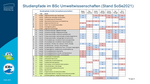
This pathway is aimed at students with a broader interest in chemistry and microbiology. The combination of both areas is particularly useful, as many natural chemical processes are microbially determined or moderated. The pathway primarily qualifies students to work in the field of chemical and microbiological environmental analysis and to continue their studies in environmental science Master's degree programmes (in Oldenburg, for example, the consecutive M.Sc. Marine Environmental Sciences or the M.Sc. Microbiology taught in English).
The basic chemical and biological training is expanded with the modules Organic Chemistry and General Microbiology. The pathway provides a comprehensive insight into the fields of geochemistry, environmental chemistry and marine chemistry. Practical skills and basic skills in instrumental analysis are taught in the environmental analysis project study and the practical course in organic chemistry. Students can also acquire skills in basic microbiological working techniques. The Microbial Ecology/Environmental Microbiology module is also a suitable addition.
Physical oceanography
This pathway focuses on the recording and modelling of physical processes in oceans and coastal waters. The pathway primarily qualifies students for careers in the field of marine environmental monitoring and prevention. It offers an introduction to (physical) marine research, which can be continued by studying a Master's degree programme with a marine focus (in Oldenburg: Marine Environmental Sciences, Marine Sensors and Environmental Modelling).
Basic scientific knowledge is expanded through modules with physical and mathematical modelling content. Basic knowledge of central processes in marine ecosystems is acquired, which can be deepened in various areas (marine ecology, marine biology, marine/geochemistry). The content of the Environmental Physics module focuses in particular on physical oceanography. Ship trips are part of some modules.
Modelling
Modelling is a generic term for a variety of different modelling techniques and applications. Specialised knowledge in mathematics and programming can be usefully supplemented by a variety of environmental science topics, depending on the field of work or research. The pathway prepares students for academic appointments in the field of environmental modelling in various areas (e.g. nature conservation planning, landscape ecology, marine ecology and physics), as well as for the study of advanced Master's degree programmes with a focus on environmental sciences and modelling (e.g. at the University of Oldenburg: M.Sc. Marine Environmental Sciences, M.Sc. Environmental Modelling and, if applicable, the planned Master's degree programme Biodiversity, Ecology, Evolution).
The mathematical foundations are deepened by mathematical modelling core modules. The basic scientific knowledge is supplemented and deepened by modules from a broad range of disciplines (physics, biotic ecology, geoecology) and aims to acquire further knowledge of the various compartments and central processes in marine or terrestrial ecosystems. The pathway can be developed both in a marine, research-orientated direction and in a terrestrial, more planning-orientated direction.
Marine ecology
This pathway is aimed at students with a broader interest in biological and ecological topics in the marine sector. It primarily qualifies students for work in the field of marine environmental protection and for further Master's degree programmes in these areas (at the University of Oldenburg: M.Sc. Marine Environmental Sciences and possibly the planned Master's degree programme Biodiversity, Ecology, Evolution).
Depending on interest, the focus on marine ecology can be supplemented in this pathway with general marine science or modelling topics. In the compulsory elective area, students deepen their knowledge of ecology and microbiology. As an accentuation, advanced knowledge in the biotic ecology of marine environmental systems is acquired. The acquisition of knowledge and skills in the field of modelling is a useful addition. Practical skills are taught (depending on the focus) in the project studies Oceanography or Environmental Modelling.
Terrestrial ecology
This pathway is aimed at students with a broader interest in biological and ecological topics in the terrestrial area. It primarily qualifies students for work in the field of landscape ecology and environmental protection and for further Master's degree programmes in these areas (at the University of Oldenburg: M.Sc. Landscape Ecology).
Compulsory elective modules with ecological topics deepen the previously acquired basic scientific knowledge. As a specialisation, advanced knowledge in the biotic ecology of terrestrial environmental systems is acquired and deepened according to the student's interests. Practical skills are taught in the environmental study of nature conservation. Field work is an integral part of various modules.
Geoecology
The programme combines an ecological focus with geoscientific topics (especially hydrogeology and soil science). It prepares students for academic appointments in the field of environmental protection (nature conservation, waste management, environmental analysis) and for further Master's programmes with a focus on environmental sciences and landscape ecology (at the University of Oldenburg M.Sc. Marine Environmental Sciences and M.Sc. Landscape Ecology).
The programme teaches skills for understanding and describing processes in the near-surface geosphere using scientific methods. In addition to deepening their knowledge of (in particular regional) ecosystems, students acquire advanced knowledge of hydrogeology and soil science. These can be supplemented in the areas of geochemistry or biotic ecology. Field work is an integral part of various modules.
Landscape ecology and planning
This degree programme focuses on teaching methodological skills for describing and analysing terrestrial ecosystems with regard to environmental planning and environmental law. This pathway primarily qualifies students for academic appointments in the field of environmental protection (in particular nature conservation and environmental planning) and for further Master's degree programmes with a focus on landscape ecology, nature conservation and environmental planning (at the University of Oldenburg the M.Sc. in Landscape Ecology).
Knowledge of the various compartments and processes of Central European (especially terrestrial) ecosystems is imparted. In-depth knowledge of environmental planning and environmental law is acquired through modules in the areas of environmental planning and environmental law, spatial development and conflicts of land use. These can be supplemented in the areas of plant/vegetation ecology, animal ecology, aquatic ecology and (depending on the student's interests). The application of geoinformation systems is an important part of this training programme.
Study pathways ("old" version until SS2017)
These study pathways in the version valid until SS2017 are assigned to the two specialisations "Environmental Sciences" and "Landscape Ecology". There are also options within the pathways that allow different content orientations.
The pathways can still be studied for the most part, but will not be adapted to changes in the course programme in the meantime.
Environmental analysis study programme
This pathway primarily qualifies students for academic appointments in the field of environmental analysis and for further Master's degree programmes in environmental sciences (at the University of Oldenburg the M.Sc. Marine Environmental Sciences). The course provides solid basic knowledge of analytical sampling and sample preparation, the physical-chemical principles for separating and detecting inorganic and organic substances and the instrumental-analytical characterisation of substances in real samples (soils, rocks, surface water, groundwater and seawater).
Microbiology study path
This pathway primarily qualifies students for academic appointments in the field of microbiology and for further Master's degree programmes with a focus on environmental sciences (at the University of Oldenburg the M.Sc. Microbiology and M.Sc. Marine Environmental Sciences). The degree programme provides solid knowledge of micro- and cell biology, metabolism, taxonomy, phylogeny, diversity and distribution of microorganisms. Students also acquire basic microbiological working techniques.
Modelling study path (Uwi)
This pathway qualifies graduates primarily for academic appointments in the field of environmental modelling and for further Master's degree courses with a focus on environmental sciences and modelling (at the University of Oldenburg the M.Sc. Marine Environmental Sciences and M.Sc. Environmental Modelling). Knowledge of the various compartments and central processes of marine ecosystems as well as methodological skills and solid skills in the knowledge and application of programming languages, modelling software and geographical information systems are taught.
Ecology and planning study path
This pathway qualifies graduates primarily for academic appointments in the field of environmental protection (in particular nature conservation and environmental planning) and for further Master's degree programmes with a focus on landscape ecology, nature conservation and environmental planning (at the University of Oldenburg the M.Sc. in Landscape Ecology). This degree programme imparts knowledge of the various compartments and processes of Central European ecosystems, methodological skills for their description and analysis, environmental planning and environmental law issues and basic skills in the knowledge and application of geographical information systems.
Modelling study path (Lök)
This path qualifies graduates primarily for academic appointments in the field of environmental protection and for further Master's degree programmes with a focus on landscape ecology and ecological modelling (at the University of Oldenburg the M.Sc. in Landscape Ecology and M.Sc. in Environmental Modelling). Knowledge of Central European ecosystems, skills in the knowledge and application of geographical information systems, programming languages, modelling software and statistical modelling are taught.
Geoecology study path
This pathway qualifies graduates primarily for academic appointments in the field of environmental analysis, waste management, nature conservation and for further Master's programmes with a focus on environmental sciences (at the University of Oldenburg the M.Sc. in Marine Environmental Sciences). The programme teaches skills for understanding and describing processes in the near-surface geosphere using scientific methods.