
Summer/ Winter Schools
Kontakt
Folgen Sie uns auf Instagram
Kontakt und Impressum
Tina Grummel
International Office
Carl von Ossietzky Universität Oldenburg
Ammerländer Heerstraße 114-118
26129 Oldenburg
Weitere Informationen finden Sie im Impressum.
Summer/ Winter Schools
Jedes Jahr findet eine Summer/Winter School mit allen Projektpartnern und ihren Lehramtsstudierenden statt. Um eine möglichst hohe Teilnahme zu ermöglichen, führen wir die Veranstaltungen in einem hybriden Format durch.
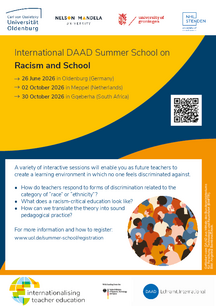
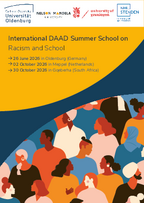
International DAAD Summer School 2026 on Racism and School
A variety of interactive sessions will enable you as future teachers to create a learning environment in which no one feels discriminated against.
- How can teachers respond to forms of discrimination related to the category of “race” or “ethnicity”?
- What does a racism-critical education look like?
- How can we translate the theory into sound pedagogical practice?
26 June 2026 in Oldenburg (Germany)
9:00 am - 9:15 am
Registration
9:15 am - 9:30 am
Welcome address
Presenters: Ulla Licandro (UOL) & Heloise Sathorar (NMU)
9:30 am - 10:30 am
Keynote: Migration and racism-critical teacher education in a migration society
Presenters: Yasemin Karakaşoğlu (Uni Bremen)
Migration challenges the structures and paradigms of national school systems. Schools are potentially places where migrant, migrantized and racialized people experience exclusion, discrimination, and racism. This makes it all the more important to critically examine the structures inherent in schools, assumptions of normality, and the attitudes and actions of educational staff when dealing with migration-related plurality in schools. The keynote will discuss findings, desiderata, and examples for practices in teacher education from the perspective of transnationality and anti-racism research with special reference to Germany.
10:30 am - 10:45 am
Tea break
10:45 am - 11:30 am
Beyond the textbook: postcolonial perspectives on representations of "race" and Black History in the EFL classroom
Presenters: Jessica Adaobi Nnamani & Julia Wurr (UOL)
In English as a Foreign Language (EFL) education, textbooks are among the most widespread media. They are not merely linguistic tools but cultural mediators that shape how learners perceive the English-speaking world. In German lower secondary schools, these materials also largely substitute real and personal experiences with target language cultures.
This presentation explores how EFL textbooks help construct students’ understanding of "race”, history, and cultural identity. Grounded in the theories of Edward W. Said and Gayatri Spivak, this presentation applies a postcolonial lens to reveal how dominant discourses influence depictions of ”race”, power, and history in a particular German EFL text book (Cornelsen’s Highlight 4). Particular attention will be paid to practical reflections from classroom experience and how educators can foster cultural awareness in a learning environment that encourages critical thinking when working with sensitive historical topics in school.
11:30 am - 12:15 pm
Input on the project "School without racism - school with courage"
Presenters: Dörte Gerkan (Gymnasium Eversten Oldenburg)
"School without racism - School with courage" is a growing network of schools that have set themselves the goal of actively confronting all forms of discrimination and understanding differences and diversity as opportunities. Gymnasium Eversten has been part of this network for three years. We would like to provide an insight into our work by reporting on specific projects. In doing so, we want to encourage people to take this very rewarding path.
12:15 pm - 1:15 pm
Lunch break
1:15 pm - 2:00 pm
Crossing borders: language learning as a pathway to democratic citizenship
Presenters: Marije Michel (RUG)
In the spring of 2025, the German government installed systematic border checks. After 40 years of free movement within the Schengen area, the border between the Netherlands (NL) and Germany (DE), both founding members of the agreement in 1985, faced systematic identity checks. While the Dutch government did not follow suit, angry Dutch citizens self-implemented checks on the border between the Netherlands and Lower Saxony in June 2025 in an attempt to hinder unwanted migration. This act of vigilante justice is yet another indication that today core democratic values in Europe are under pressure (cf. Charter of Fundamental Rights of the European Union, 2012). Yet, in order to meet future challenges, we “need a society that is resilient and solidly united”.
By focusing on the specific relationship between the Netherlands and Germany, Marije Michel will showcase how learning each other's language serves as a bridge to cultural understanding and, as such, fundamentally underlies democratic citizenship.
Article: On Borders and Democracy
2:00 pm - 2:45 pm
Decolonising the colonised mindset: reflecting on education, memory and social justice
Presenters: Heloise Sathorar & Shervani Pillay (NMU)
2:45 pm - 3:00 pm
Wrapping up
02 October 2026 in Meppel (Netherlands)
9:00 am - 9:15 am
Registration
9:15 am - 9:30 am
Internationalising Teacher Education (DAAD): from inception to future direction
Presenters: Tina Grummel (UOL)
9:30 am - 10:30 am
After DEI, what comes next? Global justice through concept-based inquiry as an educational design
Presenters: Callum Philbin (NHL Stenden)
For all the horrors of the authoritarian backlash against Diversity, Equity and Inclusion (DEI), it exposes two real limits of liberal inclusion in schools: how speech acts name inequalities without confronting them, and how an impartial justice entrenches division in place of solidarity. Callum Philbin will take us along in his vision on how to sustainably deal with both issues.
10:30 am - 10:45 am
Tea break
10:45 am - 11:30 am
Building positive classroom culture
Presenters: Vesna Radivojevic (NHL Stenden)
Inward is the only way forward in building a positive classroom culture. This workshop starts with a story, helping you position yourself as you explore ways in which you can broach this complex topic. The workshop incorporates arts and literature as successful means in getting a message across. It also helps you navigate the various complexities of a classroom culture using the asset-based pedagogy approach. As the participants of the workshop, you will have the opportunity to work in small groups and in pairs. You will gain practical ideas that are easy to apply in your classrooms.
11:30 am - 12:15 pm
Roadmap to inclusive curriculum: spot the bias, support belonging
Presenters: Kristina Thornton (NHL Stenden) & Juul Habraken (Tûmba, Fryslân)
Kristina Thornton and Juul Habraken will present and share a comprehensive tool-chooser containing resources to make curricula more inclusive, including social justice issues such as race and ethnicity. In addition, they will discuss how to address critical incidents in a classroom.
12:15 pm - 1:00 pm
Lunch break
1:00 pm - 2:45 pm
Making space for difficult knowledge from a teacher education perspective: exploring an agonistic approach for Global Citizenship Education.
Presenters: Debra Williams Gualandi (NHL Stenden)
The focus of this workshop is to challenge "universalizing western frames" in Global Citizenship Education. The workshop entails experiencing "productive conflict" through the lens of one agonistic pedagogical strategy. Through reflection it aims to make salient how classroom discussion based on this approach functions to make space for the experience of difficult knowledge, while seeking complexity over linear, solutions-centered thinking. Although agonistic pedagogical approaches and engagement with the concept of difficult knowledge can open opportunities for students to engage critically with GCE, the workshop will also deal with its potential pitfalls.
2:45 pm - 3:00 pm
Closing remarks
Presenters: Robert-Jan Smit (NHL Stenden)
30 October 2026 in Gqeberha (South Africa)
The Summer School takes place in South Africa (SAST). Due to the recent European clock change, South Africa is now 1 hour ahead. For online attendees in the CET zone, the event will start one hour earlier at 8:00 am.
9:00 am - 9:15 am
Welcome
9:15 am - 10:00 am
The impact of race on education in South Africa and how far we have come
10:00 am - 10:30 am
Tea break
10:30 am - 11:30 am
Panel of teacher educators on the need to prepare student teachers for teaching in diverse settings
11:30 am - 12:30 pm
How do you cross the bridge of race by using arts based approaches to learning, teaching and assessment?
12:30 pm - 1:15 pm
Lunch break
1:15 pm - 2:00 pm
Race and language
2:00 pm - 2:45 pm
Voices from the classroom – Examples of racism experienced and how it was dealt with
2:45 pm - 3:45 pm
Is race another barrier to inclusive education?
3:45 pm - 4:00 pm