Micrometeorological measurements
Micrometeorological measurements
The Energy Meteorology working group at ForWind focusses on the field of numerical simulation. However, in order to prove the validity of the results of the numerical simulations, it is necessary to carry out validation studies. This means comparing simulation results with observations. The Energy Meteorology working group co-operates closely with the Wind Energy Systems working group at ForWind. This group operates several LiDAR systems with which, for example, the vertical wind profile in the inflow of a wind turbine or the wind field in the wake of a wind turbine can be measured.
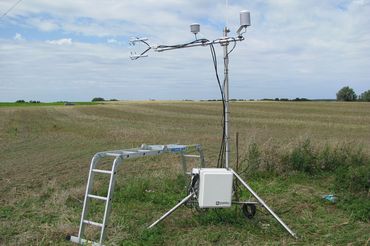
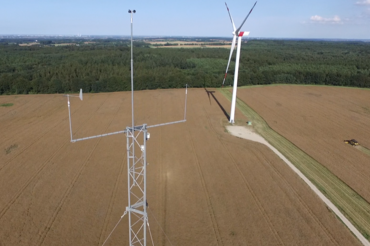
However, measurements to characterise the turbulence and stability conditions in the atmospheric boundary layer under investigation are carried out by the Energy Meteorology working group itself. Three eddy covariance measurement systems were procured for this purpose as part of the DFWind project. In addition, the Energy Meteorology working group is responsible for equipping the so-called IECplus measuring mast in the DFWind test field with meteorological sensors that go beyond the IEC requirements. The additional equipment will enable the spatially high-resolution recording of vertical profiles of turbulent variables and atmospheric stability. This will open up new possibilities for investigating atmospheric influences on the behaviour of wind turbines. Corresponding findings will ultimately be used to optimise the operation of wind turbines, taking atmospheric boundary conditions into account. For example, numerical studies by the Energy Meteorology working group have indicated that the control concept for deflecting turbine wakes by tilting the rotor plane requires information on atmospheric stability for successful application.
In addition, the micrometeorological measurement methods should also provide data for the validation of so-called footprint methods, which are used to characterise the surface area upstream of a wind turbine that influences the flow properties in the rotor area. This could be used, for example, to specifically identify disruptive elements that contribute to an increase in turbulence intensity in the rotor area.