

The goldfinch
The goldfinch
The goldfinch
Cardellino - European Goldfinch - Carduelis carduelis (LINNAEUS 1758)
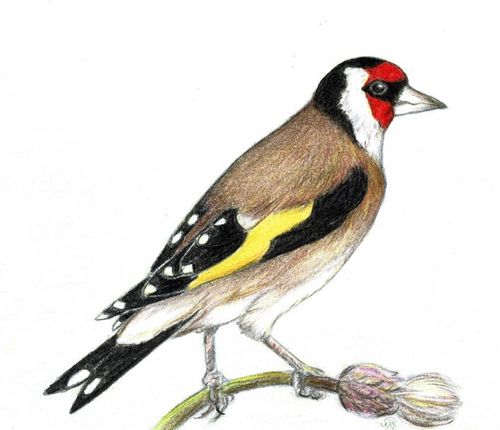
In 2019, the goldfinch was the second most frequently observed bird species on Giglio after the Mediterranean gull[see the sightings pages].
The colourful, 12 to 13.5 cm tall songbird is easy to recognise: Its black and white head with a red face and its broad yellow wing stripe make it stand out. The birds often make their cheerful-sounding call ("Stiglitt!" or "Stigelitt") in flight.
In 2019, goldfinches on Giglio were mainly seen in rural and urban areas, although there were also some sightings in the rockrose maquis and in the transition zone between this and the holm oak forest. Goldfinches generally prefer open and semi-open landscapes with varied structures. For example, they can be found in loose groups of trees and bushes, orchards, copses, avenues, parks and forest edges. When foraging, goldfinches often sit on thistles, teasels or other herbs and shrubs, which they pick out with their pointed beaks. As goldfinches are dependent on structurally rich landscapes and an abundant supply of seeds, the increasing intensification of agriculture poses a problem for them.
The goldfinch is a common breeding bird in large parts of the Western Palearctic. Its distribution range extends from the North African and Near Eastern Mediterranean coast to the south of Fennoscandia and from the Azores to Mongolia. Goldfinches can be found all year round in southern, central and western Europe. In Europe, 12 to 29 million pairs breed, in Italy 1 to 2 million.
Sources:
BAUER, H.-G.; BEZZEL, E.; FIEDLER, W. (2005): The compendium of the birds of Central Europe. 2nd edition. Aula-Verlag, Wiebelsheim.
SVENSSON, L.; GRANT, P. J.; MULLARNEY, K.; ZETTERSTRÖM, D. (2018): The Kosmos bird guide. Franckh-Kosmos-Verlags-GmbH & Co KG, Stuttgart.