

The Mediterranean gull
The Mediterranean gull
The Mediterranean gull
Larus michahellis (J.F. Naumann 1840) Yellow-legged Gull - Gabbiano reale
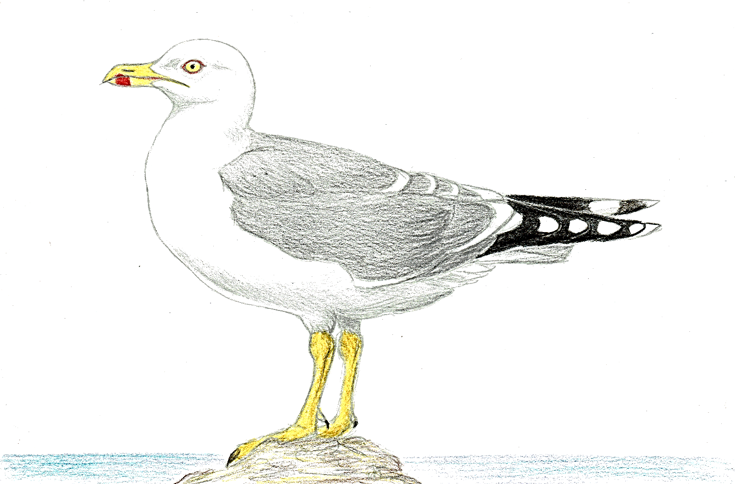
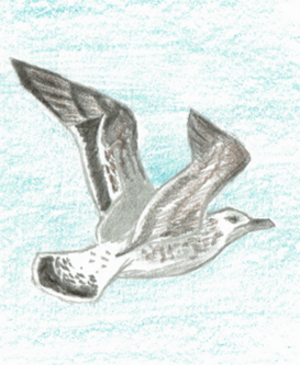
The Mediterranean gull was by far the most frequently observed bird on Giglio in 2019[see the sightings pages].
Mediterranean gulls are relatively easy to recognise on Giglio. Adult birds stand out due to their intensely yellow-coloured legs all year round. It takes four years until the birds are fully coloured. Mediterranean gulls reach body lengths of 58 to 68 cm with wingspans of 140 to 158 cm. Their vocalisations are typical cries that sound deeper and more guttural than those of the herring gull, which is common in north-west Germany.
Young Mediterranean gulls are still grey-white-brown in colour.
Their habitat can be variously structured areas, including rocky and shallow coasts, small rocky, gravel and sandy islands, dunes, the edges of water areas, but also human economic and settlement areas. On Giglio, Mediterranean gulls are mainly found on the rocky coasts, but some birds are also found in urban areas. The birds forage at sea or on the coast, in harbours or on agricultural land and rubbish dumps. They eat fish, invertebrates, small mammals, rubbish, carrion, sometimes eggs and young birds and sometimes even adults of smaller waterfowl species. Kleptoparasitism is also common.
Mediterranean gulls are the most common gull species not only on Giglio, but in the entire Mediterranean region and are found there and also on the North African-West European Atlantic coast all year round. They are also sometimes found on the North Sea coast. Their range is also increasingly expanding to the north and west. It is currently estimated that there are between 250,000 and 480,000 breeding pairs in the entire distribution area of the Mediterranean gull, although this figure has risen sharply in recent decades. An increasing number of Mediterranean gulls are also spending the summer in Central Europe without breeding there.
Sources:
BAUER, H.-G.; BEZZEL, E.; FIEDLER, W. (2005): Das Kompendium der Vögel Mitteleuropas. 2nd edition. Aula-Verlag, Wiebelsheim.
SVENSSON, L.; GRANT, P. J.; MULLARNEY, K.; ZETTERSTRÖM, D. (2018): The Kosmos bird guide. Franckh-Kosmos-Verlags-GmbH & Co KG, Stuttgart