

The honey buzzard
The honey buzzard
The honey buzzard
Falco pecchiaiolo - European Honey Buzzard - Pernis apivorus (LINNAEUS 1758)
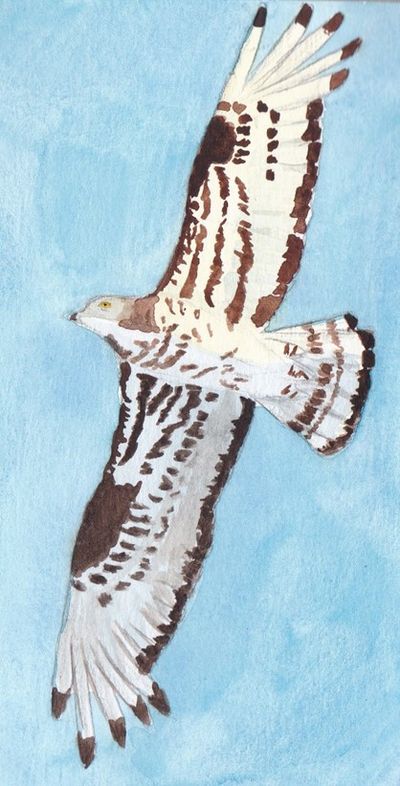
Honey buzzards were the most frequently observed birds of prey on the Giglio excursion in 2019. They only occur on Giglio during migration, as they cross the Mediterranean from their wintering grounds south of the Sahara. Like all large birds of prey, they use thermals to fly in order to save energy. As thermals do not form over water surfaces, the Mediterranean is a major obstacle for honey buzzards on migration. They therefore use the islands in the Mediterranean to soar upwards in the thermals there and then sail long distances.
Honey buzzards are about the same size as buzzards, but have longer wings and longer tails. Their head is small and resembles that of a pigeon.
The plumage of honey buzzards is very variable, but their tail is always banded and the bow spots are very pronounced compared to the common buzzard (comma-shaped). The tail and underside of the wings usually have a dark-coloured terminal band.
Sources:
BAUER, H.-G.; BEZZEL, E.; FIEDLER, W. (2005): The compendium of the birds of Central Europe. 2nd edition. Aula-Verlag, Wiebelsheim.
SVENSSON, L.; GRANT, P. J.; MULLARNEY, K.; ZETTERSTRÖM, D. (2018): The Kosmos bird guide. Franckh-Kosmos-Verlags-GmbH & Co KG, Stuttgart.