

The grey flycatcher
The grey flycatcher
The grey flycatcher
Pigliamosche commune - Spotted Flycatcher - Muscicapa striata (PALLAS 1764)
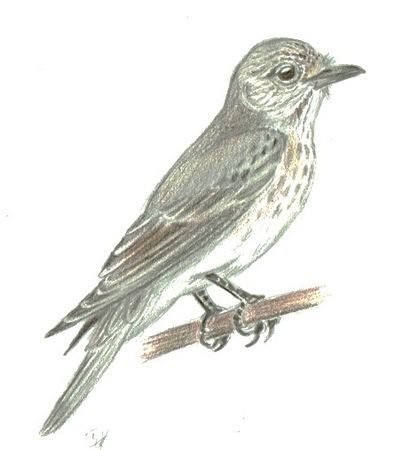
With 14 sightings, the grey flycatcher was one of the more common bird species on Giglio in 2019[see the sightings pages].
The 13.5 to 15 cm tall grey flycatcher looks very slender, but its legs appear short. The plumage is grey-brown and has a recognisable streaking on the dirty white breast and forehead, which is also reflected in its scientific and English name.
In 2019, grey flycatchers were spotted in all habitat types on the island, although they were most frequently seen in rural and urban areas. Grey flycatchers generally inhabit sparse forests, especially clearings and edges, and open to semi-open landscapes with small copses and groups of trees. They can also be found in rural settlements, parks and cemeteries. As with other flycatchers (Muscicapidae family), the grey flycatcher's diet mainly consists of insects. The grey flycatcher pursues these in an agile flight, in which it sometimes rises steeply a few metres into the air, shaking and gliding in an arc. After landing or when agitated, the upright bird can often be seen twitching its wings.
Grey flycatchers are breeding birds in most parts of the Western Palearctic. As long-distance migrants, they usually spend the winter in the southern half of Africa. 14 to 22 million pairs breed in Europe. In some parts of the breeding area, a decline in breeding pairs has been recorded for several decades.
Sources:
BAUER, H.-G.; BEZZEL, E.; FIEDLER, W. (2005): Das Kompendium der Vögel Mitteleuropas. 2nd edition. Aula-Verlag, Wiebelsheim.
SVENSSON, L.; GRANT, P. J.; MULLARNEY, K.; ZETTERSTRÖM, D. (2018): The Kosmos bird guide. Franckh-Kosmos-Verlags-GmbH & Co KG, Stuttgart.