

The velvet-headed warbler
The velvet-headed warbler
The velvet-headed warbler
Occhiocotto - Sardinian Warbler - Sylvia melanocaphala (J.F. GMELIN 1789)
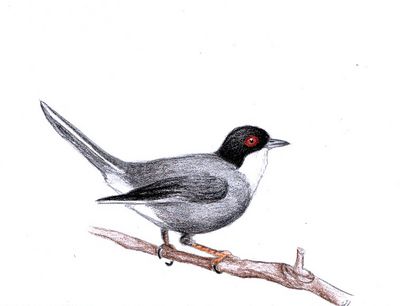
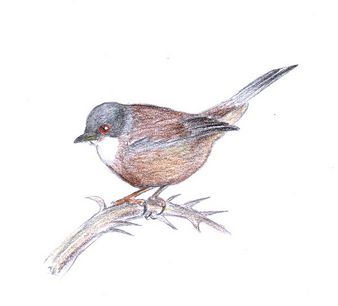
Velvet-headed warblers (male right, female left) [Drawings: Wiebke Rusch]
Together with the sepia shearwater, the velvet-headed warbler was the fourth most frequently observed bird species on Giglio in 2019[see the sightings pages].
The 13 to 14 cm velvet-headed warbler is rather compact and large-headed for a warbler. Its white throat, the red eyelid ring surrounding the brown iris, a rather long tail and relatively dark flanks are striking. Males have a black hood and a dark grey body, in females the hood is grey and the body brown.
Velvet-headed warblers live in dense shrub vegetation in warm areas, which is why they have been sighted on Giglio mainly in the rockrose maquis. Overall, velvet-headed warblers inhabit habitat types ranging from maquis to sparse stone, cork and kermes oak forests, as well as olive groves and bushes in the cultivated landscape, for example. There they feed on insects as well as berries and fruit, sometimes even on nectar. The birds are active and appear restless, often twitching their wings and tails. They can also be observed in a typical ducking position with their heads lowered.
The velvet-headed warbler is a breeding bird of the Mediterranean region and the North African Atlantic coast. Often, especially in the west of its range, it spends the winter in the breeding area and can therefore be found all year round. In Europe, 3 to 8 million breeding pairs are estimated, 0.5 million to 1 million of them in Italy.
Sources:
BAUER, H.-G.; BEZZEL, E.; FIEDLER, W. (2005): Das Kompendium der Vögel Mitteleuropas. 2nd edition. Aula-Verlag, Wiebelsheim.
SVENSSON, L.; GRANT, P. J.; MULLARNEY, K.; ZETTERSTRÖM, D. (2018): The Kosmos bird guide. Franckh-Kosmos-Verlags-GmbH & Co KG, Stuttgart.