
Information on near-infrared spectroscopy
Information on near-infrared spectroscopy
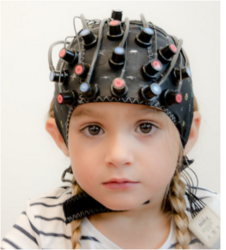
NIRS stands for near-infrared spectroscopy. This method works with light waves in the 700-900 nm range, i.e. in the near-infrared range, and has no side effects. It is often used to examine babies. With NIRS, the blood flow changes in the human brain are measured completely and non-invasively. Changes in blood flow in the brain are caused by changes in the activity of many nerve cells, such as those caused by sensory stimuli, movements or thought processes. For the NIRS measurement, light sources and light detectors are placed at various points on the head. The light sources and light detectors are attached to a special cap (similar to a bathing cap, see picture). The light sources emit light that passes relatively unhindered through the skull bone. On its way through the brain, certain parts of the light are absorbed and others are reflected. Some of the reflected light reaches the light detectors again after travelling through the upper parts of your head. Based on the amount of light measured, the relative concentration of oxygenated and deoxygenated blood in the brain tissue between the light source and the light detector can be calculated. This allows conclusions to be drawn about local brain activity.