
Exhibits
Exhibits

What does the earth under Oldenburg look like?
Oldenburg is predominantly built on sand. But what does the sand look like, is it the same everywhere, and where does it come from? The different types of sand found under Oldenburg are on display. At the bottom is the fine, green sand from 10 million years ago, when Oldenburg was still below sea level, i.e. under water. Above this are various layers from ice ages, when Oldenburg was covered by a kilometre-thick layer of ice. At the very top is the peat from the moor and the dune sand from the Osenberg mountains near Sandkrug. Samples allow visitors to feel and see the significance of the different deposits for everyday life, such as the extraction of drinking water. top 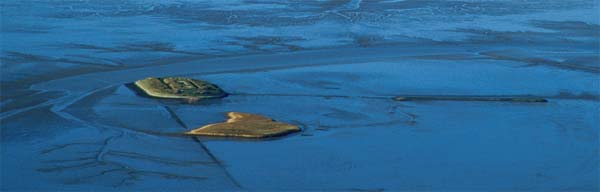
How does the silt get into the Weser?
The water in the Weser is not blue, but brown-grey. This is due to the many particles floating in the water. For example, small creatures, but also countless tiny grains, most of which are much smaller than the grains of sand on the beach. They are moved by the water. If the water does not flow, they sink to the bottom. The larger and heavier ones sink faster than the smaller and lighter ones. This is how silt is formed. In the exhibition you can observe the journey of the tiny particles and measure how quickly or slowly they sink.
How does the sand get to the beach?
The building material for the sandcastles on our beaches has travelled a long way: many grains have been broken out of the mountains as boulders, rolled downstream through streams and rivers, crushed and shaped in the process, and reached the coast after a long journey. But there the journey continues: gripped by waves, moved by the current, the sand remains in constant motion. But the sand also moves through the air, carried by wind and storms. But how does that work? Do all grains move in the same way? What do grain size and sinking speed have to do with it? Who manages to create small sand ripples? All these questions can be answered in the exhibition. top 
What does the seabed look like?
For more than 100 years, marine researchers have been sampling the seabed to explore the underwater world in more detail. But for a long time, it was not known what the seabed really looked like. For some years now, scientists have been using remote-controlled, unmanned underwater vehicles. They are equipped with video cameras and transmit fascinating images from a depth of several thousand metres. These diving robots offer completely new possibilities for exploring undersea volcanoes or deep-sea corals. In the exhibition we show large and small models of these underwater vehicles.
Why does the sand stick to the magnet?
Magnets stick to the fridge door, hold the wooden railway together and are made of iron - a no-brainer! Who would have thought that there are also magnetic grains of sand and rocks? They can be found on volcanic islands in particular, but also on the Baltic Sea beach! In the exhibition, secret messages can be written with magnetic sand and small boats are propelled by the magnetism of rocks!
Where is the smallest library in the world?
A group of figures makes it possible to discover the different forms and functions of human cells. A look inside the cell reveals the smallest library in the world.
If you were to write down the information of a cell, you would need around 6,000 very, very thick books. These books contain information such as the colour of someone's eyes or hair or how tall they will grow. You can also read in these books who is related to whom, because the information is passed on from parents to children, it is inherited. In the exhibition, you can enlarge and observe a skin, hair and blood cell. Every cell contains the same information. However, every living being has its own personal library.
Weightlessness in the classroom - is that possible?
Astronauts float weightlessly in the International Space Station. But how does weightlessness actually occur?  It seems astonishing and contradictory that the Earth's gravity also acts at a height of around 400 kilometres above the space station. After all, it is gravity that keeps the space station in orbit around the Earth. The centrifugal force, also known as centrifugal force, acts in the opposite direction to gravity in this orbit. Both forces cancel each other out and we speak of weightlessness. This principle also applies in free fall, so you don't need to fly into space to experience weightlessness. The Drop Tower Bremen enables scientific research under zero gravity conditions at the University of Bremen. Experiments in weightlessness are even possible in the classroom. top Concept of the exhibition: Haus der Wissenschaft, MARUM, Bremen, Dr Martina Pätzold