
10 years
10 years
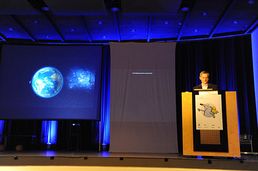
Prof Dr Andreas Engel, Physics
Congratulations and compliments to Kuni and his tireless team: ten years of KinderUni have proved to be a wonderful opportunity to get children interested in science and to bring back children's enthusiasm for science.
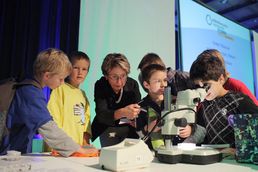
Prof Dr Ellen Kiel, Biology
"Do you think we could shoot our own film material?" The cameraman probably soon regretted his willingness to answer my question. At the latest when he dragged the heavy camera through the water in chest-high waders for my "little" film idea on the hottest summer's day - while all the mosquitoes and horseflies in the area regarded him as a welcome "blood bar".
P.S.: He still says hello to me. The mesmerised eyes of the children watching his wonderful shots probably made up for it.
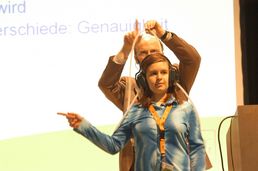
Prof Dr Birger Kollmeier, Physics
Everyone was very excited for the premiere of the KinderUni with "The Little Man in the Ear". The large lecture theatre could have been filled to the last seat seven times. When the university president at the time, Siegfried Grubitzsch, admitted in front of the microphone that he was also very excited, I felt quite strange. But then the bell rang, the music faded away and the children reacted very quickly and directly to every little gag - the stage fright was gone! Many thanks to the children from the first hour, the organisation team and of course: All the best, Kuni!
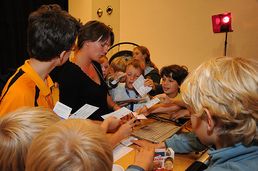
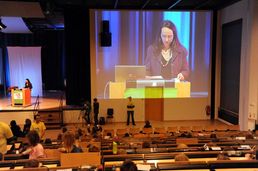
Prof. Dr Esther Ruigendijk, Dutch Studies
It's not directly a moment that I remember best - rather a general impression, something like this: Suddenly there are over 800 children sitting in front of you, I've never had an audience that big. And I've never had such a great audience either. It was really nice to see how interested the children were, how enthusiastic, and how directly they reacted to different parts of the lecture. And they asked so many questions! For me: KinderUni? Any time again!
My congratulations on 10 years of the KinderUni: it's nice and important that the KinderUni exists, for the visitors and for those who give lectures. I would like to congratulate the KinderUni team wholeheartedly on this successful project.
Prof Dr Melanie Unseld, Music
When asked what made the most lasting impression on me during the KinderUni, I can only say: the children's ability to listen.
During the preparations for my KinderUni lecture "Of knights, thunderstorms and dangerous voyages. How can music tell stories?" I was warned that the music should not be too long, otherwise the children would probably stop listening. But now I'm researching in a field in which listening comes before thinking about music. We first have to receive music in order to be able to think about it. That's why the KinderUni lecture was an experiment for me. And it was a success!
The children not only listened very attentively to the music, but they also set out to understand it with great interest: What sounds how? And how can I immerse myself in the music by listening in order to recognise leitmotifs, to understand musical connections, in short: to ask questions of the music.
Prof Dr Mathias Wickleder, Chemistry
How can you really put a lecture to the test? Right, with a critical audience! And what audience is more critical than a lecture theatre full of inquisitive children? I fondly remember our lecture on "How does light come into the world?" We were able to impress with numerous chemical experiments, including an experiment we called "elephant toothpaste" (a special decomposition of hydrogen peroxide).
The spontaneous question from an audience member: "Do elephants even brush their teeth?" As a lecturer, you're quickly speechless. You always have to be very careful not to accidentally stray into neighbouring disciplines!
Congratulations on the KinderUni, which really challenges both sides: Listeners and lecturers!
Prof Dr Gerhard Zotz, Biology
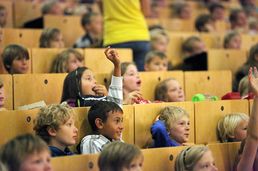
The two rounds of questions! The children's truly impetuous thirst for knowledge, the almost boundless, natural, demanding curiosity that burst out of countless children's mouths - "I want to know! - Tell me".
Somewhere along the long road from primary school to university, this enthusiastic and, for me as a teacher, truly inspiring freshness is unfortunately lost in most young people. And then they say at university: "Do I really need to know that?"