
Archive 2017
Archive 2017
The Applied Geography and Environmental Planning working group at the University of Oldenburg took part in the 2nd Sustainability Workshop
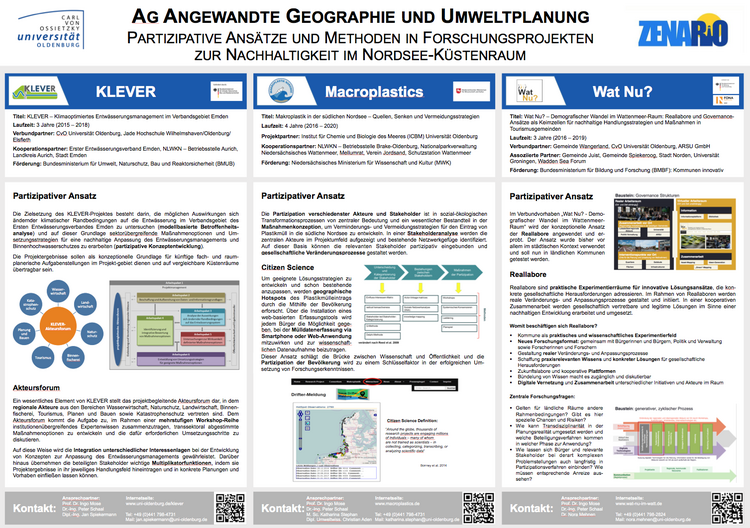
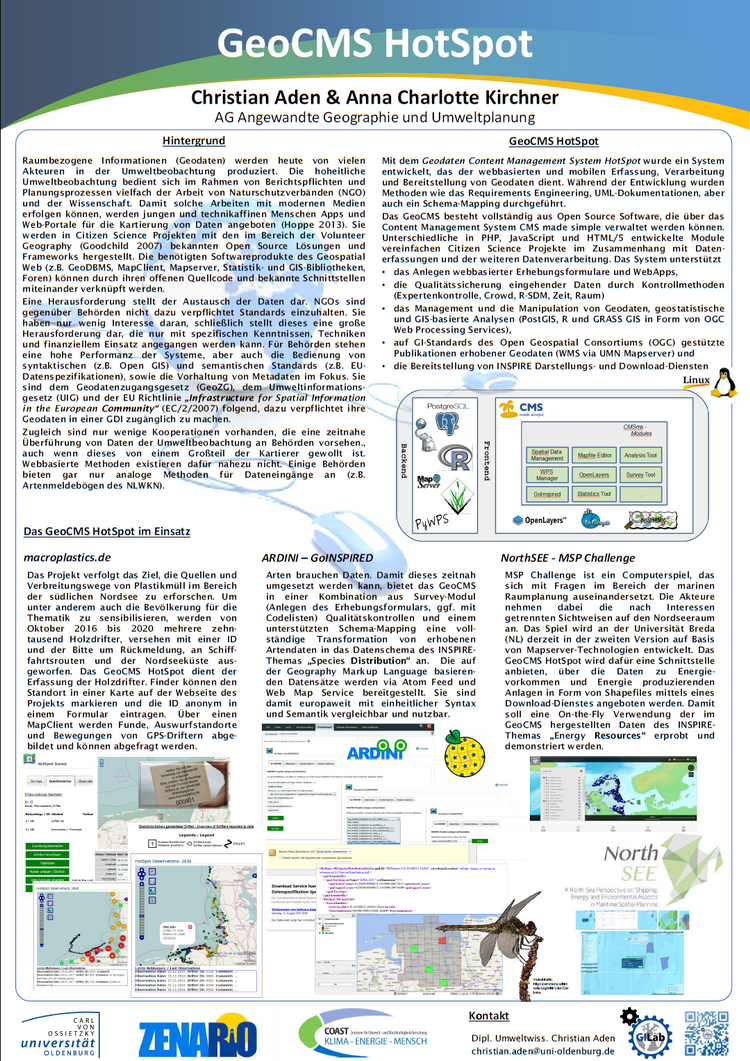
The Smart House Oldenburg hosted the 2nd Sustainability Workshop of the University of Oldenburg on 11.01.2017, organised by COAST - Center for Environmental and Sustainability Research. At a market of opportunities, the Applied Geography and Environmental Planning working group presented its current research projects with posters and brochures to a small audience of experts.
Farewell to Prof Dr Ulrike Grabski-Kieron
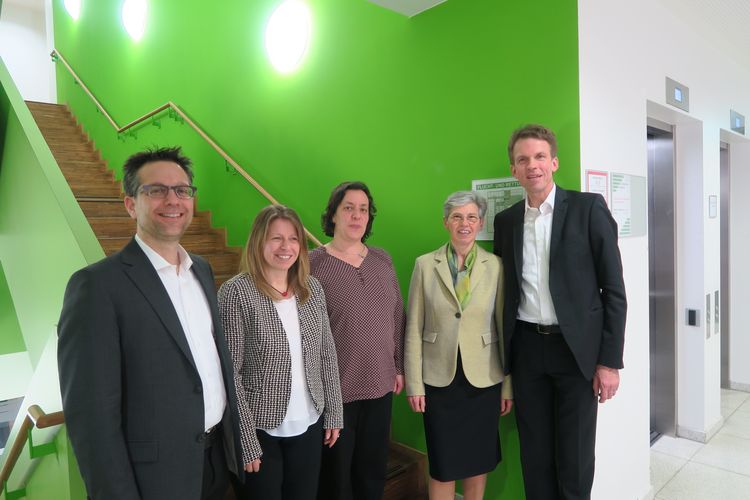
On 3 February 2017, Prof. Dr Ulrike Grabski-Kieron from the Institute of Geography at the Westfälische Wilhelms University of Münster gave her farewell lecture. Mrs Grabski-Kieron held the chair for local, regional and rural development/spatial planning in Münster. She was associated with the Applied Geography and Environmental Planning Working Group in Oldenburg through her many years of activity in the Rural Areas Working Group of the German Geographical Society, of which she was the spokesperson together with Prof Dr Ingo Mose since 2004. As part of the farewell ceremony, Ingo Mose gave a guest lecture in Münster on the topic "From residual size to potential space? Development perspectives for rural peripheries in Europe".
The photo shows Ulrike Grabski-Kieron (second from right) together with Ingo Mose and other members of the Rural Working Group's speakers' group: Christian Krajewski (Münster), Anja Reichert-Schick (Greifswald) and Annett Steinführer (Braunschweig) (from left). Missing: Luisa Vogt (Soest).
Excursion of the "Sustainable tourism" seminar to Bremerhaven
Students from the "Sustainable tourism" seminar went on an excursion to Bremerhaven on 9 February 2017. Led by Ingo Mose, they visited the Atlantik Hotel SAIL City, where hotel director Tim Oberdieck introduced the group to the sustainability philosophy of his hotel management. The group then had the opportunity to visit selected parts of the hotel. Another visit took the group to Erlebnis Bremerhaven GmbH, the city of Bremerhaven's tourism marketing organisation, where its director, Raymond Kiesbye, gave the students an overview of his institution's activities. A tour of the "Havenwelten" with the central attractions of maritime tourism in Bremerhaven rounded off the visit to the Weser estuary.
Excursion to the Irish Atlantic coast
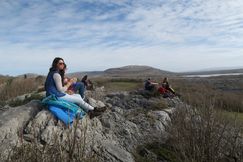
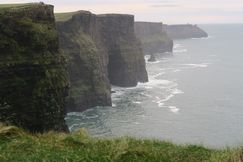
From 6 to 10 March, students on the Bachelor's and Master's degree programmes in Environmental Sciences, Landscape Ecology and Water and Coastal Management visited the city of Galway on the Irish Atlantic coast under the guidance of Ingo Mose and Peter Schaal.
The excursion focussed on issues of coastal spatial development and coastal zone management. Supported by colleagues from the School of Geography at the National University of Ireland Galway, with whom the IBU has maintained an ERASMUS partnership since last year, the group focussed on the urban development of Galway, the dynamics of coastal morphology, coastal protection, tourism and nature conservation on the coast as well as planning tasks. In addition to Galway itself, the university and the City Council's planning department, visits were made to the neighbouring seaside resort of Salthill, the Burren National Park and the Cliffs of Moher.
The Oldenburg group would like to thank their Irish hosts Ulf Strohmayer, Kevin Lynch and Mary Cawley as well as Liam Carr, Terry Morley and Chaocheng Zang for their contributions to the success of the excursion!
Sabine Wüstemann publishes master's thesis on cultural landscape change in Oberpinzgau
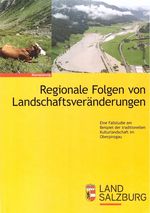
The Applied Geography and Environmental Planning working group congratulates Sabine Wüstemann, former student of the Master's programme in Sustainability Economics and Management and research assistant in the working group, on the publication of her Master's thesis on cultural landscape change in the Austrian region of Oberpinzgau in the series "Salzburger Materialien zur Raumplanung"!
Ingo Mose speaks at the Oldenburg Children's University
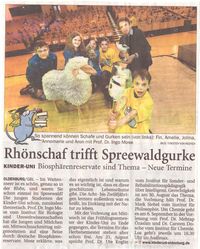
As part of the Oldenburg Children's University last week, Ingo Mose gave a lecture entitled "What do a bird, a sheep and a cucumber have in common?" on the goals and tasks as well as selected projects of the biosphere reserves in Germany.
Excursion to the Wildeshauser Geest Nature Park
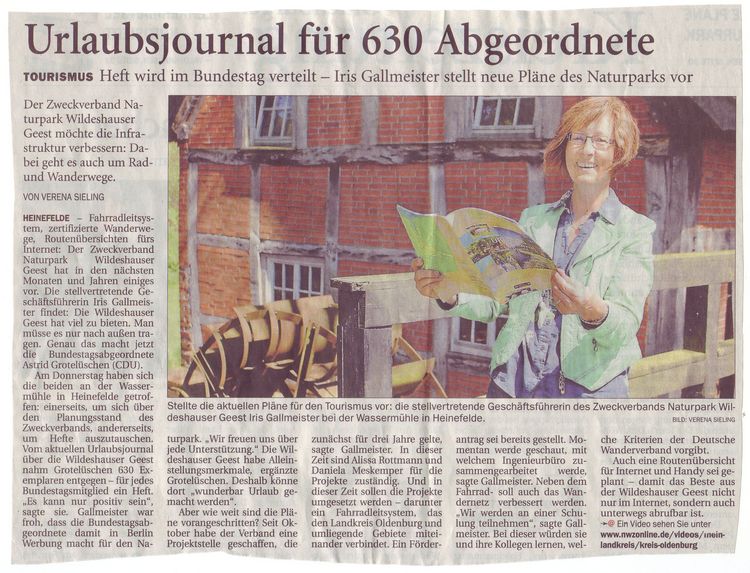
As part of the seminar "Protected areas and regional development", students from several Master's degree programmes visited the Wildeshauser Geest Nature Park on Friday 12 May. As part of an all-day cycling excursion led by Ingo Mose, they visited various
sites in the nature park that are important for tourism and local recreation as well as from a nature conservation perspective. At the centre of the excursion was a visit to the office of the Wildeshauser Geest Nature Park Association, where its deputy managing director Iris
Gallmeister and her colleague Alissa Rottmann were available for a discussion about current and future tasks. In keeping with the occasion, the Nordwest-Zeitung reported on the nature park's latest plans on the same day.
Groningen relationship with Oldenburg: 12.5 year anniversary
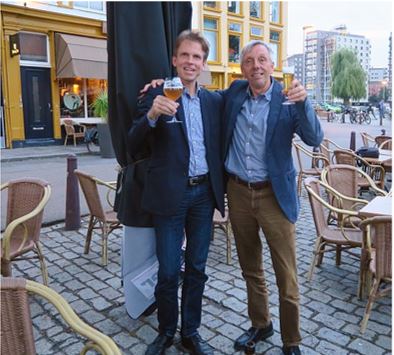
On the occasion of the 7th trilateral students seminar Oldenburg-Bremen-Hamburg-Groningen, professors Ingo Mose from Oldenburg and Dirk Strijker celebrated their "copper" relationship: they started their cooperation 12.5 years ago with a meeting at Mose's office in Oldenburg. The relationship has resulted in the trilateral students seminar, in beautiful projects, in support for the Double Degree Master programme Water and Coastal Zone Management, and the PhD-defense of Nora Mehnen in 2013. Both partners have confidence in the future of their relationship.
Italian landscape planner opens ZENARiO colloquium
The ZENARiO Colloquium on Sustainable Spatial Development for this winter semester was opened on Monday, 20 November 2017, with a lecture by Dr Emma Salizzoni. Ms Salizzoni, who works as a landscape planner at the Politecnico di Torino in Italy, spoke on the topic ‘Protected areas versus urbanisation – challenges and conflicts along the Euro-Mediterranean coast’. Her lecture focused on the ongoing processes of urbanisation along the Mediterranean coast of Spain, France and Italy, which are resulting in numerous environmental problems – ranging from the progressive sealing of the landscape to the irreversible loss of biodiversity. Particularly striking is how urbanisation also affects legally protected landscapes: built-up and protected landscapes often adjoin one another directly – and it is not uncommon for urbanisation to continue even within protected areas. An overview of conceptual approaches to solving the apparent problems, the underlying legal instruments, and possible forms of landscape governance that might be suitable for resolving the existing conflicts rounded off the well-attended lecture.
This winter semester, the ZENARiO Colloquium is centred on the overarching theme of ‘Coastal regions of Europe in transformation’ and will bring a further six international speakers to Oldenburg over the coming weeks.
How rural is Großenkneten?
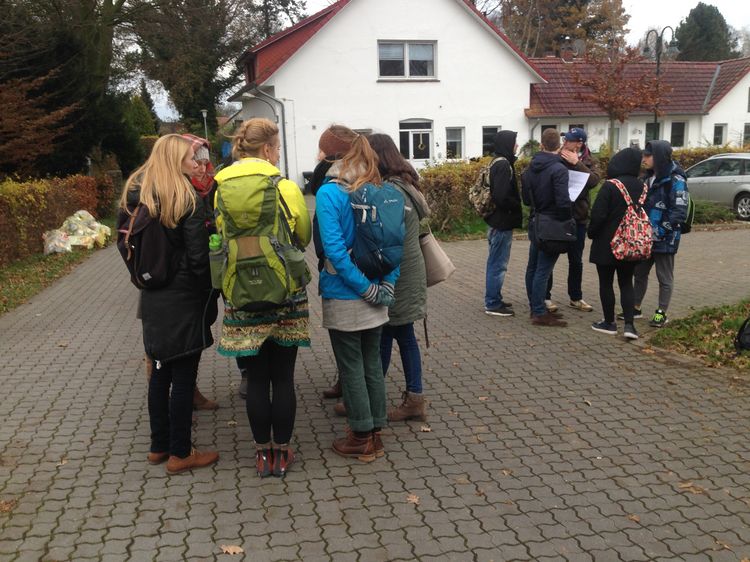
As part of the seminar "Space and society" (Ingo Mose) on 23 November 2017, students on the Master's degree courses in Landscape Ecology, Sustainability Economics and Management and Water and Coastal Management visited the village of Großenkneten in the south of the district of Oldenburg. Using the example of Großenkneten's local development, selected aspects of spatial structural change were discussed and the question of what is associated with the term "rurality" and to what extent Großenkneten can be characterised as rural was explored. The students' research on site revealed an ambivalent picture: While typical characteristics of what can be considered "rural" could certainly be identified in parts of the village - agriculture, proportion of open space, density of social contacts - no significant differences to the structures of urban spaces could be discerned for many areas - although supposed characteristics of the rural are still virtually idealised, especially by people with an urban background. In fact, according to the conclusion of the excursion, processes of homogenisation are causing many of the traditional differences between rural and urban areas to increasingly disappear.