

Alpine bat - Hypsugo savii
The alpine bat -

It has a dark face and ears, similar to dwarf bats, but its white-grey underside stands out clearly from its dark brown back.
The sonogram of the alpine bat
shows a quasi-constant frequency call (QCF). These calls are not constant-frequency (CF) as in the horseshoe bat, but fall off slightly in the course of the call.
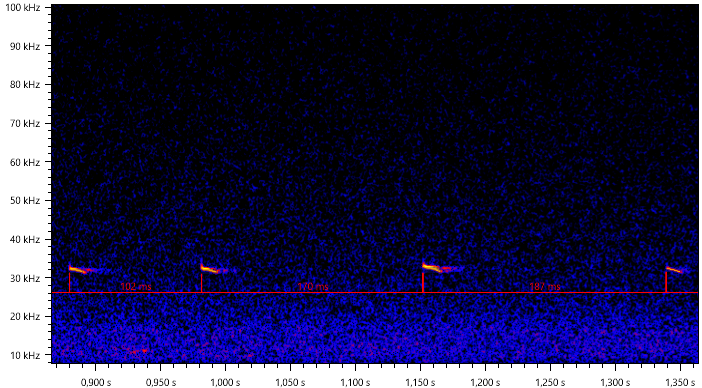
The echolocation calls of the alpine bat have a frequency of 30 to 37 kHz, thus lower than all dwarf bat species and therefore easy to identify.
Alpine bat - Hypsugo savii
Results
The alpine bat was detected in various habitats on Giglio, including in the maquis and near the Allume. Several calls were recorded in both areas, both by the mobile phone logger and by stationary loggers. The species had previously been documented on Giglio.
The alpine bat is found throughout the European Mediterranean region. Its habitats range from Mediterranean coastal regions to high mountains, although it is often found in karst areas. Typical habitats include mosaic-like cultivated landscapes such as maquis and garrigue. The alpine bat mainly roosts in crevice habitats such as rock crevices.
Giglio therefore offers a suitable habitat for this bat species, as the island offers typical habitats such as cliffs, maquis and garrigue, which are favoured by the alpine bat.
At a glance:
Appearance:
| Body length: | 4.2 to 5.5 cm |
| Wingspan: | 22 to 27 cm |
| Weight: | 5-9 g |
| Fur: | long dark brown back fur, with light white-yellowish-white belly |
| Special features: | Strikingly colourful coat |
Distribution, habitat and behaviour:
| Distribution area: | Mediterranean region, from southern Europe via the Middle East to North Africa |
| Habitat: | Mediterranean landscapes, mainly in karst areas, with mosaic-like cultivated landscapes such as maquis and garrigue, as well as coastal regions and mountainous regions up to an altitude of over 3000 metres. Roosts in crevices and buildings. |
| Localisation call: | Frequency modulated (FM) calls, ranging from about 25 to 40 kHz. |
| Hunting behaviour: | The alpine bat hunts mainly in open landscapes and along structures such as rocks or buildings. |