

White-edged bat - Pipistrellus kuhlii
The white-edged bat

The sonogram of the call of the white-edged bat.
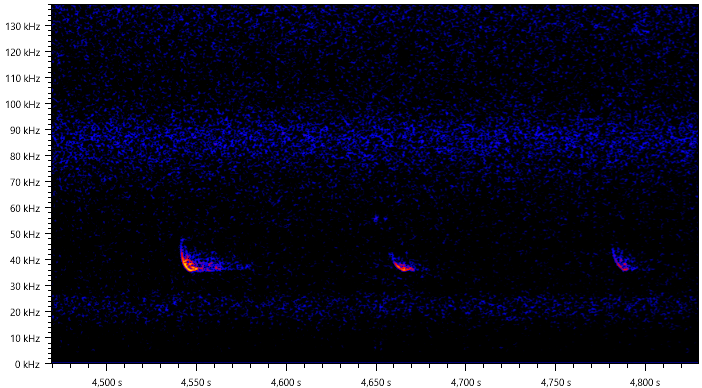
The sonogram of the white-edged bat falls within the frequency range of 40-45 kHz, which overlaps with other species of the genus Pipistrellus. This overlap makes it difficult to clearly distinguish the species based on the call frequencies alone, as several species call in similar frequency ranges.
White-edged bat - Pipistrellus kuhlii
Results
Pipistrellus kuhlii was detected in all habitats surveyed, and always with the most call records. In the settlement area of Campese, it was observed hunting at street lamps.
In addition to the white-edged bat, other calls were detected that can be assigned to the Pipistrellus call group. However, these calls could not be clearly identified to species level, as there is an overlap in call frequencies between the species. Due to the accumulation of calls with maximum frequencies above 50 kHz, the presence of the pipistrelle bat(Pipistrellus pipistrellus) can also be assumed. However, further investigations are required for a reliable determination. The presence of P. kuhlii on Giglio is already known.
At a glance:
Appearance:
| Body length: | 4.1- 5.3 cm |
| Wingspan: | 22 - 24 cm |
| Weight: | 5 - 9 g |
| Fur: | brown-grey fur with lightly contrasting underside |
| Special features: | Characteristic light-coloured edge of the otherwise dark flight skin |
Distribution, habitat and behaviour:
| Distribution area: | Found in large parts of southern, central and eastern Europe, especially in Mediterranean regions. |
| Habitat: | Open to semi-open landscapes, often close to human settlements. Roosts are in crevices in buildings and rock faces. |
| Localisation call: | Frequency-modulated sounds, with a frequency of 34 to max. 45 kHz. |
| Hunting behaviour: | Hunting near artificial lighting, such as streetlights with an agile, fast and small-scale flight. |
| Migration: | Localised species, moves over shorter distances between summer and winter roosts. |